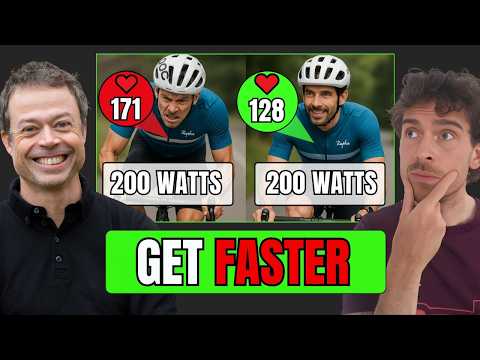
In this video, Mattias Reck, head coach of the Lidl-Trek team, explains how amateur cyclists can train to run faster. He clearly compares how to effectively control training time, intensity and frequency and the differences between the training styles of professional and amateur athletes, particularly emphasizing the importance of a power meter.
1. Training design for amateur cyclists 📝
Coach Matthias Reck explains his training plan based on a hypothetical scenario of a 40-year-old amateur cyclist training 10 hours a week to prepare for a road race. Many amateur riders mentioned that they used to have a lot of training time, but are now in a time crunched situation, and suggest a training method that takes this reality into consideration.
During the winter, you should focus on easy endurance training and add high-intensity interval training as the season approaches.
"In the winter, of course, you should do easy endurance training, and then do a couple of interval training sessions, and in the winter, do easy endurance training. As you get closer to the season, you have short high-intensity training and easy endurance training, which at some point should be a combination of the two. So as the season approaches, you should have a combined volume and intensity session at least once a week."
Especially for amateurs who don't race a lot, doing interval training during the week and easy endurance training on the weekend may not be enough. One day a week requires training with a combination of volume and intensity, similar to the training style professional athletes naturally experience through stage races.
"If the average person only does easy endurance training on the weekends and interval training on Tuesdays and Thursdays, there should be days that combine the two as you get closer to the season."
Using a Sunday group ride as an example, the coach advises that while elite riders might want to take it easy on the weekend, other riders should train hard, almost like a race. 😮
2. Distribute training intensity: use the 80/20 rule and Zone 3 📊
We emphasize that the 80/20 rule is still valid when it comes to distributing training intensity. This means that 80% of your total training time should be at low intensity (endurance) and 20% at high intensity (intervals). He explains that it is not advisable to significantly increase the proportion of intense training such as 50/50 or 60/40.
The most important question is How much Zone 3 training can you do? Zone 3 is a moderate intensity zone that uses a lot of energy and can cause fatigue.
- Riders with smaller engines or who are time crunched despite their years of experience may do more Zone 3 training. This is because they already have good recovery abilities and Zone 3 training is not too taxing.
- However, if your training volume is high, like elite riders, you should be careful with Zone 3 interval training. Zone 3 training burns a lot of energy and puts a lot of strain on the body, so doing too much can hinder recovery and have a detrimental effect on your overall training.
"Pro athletes have realized over the years that if you do endurance riding too hard, you won't be able to maintain enough volume. If you want to be a sufficiently durable rider, volume is really important, and to do that you have to lower the intensity.** So they have a different training zone system."
3. Importance of training zone settings and power meters for professional athletes 💡
Coach Matthias explains how top professional athletes like Mads Pedersen set up their training zones. The training of professional athletes relies heavily on 'feeling', and the principle 'Easy is easy' is important.
Because professional athletes have very high threshold power, their Zone 2 ceilings may also be high for the average amateur. However, training at this intensity every day will burn a ton of calories and tire you out quickly.
"Even a player like Mads will feel after two weeks, 'Hmm, my sprint power seems to have dropped too much.'"
Therefore, professional athletes comprehensively utilize 'feel', 'heart rate', and 'power' when training.
- Only use a power meter during interval training. This is because heart rate does not remain constant but drops as training volume increases.
"If you're in the Tour de France and after 10 days, your heart rate drops by about 10%, but your power doesn't. If you're a good rider, you can produce the same power in stages 3 and 17. But your heart rate drops by about 10%, and your power stays. It's hard to understand why, but it could be due to blood volume or nervous system efficiency. So it's difficult to monitor training with heart rate for athletes who train a lot."
- In endurance training, I mainly use 'feel' and 'heart rate', but I use a power meter to check if I'm within the appropriate range.
The coach sees people getting frustrated because they can't get their heart rate up in spinning classes without power meters, and explains that having a power meter allows you to check your strength and progress much more objectively. 📈
"I see people who are depressed because they've been training and their heart rate isn't up. They think, 'Has my threshold gone down?' But if you have a power meter, you'll know, 'Oh, I'm a lot stronger.'"
4. Common mistakes made by amateur cyclists and ways to improve 🎯
It is commonly known that people train too hard on easy days and too easy on difficult days. However, the coach points out that amateur riders tend to take pain in every workout. This means that you run too hard even in easy endurance training, and you do your best in interval training.
Professional athletes have sharply separated training zones. For example, an athlete with a critical power of 450W would do Zone 3 intervals at 380W and easy endurance training at 250-260W. There is thus a large 'polarization' between low and high intensities.
However, for amateur riders, this intensity gap is small, with easy endurance training at 180W and critical power at 220-240W. Therefore, amateurs should try to create greater polarization of training intensity.
- When doing high-intensity interval training: Short interval training ensures you spend enough time at really high intensities. For example, short interval repetitions such as 70-20s, 40-20s, 30-15s, spikes and fast starts are effective. 💪
- When training for endurance: When training for endurance, you must be careful not to overrun.
- Use Zone 3 training: If you have a lot of experience and don't have enough training time, don't be afraid to use Zone 3 training, but proper nutrition is essential.
"Eat right. Eat right. If you test it out and see how many carbs you burn while averaging 220-240 watts on an endurance ride, you'll be amazed."
This suggests that Zone 3 training requires more energy than expected, and that you can train and recover effectively only when supported with sufficient nutrition. 🍎🍌
In conclusion 🌟
Coach Matthias Reck emphasizes that in order for amateur cyclists to run faster, it is important to clearly polarize training intensity and obtain objective training data using a power meter. Additionally, as we get closer to the season, we include training that combines volume and intensity, and we do not forget the practical advice of using Zone 3 training appropriately but paying attention to nutrition. We hope these tips will help you improve your riding skills even further! 🚵♀️✨