In August 2025, Anthropic conducted surveys, in-depth interviews, and internal data analysis to understand how its own engineers and researchers actually use AI. This report vividly shows that AI adoption is fundamentally transforming developers' workflows, boosting productivity and expanding work domains, while simultaneously raising new concerns such as maintaining technical depth and reduced collaboration with colleagues. Through Anthropic's internal case study, we get a fascinating preview of the workplace changes the AI era will bring.
1. Survey Data: A Dramatic Surge in Productivity
First, Anthropic surveyed 132 internal employees about how they use Claude. The results were quite striking -- AI dependency and productivity numbers had jumped dramatically compared to just one year prior.
Which Tasks Is It Used for Most?
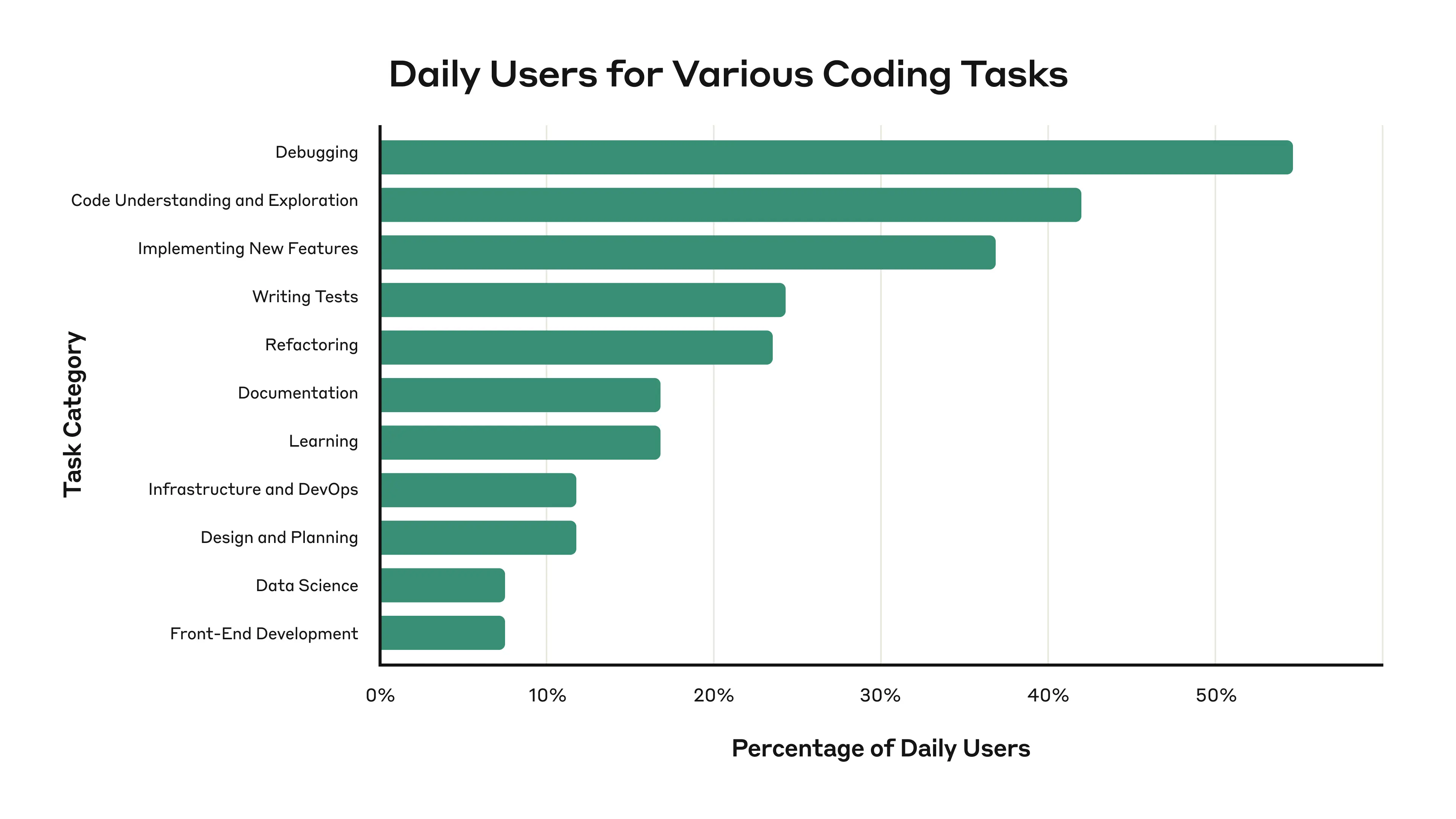
Among coding tasks, employees used Claude most frequently for debugging and code comprehension (explaining existing code). Fifty-five percent reported using Claude daily for debugging, and 42% for understanding code. Tasks like data science and frontend development had relatively lower frequency, likely because those tasks are less common overall.
Usage and Productivity: Doubled in One Year
Engineers now use Claude for approximately 60% of their work and report an average 50% productivity improvement. Compared to the same time last year, these numbers have jumped 2-3x. Notably, the top 14% of "power users" felt their productivity had increased by over 100%.
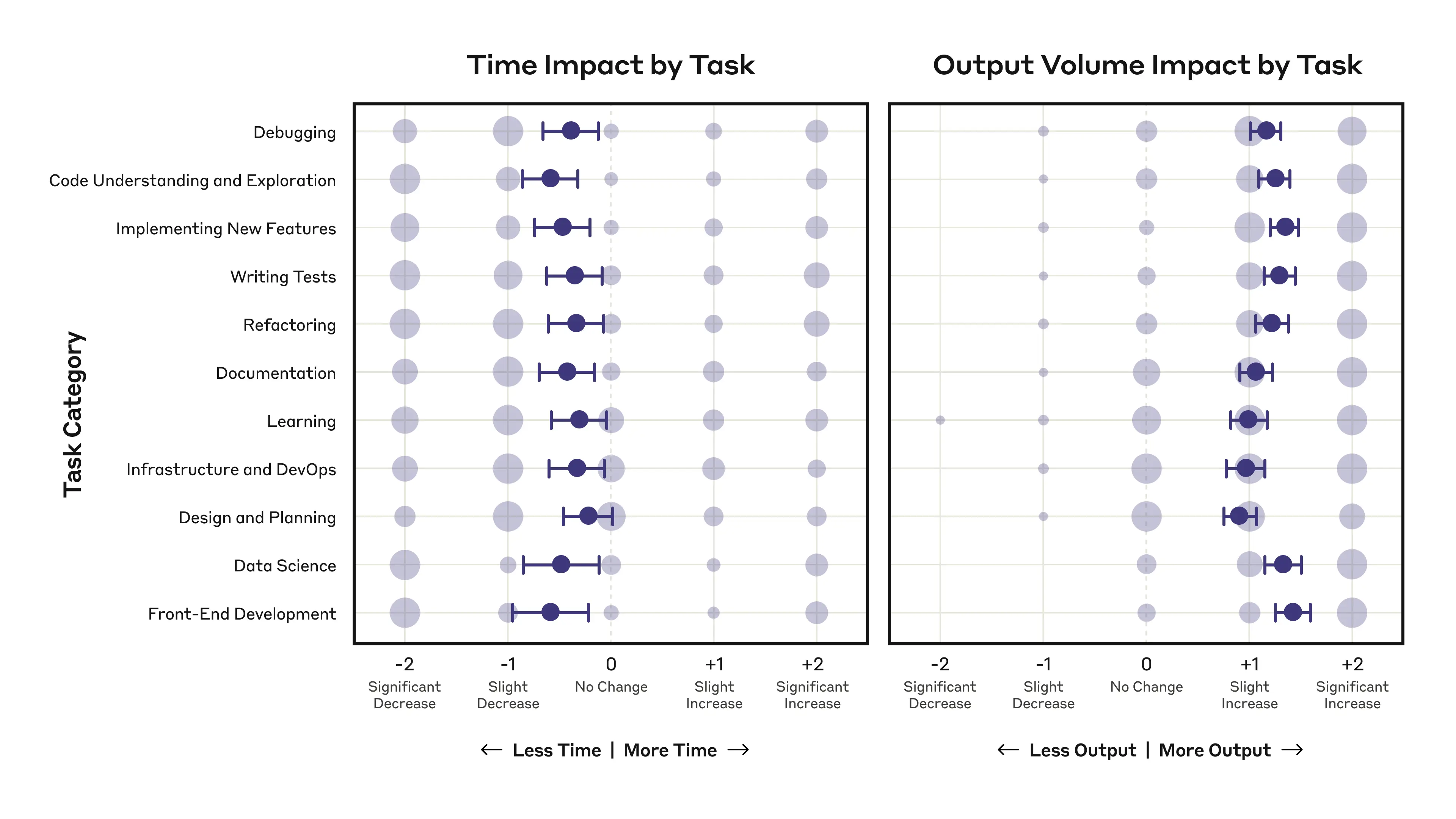
An interesting finding concerns the relationship between time and output. As the graphs below show, time spent on each task (left graph) decreased, but output volume (right graph) increased by a much larger margin. In other words, they are saving a bit of time while getting much more done.
New Work Made Possible by AI
It is not just about doing existing work faster. Respondents reported that 27% of Claude-assisted work would not have been attempted at all without AI. Examples include expanding projects previously abandoned due to time constraints, or building nice-to-have tools (such as an interactive data dashboard) that were never prioritized.
However, people are not handing everything over to AI. Employees estimated that only 0-20% of tasks could be fully delegated to AI. While AI is an excellent collaborator, active human oversight and verification remain essential.
2. In-Depth Interviews: The Changes Numbers Cannot Show
If the survey showed the "what," interviews with 53 people revealed the "how" and "why." Engineers spoke candidly about their feelings and how their work patterns had changed.
Strategies for Delegating to AI
People do not assign just anything to AI. They tend to delegate tasks that are easy to verify, low-stakes if they fail, and tedious and repetitive.
If it's a one-off debugging task or research code, I hand it straight to Claude. But if it's conceptually difficult or involves specialized debugging or design problems, I do it myself.
The more excited I am to do something, the less likely I am to use Claude. If I feel resistance... it's much easier to just start a conversation with Claude.
Engineers Becoming "Full-Stack"
One of the biggest changes is the expansion of technical capabilities. Backend engineers are building impressive UIs with AI assistance, and researchers are doing their own data visualizations. People now tackle fields they previously found intimidating.
The design team asked, "Wait, you did this?" I said, "No, Claude did it. I just typed the prompts."
Concerns About Losing Skills: Skill Atrophy?
But where there is light, there is shadow. Some engineers worry that heavy reliance on AI may cause their deep coding skills to atrophy. The incidental learning gained from struggling through problems yourself is disappearing.
Producing results is so easy and fast now that it's becoming increasingly difficult to take the time to learn something deeply.
Some miss the joy of coding itself -- the "hands-on" satisfaction. But many accept giving up that pleasure because the productivity gains are simply too significant.
Changing Workplace Relationships
An interesting phenomenon: people turn to Claude before colleagues. Questions that would have gone to senior developers or peers now go to AI first. While this boosts efficiency, there are wistful observations about reduced human interaction and fewer mentoring opportunities for junior engineers.
I love working with people, but it's sad that they are now less "needed"... Juniors don't come by to ask questions as often anymore.
Anxiety and Expectations About the Future
Engineers feel their role is shifting from "person who writes code" to "manager who oversees AI agents." They are optimistic in the short term, but there is underlying anxiety about whether AI might replace everything in the long run.
I'm optimistic in the short term, but in the long term, I think AI will eventually do everything and make me and many others obsolete.
3. Claude Code Data Analysis
To verify the survey and interview findings, Anthropic analyzed 200,000 internal data records from between February and August 2025.
Harder Problems, More Autonomy
The data clearly shows that Claude usage patterns have evolved:
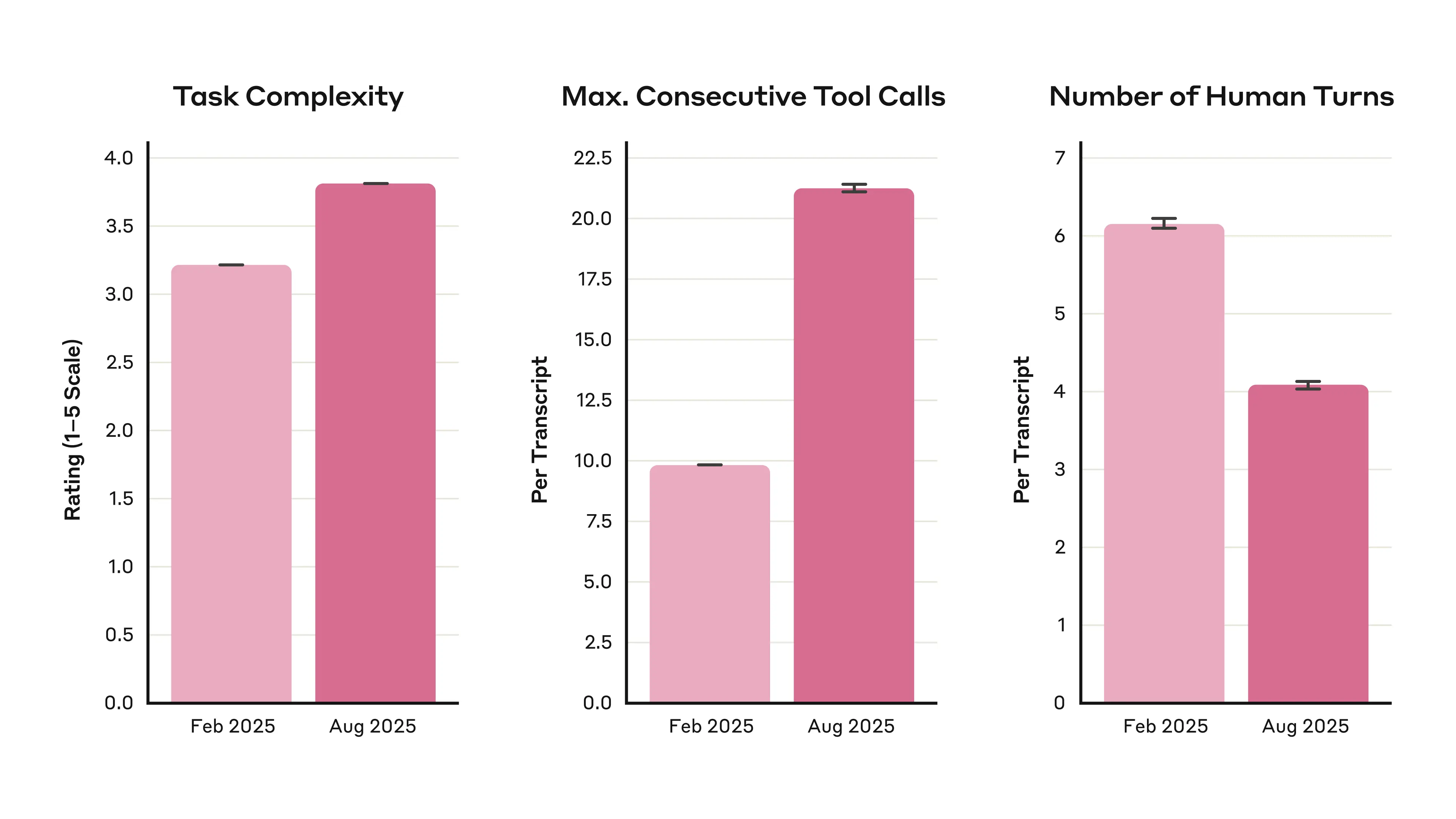
- Increased difficulty: Compared to six months prior, more complex problems (score 3.2 to 3.8) are being assigned to Claude.
- Increased autonomy: The number of consecutive tool uses Claude performs without human intervention more than doubled, from 10 to 21.
- Reduced intervention: Conversely, the number of times humans needed to intervene decreased by 33%.
Focus on Building New Features
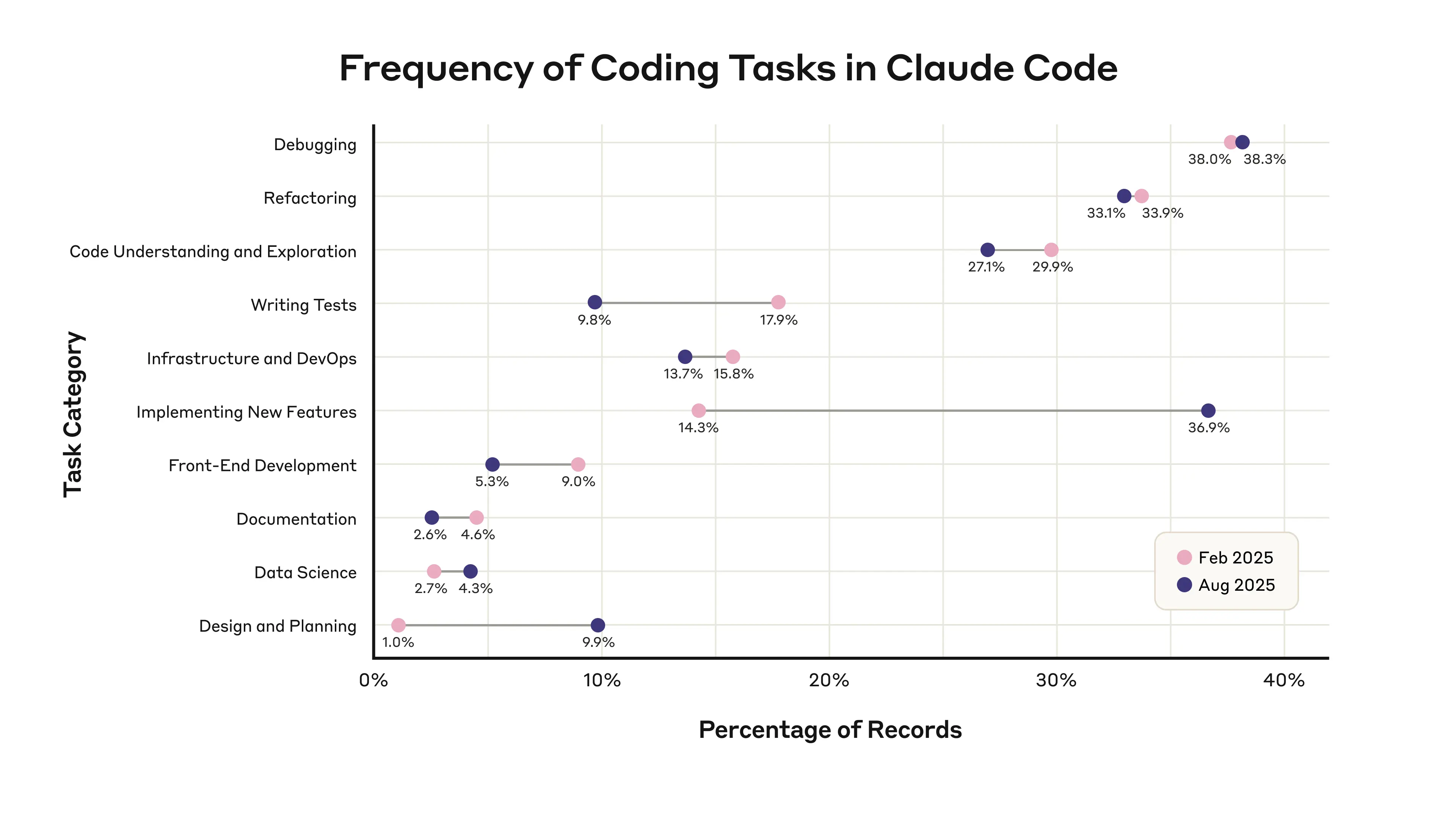
The most notable change is that the share of "new feature implementation" tasks surged from 14% to 37%. The proportion used for design and planning also grew significantly. This shows that AI has moved beyond simple assistance to performing core development work.
Every Team Becoming "Full-Stack"
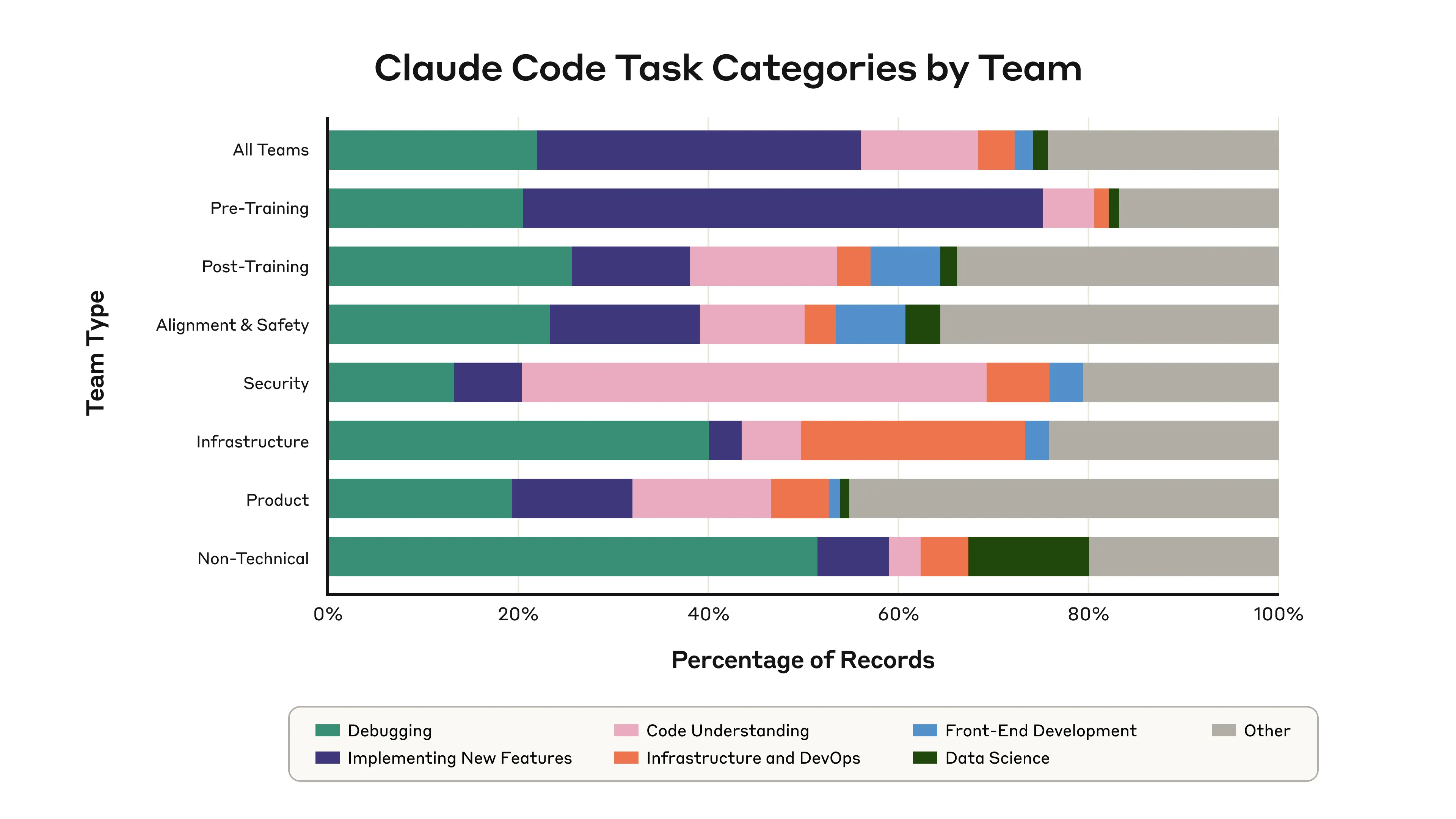
How teams use AI is also telling. The security team uses Claude for code analysis, non-technical teams for debugging, and the research team for frontend work. Everyone is supplementing areas outside their specialty with AI, effectively becoming "full-stack."
4. In Closing: Where Are We Headed?
The changes inside Anthropic show that AI is moving beyond simply aiding work to redefining the very nature of how work is done. Engineers are learning faster, tackling tasks they used to avoid, and crossing boundaries between specialties. But alongside this, concerns about losing depth of expertise and uncertainty about future careers are growing.
Whether the current changes are analogous to the evolution of programming languages from low-level to high-level, or something that fundamentally upends the human role, remains unclear. But Anthropic is using itself as a laboratory, experiencing these changes firsthand and working to find the right future for working alongside AI. More concrete responses and plans are expected to emerge in 2026.