The key to an effective presentation lies in intuitive structure and human credibility. The know-how shared by Vince Pierri provides concrete methods for everyone -- from first-time speakers to seasoned professionals -- to deliver talks that audiences "can't forget." With a 6-step structure for delivering clear core messages and an abundance of practical, immediately applicable tips, this framework can be put to use on stage right away.
1. Moving Beyond Presentation Anxiety to a Framework
Everyone starts with a fear of presenting. Sweaty palms, a trembling voice -- you've probably experienced it at least once. The author, Kyle, felt the same way.
"I was terrified of speaking in front of people. The more I thought about it, the more anxious I became. But I pushed through the fear, and I'm glad I did."
The reason most executives dread presentations isn't a lack of leadership ability -- it's because standing on stage facing hundreds of pairs of eyes is an entirely different game. But Pierri's coaching experience with various CEOs and executives yielded a surprising conclusion.
Above all, the biggest obstacle isn't stage fright -- it's lack of structure. Without a clear flow, confidence drops and the audience loses trust.
What's needed is a repeatable structure (framework) that anyone can follow. The step-by-step framework introduced next is exactly that solution.
2. The First 5 Minutes: 'Tension' Is the Key
Every great talk must begin with audience tension. If the opening fails to capture the audience's attention, no matter how well you deliver the remaining 25 minutes, their interest is already gone.
The 3-Step Opening Formula
-
Pain Point (2 minutes)
- Specifically mention a problem or frustration the audience is already experiencing.
- Caution: Many leaders jump straight to solutions, but if the audience doesn't empathize with the pain, they won't care about the solution either.
-
Problem (2 minutes)
- Go one level deeper into the root cause of the problem.
- Example:
"The real reason churn is high isn't the product. It's the onboarding."
- Avoid vague statements ("Change is hard," "Competition is fierce") and be as specific as possible!
-
Promise (1 minute)
- Clearly declare what specific outcome the audience will take away from this presentation.
- Example:
"Today I'll show you three onboarding strategies that reduced churn by 40% in six months."
- This "promise" acts as the contract for the talk, so keep it concise and clear!
3. Three Ways to Build Trust

Titles and reputation alone won't earn your audience's trust. Trust is built through evidence that you've walked the path yourself. The main methods are:
- Experience: Stories drawn from firsthand failures, experiments, and successes
- Research: Credible data, case studies, and benchmarks
- Empathy: Short personal stories showing you've been in the same position as the audience
In particular, vulnerability -- not hiding your failures and weaknesses -- actually draws the audience's attention.
"When I became VP, I thought my role was to have all the answers. But what my team actually needed was 'clarity.'"
4. Maintaining Focus with 3 Messages
The most common mistake is trying to cram too many messages into one talk. Exactly 3 key points is ideal -- that way they stick until lunch!
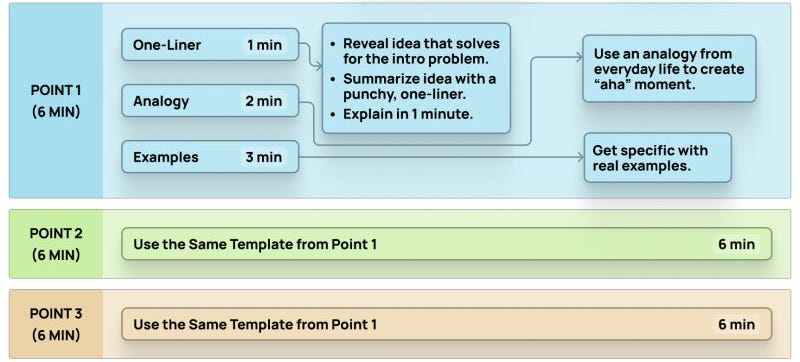
Structure each point as a "mini framework":
-
One-Liner (1 minute)
- Express the core concept in a short, memorable sentence
- Example:
"Churn isn't a product problem -- it's an onboarding problem."
-
Analogy (2 minutes)
- Use everyday comparisons to convey abstract concepts simply and intuitively
- Example:
"Onboarding is like a new hire's first 90 days. Stumble here, and they've mentally checked out before they even started."
-
Concrete Examples (3 minutes)
- Use real companies, data, and actual success stories to show how it applies in practice
- Example:
"Company X added a product tour and first-week goal-setting feature, reducing churn by 40%."
Repeat this structure for each of your three messages.
5. Close with Impact and a Call to Action

Don't let up until the very end! Common closings ("Let me wrap up, thank you...") leave no lasting impression and weaken the connection with the audience.
A 2-Step High-Impact Close:
-
Final Story (2 minutes)
- A concrete story about someone in the audience or a real person who applied these strategies and succeeded
- Example:
"A mid-sized SaaS company applied these three strategies and generated an additional $3 million in annual revenue."
-
Call to Action (2 minutes)
- Give a very specific, immediately actionable task.
- Example:
"Before you leave this conference today, write down one thing you'll change in your onboarding process, and tell a colleague about it."
The key is not a vague "go for it!" but a concrete action goal they can start right now.
6. The Complete Structure at a Glance
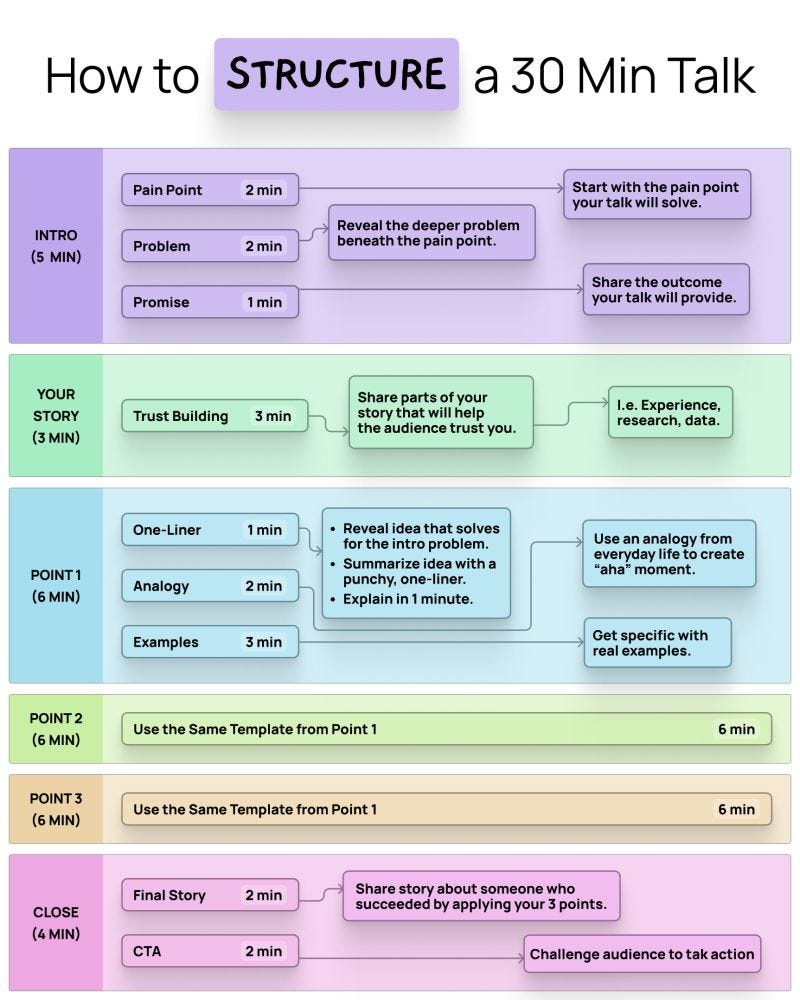
This framework is designed around how the human brain absorbs information.
- Pain -> Problem -> Promise: Creates curiosity and motivation
- Building Trust: Enhances the speaker's persuasiveness
- One-Liner -> Analogy -> Examples: Imprints the message in memory
- Final Story + Call to Action: Gets the audience to actually take action
Think of it like architecture. Without the foundation, walls, and roof, the building collapses -- and the same goes for presentations.
Especially for less experienced speakers or executive-level presenters, remember these three things:
- Use plain language, not corporate jargon!
"Nobody wants to hear about 'maximizing synergies.' Simple language is best."
- Be ruthless about time allocation!
- For a 30-minute talk, cut one or two points without hesitation. Practice with a timer.
- One talk, one message!
- Don't try to cover your entire leadership philosophy at once. Go deep on a single change.
Following this structure will noticeably improve audience response and naturally diminish pre-talk anxiety.
"Confidence doesn't come from mantras or gestures. It comes from a clear message."
Closing
Vince Pierri's presentation framework demonstrates that clear structure, trust, and a high-impact close are the cornerstones of a great presentation. When you deliver your core message simply and specifically, anyone can command a powerful stage. Try this framework the next time you present