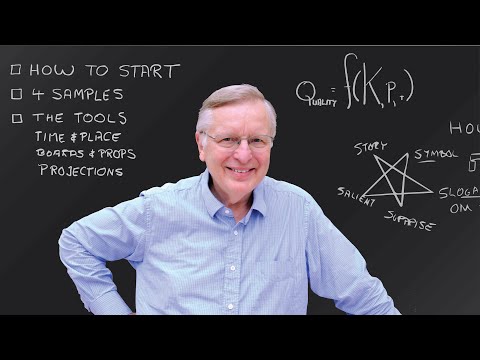
This lecture lays out proven, practical rules and tool techniques for maximizing the speaking ability that shapes success in life. It covers the importance of the blackboard and visual props, the fatal mistakes to avoid when making slides, and concrete techniques for absorbing an audience. It goes on to explain, in plain terms, strategies for imprinting your ideas in interviews and research talks and for finishing with a strong impression. 🎤
1. Why speaking matters, and the success formula
Success in life is decisively shaped by your ability to speak, your ability to write, and the quality of your ideas. Many people think outstanding speaking is an innate gift, but it can in fact be explained with a clear formula.
The quality of successful communication follows the relationship Knowledge × Practice × innate Talent, in which the weight of innate talent is very small. Even an Olympic gymnast with extraordinary natural physical ability will fall on a beginner ski slope without technique and practice. With the right knowledge and enough practice, anyone can become an excellent speaker. ⛷️
"The Uniform Code of Military Justice provides for court-martialing an officer who sends a soldier into battle without a weapon. Students need a similar protection, because they should not go out into the world without the ability to communicate."
Before the lecture proper, a basic rule is emphasized: put the electronics away. The human brain has only one language processor, so checking email or browsing the web on a laptop not only prevents you from focusing on the talk, it also disturbs the audience around you and the speaker. 💻📵
2. How to start effectively, and the core delivery heuristics
Many people try to warm up the room with a light joke at the start of a talk, but this is not recommended. Early in a talk the audience is still settling in and adjusting to the speaker's tone and style, so they are not ready to take a joke properly. Instead, start with an empowerment promise that clearly states what the audience will take away from the talk.
"By the end of these 60 minutes, you will have learned things about presenting that you didn't know before, and some of them will change your life."
Four core techniques help the audience absorb the content fully:
- Cycle: About 20% of any audience is distracted at any moment, so you must repeat the core idea at least three times for it to land completely.
- Build a fence: Draw a clear boundary showing how your idea differs from similar concepts by others, preventing confusion.
- Verbal punctuation: Continuously provide landmarks such as "first" and "second," telling listeners where you are so those who lost the thread can rejoin.
- Ask questions: After putting a question to the audience, you have to endure seven seconds of silence so they can think of an answer. To the speaker those seven seconds feel very long, but they are the essential wait time for the audience to respond. ⏳
3. The setting: the magic of time and place
Choosing the time and place is very important for maximizing the effect of a talk.
- The best time: 11 a.m. is ideal. The audience is fully awake and not suffering from post-lunch drowsiness — the optimal window for concentration.
- Lighting: Keep the lights fully on. Darkening a room makes people sleepy by instinct. Turning off the lights so the slides look better is the fastest route to closing your audience's eyes. 💡
- Advance scouting: Just as a bank robber studies the site in detail before the job, a speaker should visit the venue beforehand to check its quirks and movement paths, preventing surprises.
- Audience density: If listeners are scattered sparsely across too large a space, the atmosphere goes cold, so choose a room of a size where at least half the seats will be filled.
4. The aesthetics of presentation tools: boards, props, and slides
If the purpose of the talk is informing and teaching, the blackboard is the ideal tool; if the purpose is exposing ideas, slides are appropriate.
The power of the blackboard
The board offers free-form diagramming and also a pacing effect. The speed of writing with chalk matches precisely the speed at which a person understands and absorbs a new concept. It also becomes an excellent focal device that lets a novice speaker use hands that would otherwise feel awkward. Putting hands in your pockets or hiding them behind your back can provoke wariness. ✍️
The magic of props
Just as a burning stove on a theater stage heightens tension, visual props burn a talk's message into memory. The physics professor's demonstration of conservation of energy — pulling a heavy iron ball on a rope right up to their own nose and letting go — leaves the audience with an impression they never forget.
The powerful effect of boards and props comes from empathetic mirroring: watching the speaker's movements activates the audience's mirror neurons. 🪞
Rules for making slides
Most slide presentations are ruined by too many slides and dense text. The human language processor cannot read and listen at the same time, so when a slide is full of words the audience reads instead of listening to the speaker.
- Minimize text: Slides are a seasoning for your speech, not the main dish. Strip out unnecessary backgrounds, logos, long titles, and bullet points.
- Font size: Use a large font of at least 40–50pt so you are physically prevented from cramming in text.
- Avoid laser pointers: Using a laser pointer inevitably turns the speaker's back toward the screen, breaking eye contact with the audience. Instead of shooting a beam, it is far better to insert a small arrow or graphic element into the slide itself in advance. 🎯
- The print review: Print draft slides on paper and spread them across a table — you can see at a glance whether the content is far too heavy.
5. A framework for transferring knowledge and persuading an audience
In business or academic talks where you must persuade rather than merely teach, strategic construction of the delivery is essential.
How to inspire an audience
Audiences are most deeply inspired when they see a speaker pour out genuine passion for their field. You can stimulate intellectual interest by offering an entirely new way of seeing a problem and by showing the compelling process of compressing a complex computation into a few seconds.
Teaching how to think through storytelling
Humans fundamentally understand the world through stories. Teaching thinking is therefore the process of giving your audience the core stories they need and showing them how to analyze those stories, combine them, and test their validity. 📖
Winning in five minutes: interviews and job talks
In a job interview or an evaluation talk, it is decided within the first five minutes.
- Present a vision: identify a problem everyone considers important and reveal your own differentiated approach to solving it.
- Show accomplishments: prove, in a clear list, the concrete steps you have taken toward that vision, the systems you actually built, and the contributions that resulted.
6. "Winston's Star" for imprinting research and ideas on the world
However outstanding a piece of research or an idea may be, if it is not packaged properly it fails to win recognition and is easily forgotten. To spread an idea widely and make it memorable, the five-S "Winston's Star" strategy is useful. ⭐
"You get used to being famous over time. But you can never get used to being forgotten and ignored."
- Symbol: a representative visual form that lets people call the idea to mind intuitively (for example, an arch model)
- Slogan: a concise, powerful phrase that cuts to the core (for example, one-shot learning)
- Surprise: a twist, such as the claim that a clear rule can be learned from a single example without millions of data points
- Salient idea: one core concept that stands out and does not get buried among too many ideas (for example, the near miss)
- Story: a narrative structure that logically explains how the idea works and why it matters
7. The closing slide and the final words
The last impression of a talk is the decisive moment that determines how the whole presentation is judged.
What not to put on your final slide
- A vast list of collaborators: it makes your own contribution look diluted. Thanks are better delivered on the first slide.
- A "Q&A" or "Questions" slide: leaving an information-free blank screen up for the 20 minutes of questions is a waste.
- A plain "Conclusion": rather than a generic conclusion, emphasize what you newly achieved.
- The right alternative: leave a contributions slide summarizing the clear value you produced up as the final screen. 📊
The art of the closing line
Ending habitually with "thank you for listening" is not recommended. It can create a weak impression, as if you were thanking the audience for politely enduring boredom in their seats.
- Closing humor: by the end of a talk the audience has adjusted to the speaker's style, so finishing with a cheerful joke makes them remember the whole talk as an enjoyable time.
- A confident finish: like great statesmen who declare a clear vision and then take their leave with poise, close the stage with a definite message.
- A salute to the audience: the finest ending is to close with dignity, expressing high regard for the discernment of an audience that understood the value of a precious idea and gave their time to listen. 👏
Closing
Excellent speaking is completed not through natural eloquence but through careful technique that respects the audience's cognitive structure, and strategic training. When you boldly cut unnecessary slide text, actively use the board and props, and convey a clear vision and clear contributions, your ideas will finally be recognized at their full value and spread widely into the world. ✨