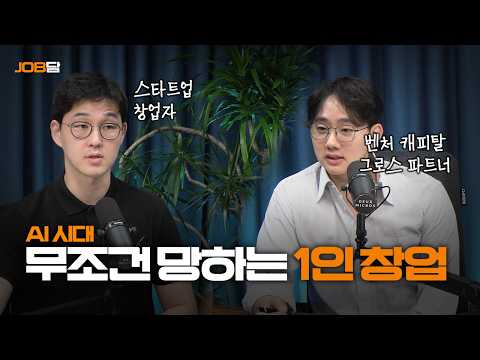
In this video, we discuss realistically about one-person entrepreneurship in the AI era. Candid's CEO Lee Joo-hwan and Base Ventures partner Kim Ki-soo have an interesting discussion from their respective perspectives on whether starting a business or joining a team is a better choice. With the advancement of AI technology, we have entered an era where many things can be done on one's own, but through various examples and cool-headed numerical analysis, we show that starting a successful one-person business is not easy at all. It also contains practical advice on what type of person is suitable for starting a business and what path to choose if you lack experience.
1. In the AI era, can you do everything by yourself? 🤔
The video begins with the question of whether there is a need to work for someone else when we have entered the AI era and can now make everything on our own. Regarding this question, Candide CEO Lee Ju-hwan emphasizes that judgment, perception, and intention are more important than the ability to utilize AI. We suggest that it is a logical leap for juniors without sufficient experience to jump straight into starting a business just because they are good at handling AI.
"Once you think that AI has emerged and standardized something, it ultimately comes down to execution. Then, what's more important is whether we use AI well… or what it means to use AI well as an agent manager, then you have to make a judgment and give input very well about what you will do."
"I think it will arise from the flow of people who have been deeply interested in the phenomenon of objects for a long time. But, for example, if a junior persona is a person who has really only thought about computers since childhood. It may be meaningful if that person comes out to society and says that they want to solve a computer-related problem right away, but in fact, I think most people probably don't have such a persona."Partner Kisoo Kim suggests that there may be opportunities for young entrepreneurs to demonstrate destructive creativity even without domain expertise. For example, they explain that items such as 'Elite Job', which connects Seoul National University students to startup internships, are something only they can do. However, at the same time, many people who attempt to start a one-person business warn that it is only a short-term 'food' and that it is likely to disappear within 6 months to a year.
"But I think there are definitely things that a young entrepreneur, Fresh Eye, can do that doesn't require such domain expertise."
"Many people are trying, but not many are running proper businesses... I think it would be very cautious to recommend starting a business because it seems like this is a food industry that will almost completely disappear within 6 months to a year."
2. Who is suitable for a one-person startup? 🌟
So what kind of person is suitable for a solo entrepreneurship? CEO Joohwan Lee claims that people like celebrities are more advantageous than people who are simply highly intelligent. He explains that in an era where the product itself does not have much differentiation, the charm of the founder, or the ability to arouse 'fan spirit', is important.
"Actually, I think that a suitable person to be a solopreneur is someone who is a bit of a celebrity rather than someone who is intellectually or highly intelligent."
"I think they are people who can really actively appeal to people's interest and likes. So, I also think that those people who can better promote their product or why I tried to make it... and who have the ability to say, 'Because this person made it, I'm interested and want to try it out', might actually be talents closer to solopreneurs."Partner Kisoo Kim says that only overwhelmingly smart or talented people can achieve great success in a one-person startup. In fact, cases such as 'Polcia', which achieved sales of 1.3 billion won in 30 days, and 'Base 44', which was sold for 130 billion won in 6 months, are said to show that the founders had genius far from ordinary people.
"One of the reasons why I thought that people who are overwhelmingly smart or talented should jump into the startup scene is that I looked for myths created by people who seemed like criminals among one-person startups or small teams that have recently achieved great value, but it was actually very difficult to find them."
3. The reality of 'one-person start-up earning 10 million won per month' 📊
I was impressed by the part that analyzed with specific numbers how difficult it is to start a one-person business earning 10 million won per month. In order for two teams to earn 10 million won per month each, they need to achieve 40 million won in monthly sales, which is calculated to require 8,163 paid subscribers. At this time, if we assume that the paid conversion rate of website visitors who pay immediately without a free trial is 2%, the shocking reality is revealed that the cumulative number of website visitors must reach a whopping 400,000. 😮
"We need about 8,163 paying subscribers. But our subscriptions are four times the number of our subscribers."
"Once you reach 8,000 paying subscribers, the total number of website visitors will be 400,000."
Furthermore, considering the monthly churn rate of 5%, they point out that 400 subscribers per month are lost, making it very difficult to continuously attract customers. In the end, it is difficult to achieve these numbers with one simple item, and it leads to the conclusion that the ability to continuously produce various products based on the founder's 'fan spirit' is essential.> "The real problem is what comes next. 400,000 people have paid. So will those people continue to use it? This is the problem."
"Maybe the reason he can make a lot of money is not because of one product, but because he has 40 or 50 products. But the people who use those products are all the same."
Partner Kisoo Kim emphasizes that if you have the ability to generate this level of traffic, you can work with greater rewards (stock options, higher salary) and less risk when you join the company.
"If you create a company with that much traffic, you will get stock options and your annual salary will be 150 to 200 million won."
"That's right. And I don't have to take care of the risks, I have four major insurance policies, and I have something to explain when I'm asked to do something."
4. Why you should join a 'good team' instead of starting a business 🤝
CEO Lee Joo-hwan advises those considering starting a business that it is important to first join a good company and gain experience. This is because, beyond simply learning business operation know-how, you can form a strong network like the 'PayPal Mafia' or 'Baemin Mafia' and have an advantage in attracting investment.
"In the end, I think it would be better to join a good company, gain some experience, and then leave."
"For those who graduated from Toss, VCs keep an eye on them and invest when they come out. As soon as I come out, I have a huge advantage in that I can receive investment based on the experience I had at this company."
Partner Kim Ki-soo says the biggest reason to join a good team is being able to have high standards for 'what constitutes a good level of work'. The experience of working at a company that is obsessed with perfection like Toss helps you raise your own work standards and develops the eye to recognize good talent.> "I think it's a good point to have a view on what constitutes a good level of work."
"For example, in a great team like Baemin, PayPal, Toss, etc., if I gain experience on who the high-quality team members are, I will naturally set that standard when selecting my team members."
5. Advice for those preparing to start a business 💡
5. Advice for Those Preparing to Start a Business 💡
In the second half of the video, practical advice and examples are presented for those considering starting a business. CEO Lee Joo-hwan introduces an example of receiving in-house start-up support in recognition of one's abilities at a company, and says that there is a way to achieve one's dream by cooperating with the company even if one does not start an independent business.
"The company will give you money, so you just sit here and start a business. I'm working dually while working at the company."
"I like that person's skills and abilities so much that I just want to change roles. You can help us in your spare time like a part-timer and start your own business. I'll even invest money."
Partner Kisoo Kim points out that although the government's policy to support startups is active, the risk of idea theft is also high. In particular, there are many cases of large Korean companies copying ideas from small and medium-sized startups, so entrepreneurs with competitive ideas may be reluctant to be exposed to government programs.
"One of Korea's chronic diseases is that when small and medium-sized startups develop extremely competitive technologies and products, larger companies take over."
"Rather, I think the government might be reluctant to expose it to certain programs. If this spreads through that, similar items will definitely come out quickly, and I feel like my idea and some of my assets won't be well protected."
---## 6. Subscriber Story: Should I start a business? 🤔
6. Subscriber Story: Should I Start a Business? 🤔
The two experts give an interesting answer to the story of a subscriber who said he was thinking about starting a business while watching 'Job Dam' while working out. Partner Kisoo Kim says that the 'domain knowledge' that the storyteller possesses is important, and that if that knowledge is rare in the industry, starting a business can be positively considered.
"I think having domain knowledge can be a moat point to some extent. However, to make a real decision, I think it will depend on whether the domain knowledge I have is something that everyone who is in this industry knows, or whether I especially know a lot of grammar, vocabulary, and things like that."
CEO Lee Joo-hwan pays attention to the storyteller's passion for watching startup videos while working out, and praises him as someone who is already ready to start a business. They are encouraged to believe that stamina and perseverance in both work and exercise will be great assets in starting a business, and are given the choice of whether to contact Base Ventures or Candid. 😂
"No, what you're saying is that you're watching YouTube chat while working out is because you're already in a very deep state of various situations regarding startups and entrepreneurship. He's watching these videos right now while doing his own hobby. ... Ah, this person is quite prepared. I think your future will be very promising."
---## Conclusion One-person entrepreneurship in the AI era may seem attractive on the surface, but in reality, it can be seen as a formidable challenge. To be successful, you need good judgment, deep domain knowledge, and maybe even a 'celebrity' charm. Rather than jumping in blindly, we emphasize that it may be wiser to join a good team to gain experience, build a network, and raise the 'standard of doing a good job'. Of course, it also conveys the message that opportunities are clearly open to a small number of talented individuals with strong ideas and passion, and provides a realistic and balanced perspective to everyone considering starting a business. 🚀