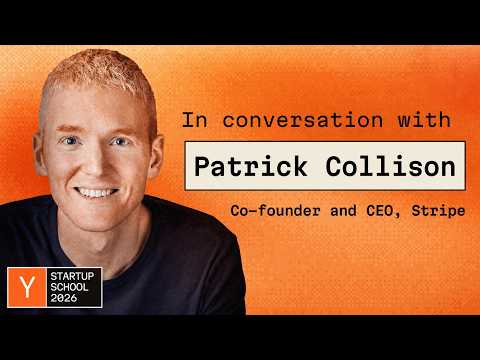
Stripe co-founder Patrick Collison says that although AI is rapidly changing coding and company-building, deep knowledge, clear writing, and obsession with real customer problems still matter. He explains why Stripe was able to spend roughly two years preparing despite the common advice to "launch fast," and argues that the AI era has actually created more room to tackle bigger, more differentiated problems. His conclusion, backed by Stripe's own data, is that in terms of the number of companies started, growth speed, and the likelihood of reaching revenue, 2026 is a better time to start a company than any point before it.
1. Learning still matters even when you can hand it to AI
The conversation opens with host Harj Taggar recalling when he first met Patrick roughly 20 years ago. Patrick, then a teenager, was so deeply immersed in programming that he had built Chroma, a dialect of Lisp. Harj asks whether it's still worth building such a thing yourself, given that a talented 16-year-old today could prompt an AI like Claude to create a similar language.
Patrick points to the low-level work people used to do by hand that has since moved into compilers. People used to write assembly and machine code by hand, optimize instructions, and worry about memory layout. Compilers now handle that, and people don't particularly miss it. By the same logic, writing source code itself may someday be replaced by instructing AI in natural language.
"Maybe we shouldn't miss source code and should move to the level of instructing Claude. But emotionally, I do miss it."
On the more fundamental question of what students should study in the AI era, however, he emphasizes the speed and utility of holding knowledge in your own head. He compares it to a computer's cache. You can ask an external system or AI agent a question and get an answer, but instantly recalling something you already know is far faster. Just as reading from a CPU's L1 cache is overwhelmingly faster than fetching from RAM or over the network, the human brain has a "cognitive L1 cache."
"You can ask an agent to compute or look something up. But that's much slower than already having it in your cognitive L1 cache."
Talking to an AI, dictating, and reviewing the results all incur round-trip time. If you can pull basic concepts straight out of your own head, you can do many more iterations and connections of thought. Even granting models the fullest credit for their capabilities, Patrick believes this kind of neural lookup — instantly using what a human already knows — will remain an important edge for a long time.
He also notes that if you look at what companies like Stripe and the AI labs actually value, they still place a large premium on high cognitive ability and deep understanding. So the advice is not to give up on developing intellectual capability too early just because AI has arrived.
2. Writing and communication aren't easily replaced by AI
Harj asks whether there is anything Patrick deliberately does himself as CEO, even though AI could do it fairly well. Patrick's answer is clear: he still writes himself.
He says he dislikes AI writing not only for philosophical reasons but because of the quality of the output itself. He grants that AI has shown astonishing ability, even solving hard mathematical problems. Even so, he has not yet read an LLM-written essay that genuinely persuaded him.
"These models might prove the Jacobian conjecture. They're clearly capable of enormous things. And yet I still haven't read an LLM essay that I found genuinely compelling."
He sees writing and interpersonal communication not as a mere sentence-generation skill but as the ability to reasonably grasp and convey multiple dimensions of reality. AI can produce grammatically smooth sentences, but he feels it still falls short of capturing real-world context, relationships, intentions, and subtle judgment.
That's why he says he has never once sent the pre-written phrases various services suggest, like Gmail's autocomplete or WhatsApp's AI reply suggestions.
"I have never once sent one of those auto-suggested sentences."
The point of this section isn't to reject AI. It's that precisely in an era where AI has become extremely powerful, the ability of founders and leaders to structure their own thinking and express it accurately and persuasively matters more.
3. Dropping out of college is not a trapdoor
Patrick describes his somewhat unusual background as "someone who dropped out of college twice to start companies." He left after finishing his freshman year at MIT to build a company with Harj. After that company ran for a few years, he returned to MIT for another year, and then dropped out again to start Stripe.
"Dropping out isn't a completely irreversible trapdoor. You can drop out and go back."
He originally loved physics and, growing up in Ireland, imagined a life as an academic. He dreamed of physics research while reading Feynman's books, but after coming to the US he encountered startups as a realistic option. When he left college, startups were not the widely known career path on campus that they are today, and the people around him found his decision very strange.
That doesn't mean he recommends dropping out to every student. On the contrary, he says there's nothing wrong with graduating if you enjoy college life and find learning interesting. He felt an excessive sense of urgency at the time, and in retrospect he judges that it wasn't really necessary.
"If you're enjoying college, I actually think there's no harm in finishing. The urgency I felt was, in hindsight, a bit unnecessary."
Conversely, if college doesn't suit you, the coursework genuinely doesn't interest you, and something else pulls you more strongly, the cost of dropping out may not be as large as people think. In his experience, the lifelong reputational damage parents commonly worry about almost never happened.
"As far as I could tell, nobody really cared. You don't have to drop out, but the cost of dropping out is very small."
He rushed at the time for two reasons. One was a sense that "life is short," plus a habit of wanting to finish school quickly. The other was the fear that the opportunity in Silicon Valley would vanish soon. But he thinks the second judgment was wrong. Silicon Valley has continued to overflow with opportunity for decades.
A question comes up about the anxiety among students today that "if you don't start a company and make money right now, you could be locked into a permanent underclass." Patrick answers that humanity has always loved apocalyptic narratives in which society is completely upended in the face of enormous technological change. The invention of the airplane was an enormous change too, but it didn't produce all of the social reorganization the enthusiasts of the time imagined.
"I'll take the other side of the bet that these are the last few years in which you can start a company."
In other words, the opportunity in the AI era is large, but you don't need to be swept up in the fear that it's now or never.
4. Why Stripe was both an obvious and an absurd idea
Stripe's starting point was a very concrete customer problem. Patrick and his brother John Collison had personally experienced how cumbersome it was to accept money on the internet or bolt on a payment system. The existing approaches were unpopular and outdated, requiring complicated paperwork and in-person bank visits. He jokes that the paperwork at the time "seemed to be written in Latin."
The core lesson he learned at YC was exactly this. A founder shouldn't imagine a plausible-sounding problem in their head — they should find a problem someone actually feels pain about and wants to pay to solve.
"It's very easy to fall into the fantasy that you have a customer problem, when it isn't something people feel vividly enough to pay for."
On one hand, Stripe looked like an obviously good idea. The internet is important, money is important, and the way money moved on the internet was a mess. But from the other side, the very notion of two young people with no financial background building a financial services company looked absurd. At the time the word fintech didn't even widely exist yet.
"We were like squirrels in trench coats pretending to be real businesspeople or adults."
He recalls that when they met banks or partners and explained the idea, people wouldn't laugh outright but would look as if they were feeling under the desk for the security call button. That's how unlikely Stripe seemed as a company that would succeed.
Patrick says Stripe survived nonetheless because the idea was grounded not in an abstract vision but in a problem real users desperately experienced.
"It was obviously a good idea in that people really wanted it, and a bad idea in that nobody took it seriously. What saved us in the end was that it was rooted in a very specific, real user problem."
5. Stripe started with "this'll be easy" — then built quietly for a long time
The moment Patrick and John decided to start Stripe came right after the 2009 Startup School event in Berkeley. On the way back from eating sushi in Potrero Hill after the event, the two decided to seriously pursue the online payments idea they had been thinking about. Patrick says he remembers the exact spot on that walk and the words they exchanged.
"Yeah, let's just do it. It probably won't be that hard."
That turned out to be a very large miscalculation. The two thought they could work on it part-time for a few months while attending college, but Stripe became an enormous business that continues nearly 17 years later.
"Beware this ultimate yak shave. We thought we could do it in a few months while at college."
Yak shaving here means a situation where solving one thing you originally set out to do leads to unexpected prerequisite tasks that chain one after another until it becomes an enormous undertaking. Stripe wasn't merely a software project to build a card payments API. It also had to solve bank partnerships, security, money movement, reliability, regulation, and infrastructure.
Stripe started work the week after Startup School and went full-time in the summer of 2010. But the public launch was September 2011 — nearly two years after the first line of code. That was a somewhat different path from the standard YC advice of "launch fast, iterate fast."
But this was not a case of building a product in secret without customers. Stripe had its first real customer in January 2010, about two months after starting. The early customer was Ross Boucher, then at Twilio, and initially all Stripe could do was process card payments.
Customer requests expanded the product in very practical ways.
"After processing a card, Ross asked, 'How do I see my payments?' It was such an obvious request that we built a dashboard."
"'I want to refund a payment,' so we built refunds. Then a few weeks later he asked, 'So when do I get my money?' That was an obvious request too."
In this way Stripe practiced just-in-time development, matching real customer behavior and requests. The public launch was late, but the number of customers grew every month during the private beta, and the team got real user feedback every week. So "we hadn't launched publicly" did not mean "we were disconnected from reality."
"We were learning from reality, not from a product we assumed or estimated in our heads."
Patrick's conclusion is balanced. In most fields, waiting a long time can be the wrong strategy. But in a field like finance where the cost of failure is high and trust, security, and foundational infrastructure are part of the product, sufficient preparation may be necessary. What matters isn't the launch date itself but whether you are continuously in contact with real customers and letting reality correct your course.
6. In the AI era, lean startup methods alone may not be enough
Harj asks whether, if coding agents let you build software more cheaply and quickly, founders should make their very first product bigger and more ambitious — or whether they should still start from a narrow, sharp problem and expand based on customer response.
Patrick thinks the traditional lean startup approach — find a small niche problem, validate with a minimal product, then expand — still holds in part. But in the AI era, he says, that approach alone may not be enough. The internet is far larger than it was 20 years ago, and a strategy of finding small niches can be exhausted faster by competitors.
"In the AI era, you may need to be more aggressively decorrelated from other people."
What he means is not competing faster in the same niche as everyone else, but more boldly finding a starting point others haven't yet occupied. Patrick notes that many of the most successful companies of the past decade were far from the archetypal lean startup — the AI labs, the defense company Anduril, and others.
In the past, constraints on capital and headcount made starting small and narrow essentially the only option. But AI greatly expands the scope of what an organization can do and its initial execution capacity. So there is now room to build a more complex, ambitious business from the start.
"Twenty years ago, capital constraints made the lean startup approach almost the only way. But now you can start something more aggressive and ambitious from the beginning."
That said, this doesn't mean ignoring customer validation. As Stripe's case shows, even with a big goal you must stay deeply connected to customers' real problems and feedback.
7. Don't only worry about failure — think about life after success
Patrick is asked about the view that Stripe looks like a case of so-called "schlep blindness" — the idea that because most people avoid tedious, complicated, grinding work, opportunity appears for founders willing to take it on. Financial services involve plenty of boring, cumbersome work: setting up payroll, regulatory compliance, complex operations.
He acknowledges that a company naturally contains work that is unfun and unrewarding.
"Nobody starts a company in order to set up a payroll system."
But he stresses that the question a founder must ask before raising a lot of money is not only "what if I fail?" You also have to think about what life looks like if the business goes well.
"It's natural to worry about what happens if you fail. But you have to ask the opposite question too: 'What if I succeed?'"
If the company succeeds, you take on customers, employees, investors, and operational responsibility. Then the founder may keep doing that work for ten years, seventeen years, or thirty. So the question isn't just whether the market looks promising, but whether you'd still enjoy the work for a long time even after succeeding.
"Do you want to do that for 10 years, 17 years, 30 years?"
The intellectual reward Patrick gets from Stripe is being able to work with the most interesting and innovative companies in the world. Roughly 25% of US Delaware entities formed through Stripe Atlas start with Stripe, and Stripe is with these companies through the whole arc from a first founding team to large successes like Shopify or OpenAI.
"I have never once met a Stripe customer and thought, 'this business is boring.'"
He sees every business as an applied theory of how the world works. Companies are entities that actually test hypotheses about markets, technology, and human behavior. So even when individual tasks are cumbersome, looking at the business as a whole can be a deeply intellectual pursuit.
Finally, he tells Startup School attendees that Stripe Atlas incorporation is free for them, and extends a half-joking invitation for anyone who catches the urge to start a company over dinner to get in touch. 🍣
8. Will AI kill startups, or create more companies?
One of the most common worries among AI startup founders is "what if a big AI lab just does my idea?" Patrick says the question should be split in two: whether model capability itself might eliminate a particular task or industry, and whether a lab like OpenAI might enter every market directly and push startups out.
He thinks the latter fear has historically been overblown. Twenty years ago founders constantly worried "what if Google does this?" Google appeared to have essentially unlimited talent, capital, and server infrastructure. But no matter how powerful a company is, it can't push all 100 priorities perfectly. Organizations are complex, and internal conflicts and lack of focus arise.
"Human organizations are complicated. Aggressively executing on 100 priorities and managing the interference between them is very hard."
Google did extremely well in many areas, but it didn't do everything it could have. So the fear that large labs will take over every startup's market may be exaggerated.
That said, model capability itself replacing particular verticals or tasks can genuinely happen. Patrick doesn't deny this. It has already happened in some fields and may happen again. But Stripe's data points in a more optimistic overall direction.
The 2026 metrics observed at Stripe are very strong.
- The number of new businesses starting on Stripe has nearly doubled year over year.
- That growth rate is the largest annual change Stripe has observed.
- It isn't just an increase in lightly AI-built products — median company performance has improved over the previous year as well.
- The probability of companies reaching thresholds like $1M, $5M, and $10M in revenue is improving.
- Companies formed through Stripe Atlas are taking less time to reach first revenue.
"On almost every metric we can look at objectively, this appears to be the best time in history to start a business."
He summarizes that as of July 2026, Stripe's data suggests "there has never been a better time to start a company," with the caveat that nobody knows how the world will look in five years.
A similar phenomenon shows up at YC. In the past, reaching $1M in annual revenue was a big enough achievement to become industry news. That shouldn't be overstated today either, but early startups increasingly acquire customers and land revenue contracts much faster.
The shift in enterprise customers buying from startups faster is especially important. In the past, a large company's CIO or CTO would look at a new startup and wonder "will this company still exist in two years?" and hesitate to adopt an unproven product. But in the AI era the risk of maintaining the status quo has also become very large. Companies fear falling behind with outdated approaches and are more open to adopting new technology.
"Now people know that the risk of the status quo is also very high."
"There has never been a better time for a startup to sell a product and get it adopted at a fairly meaningful scale from the start."
Consumers, too, have complicated feelings about AI. They may worry about data centers or privacy, but they show strong curiosity about new AI products and a willingness to experiment. The psychological threshold for trying new technology is lowering for both businesses and consumers.
9. The AI economy may produce many winners rather than a few monopolies
Finally, Harj asks whether Stripe's data has changed Patrick's thinking about AI over the past 12 months. Many people worry about AI as a centralizing force in which a few giant companies absorb most of the economy. The frontier AI companies are indeed producing enormous results and are likely to keep succeeding.
But what Stripe observes is somewhat different. New companies are appearing rapidly, and existing companies are also reorganizing to take advantage of AI capabilities. Seeing this level of activity, he is less worried than before that a few companies will monopolize all the value.
"I think there will be thousands, tens of thousands of winners."
Patrick avoids categorical prophecy since the future isn't fixed. Even so, he says the current trend lines suggest AI may lead to a more distributed economy with more companies and broader prosperity.
"Based on the trends we're seeing, I think we're heading toward a more distributed world and more broadly shared prosperity."
Closing
Patrick Collison's message is neither simple optimism that AI will make everything easy nor pessimism that big companies and AI will eliminate all startups. He emphasizes that the ability to think and learn for yourself, choosing problems that touch real customer pain, and checking whether it's work you'd want to do for a long time even after succeeding remain the core of company-building.
Just as Stripe started from "this probably won't be that hard" and grew through years of complex foundational work, good company-building isn't completed by fast technology alone. But thanks to the execution costs AI has lowered and the shifts in the market, his most important conclusion is that more people now have the opportunity to solve bigger problems.