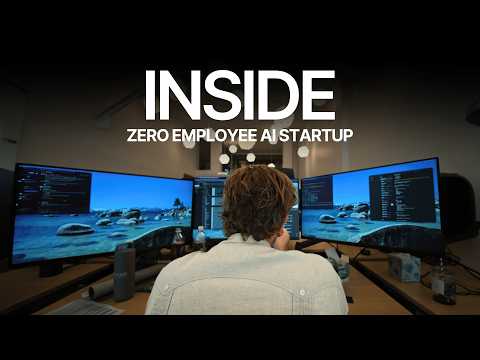
This video follows Pulsia, a platform where AI agents create and operate companies, and its founder Ben, who effectively runs it alone. The central question is whether a true "one-person unicorn" is possible. The interesting part is not just a flashy demo. The video also shows practical problems such as marketing and PR strategy, infrastructure partners, and GPU supply, and asks how to build a structure that can operate without employees. Ben's strongest advice is to stay solo or extremely small until product-market fit, and to try replacing hiring with AI as much as possible.
1. At 2 A.M., a Founder Tired of Bugs Starts Dreaming Bigger
The video begins with Ben recalling a frustrating moment from the past. At 2 a.m., he was wrestling with a computer, likely a coding tool or AI assistant, and reached a breaking point while asking why it could not fix a bug. That moment changed the direction of his life.
"At 2 a.m. I was like, 'Why can't you fix this bug?' I was talking to a computer, and it really could not fix the bug. I thought, 'What am I doing right now?'"
That frustration turned into a much bigger declaration. Instead of living around a single bug, Ben decided to automate the entire process of creating companies.
"I am going to build an AI that builds companies. And I am going to build 1,000 companies from my ideas. The dream became huge."
The host, Will, says many people claim to be doing AI, but only a few are truly building at the fringe of possibility. Ben is introduced as one of those rare cases.
2. What Pulsia Wants to Do: From "One Line of an Idea" to Company Operations
Will introduces Ben as the founder of Pulsia and summarizes the product in one sentence: a user types one sentence, and an agent architecture creates a business and operates it autonomously, 24/7.
"It is an agent architecture that lets anyone type one line, create a business, and run it fully autonomously around the clock."
Pulsia's mission is more concrete than simply making websites or apps. The goal is for agents to connect the many procedures that real businesses face.
- Opening bank accounts
- Communicating with accountants and handling taxes
- Communicating with factories or manufacturers
- Even hiring humans when needed
"Pulsia's mission is to give you a tool that can autonomously build any business, any idea. It opens bank accounts, talks to accountants about taxes, talks to factories to make things, and even hires people when necessary."
The most provocative claim is that Ben raised a $30M seed round by making VCs pitch not to Ben, but to Ben's AI agent. The goal is clearly a one-person billion-dollar company.
"Ben closed a $30M seed by making VCs pitch to his AI agent, not to him, and the goal is to build the first one-person billion-dollar company."
The user experience Ben wants is close to delegation with no babysitting.
"What I really want is this: 'Here is my business. Just handle it. I do not want to babysit you. Run 24 hours a day.'"
3. Regular Routine Creates Founder Stamina: Running, Life Setup, and Mental State
The video briefly shows Ben's daily life. He and Will go running, and Ben says founders need discipline. Startup life has intense ups and downs, so rituals become a support structure.
"Founder life is a real grind, with huge ups and downs. So you need discipline. You need rituals. The best work comes when I am in my best state."
That is why Ben cares deeply about life setup, including where he lives and the environment in which he works. If he is going to hustle for Pulsia and build the best possible customer experience, he also needs to design his own condition.
"If I want to hustle for Pulsia and create the best experience for customers, I also need to be in a good state."
On this particular day, Ben has a French podcast interview and a new feature launch. The codename is Boost, and the essence is to make Pulsia run longer and more autonomously.
"Today, I have a French podcast in an hour, and we are releasing a new feature. The codename is Boost. It lets Pulsia run much longer and more autonomously."
Ben also points to a real constraint: the cost of intelligence. Top model APIs are expensive, so early versions of the product were limited to something like one task per night. Boost is about extending that into continuous execution.
"Top model APIs are too expensive. Early on, it was like 'one task per night.' Later, we added one additional task per day. Now I want it to keep running for hours."
4. San Francisco Serendipity and Designing PR and Virality
As they move through San Francisco, the host is surprised that the product reached roughly $7M ARR not long after launch. The video description may mention bigger numbers, but inside the video this $7M ARR point is the key signal.
"The product has been live for just over a month, and it is already at $7M ARR. That feels like a number only AI makes possible."
They randomly run into a Google Ventures investor on the street. Ben interprets this as part of the appeal of San Francisco. Not every opportunity comes from a planned meeting. Sometimes the accidental coffee nearby creates speed.
"In SF, there is this serendipity. You keep just running into people. When you are raising a round, it is much easier to talk over coffee nearby."
"In Paris or somewhere else, this kind of thing does not happen as often. You can still build something good, but it is harder to randomly meet people who lift you up and make you bolder and faster."
Ben then explains how to work with other people without hiring employees: build partnerships with infrastructure and agent startups. He does not need to rebuild the internet himself. Instead, he connects with teams that are excellent at each part of the stack.
"You can work with other people without hiring employees. You partner with the best AI infrastructure startups that are building the agent era."
In an internal meeting, the importance of go-to-market and storytelling becomes very clear. The funding story, in particular, should be pushed through every possible channel.
"Funding needs to be brute-forced through every channel. The story is so beautiful that it would be a waste not to get it out."
Another interesting point is that even if a feature itself feels plain, naming and presentation can turn it into a story. Instead of simply calling the feature Boost, someone suggests packaging it as something stronger, like "God mode."
"If you call it Boost, it just sounds like a button. But if you call it God mode or YOLO mode, it becomes a much more interesting story."
The recurring keywords here are customer acquisition, virality, storytelling, and the practical realization that technology alone does not create venture-scale growth.
5. Even With "Zero Employees," You Still Need a Village: The Agent Stack and Partners
The next part turns to the backend infrastructure needed to build a product that keeps its promises. The host summarizes it well: GTM is important, but infrastructure partners are what make the promise actually work.
Ben says Pulsia is designed for non-technical users, the 99%, so agents often need to open a browser and act directly on the web. One partner mentioned here is Anchor Browser, described as a tool that helps agents automate the web quickly and interact naturally with websites without constantly hitting bot-detection barriers.
"Anchor Browser lets you automate what you want on the web as quickly as possible, without all the 'are you human or a bot' friction. That lets agents interact with the web smoothly."
Ben describes several companies as each building part of the stack. Pulsia focuses on the final product experience: the autonomous loop, orchestration, memory layer, and consumer growth. Other partners go deep on browser automation, payments, API rails, sandboxes, and similar infrastructure.
"Everyone is building part of the stack. We are building the final experience, things like the autonomous loop, orchestration, and memory layer, while partners lay down the rails underneath."
Even so, "solo" does not mean completely alone. Ben uses a vivid analogy: even a solo founder needs a village of partners and tools.
"The funny thing is that even if you are a solo founder, you need a village. You could raise capital and hire like an army, but I feel more like the Fellowship of the Ring. 'I am carrying the ring, but you all have to come to Mordor with me.'"
6. Security, Cost, Parallel Experiments, and the GPU "Black Market"
Infrastructure naturally leads to security and cost. Agents can behave wildly and may damage systems or take unexpected actions. That is why a sandbox is needed to restrict the scope of what the agent can do.
"An agent might go wild and try to break everything. So you need to put it in a sandbox and say, 'You can only move here.'"
The cost structure also changes. In the agent era, apps or businesses can be spun up and torn down in bursts. Traditional "one server per month" pricing does not fit this pattern. Ben says they will soon release a feature that lets users launch 10 businesses in parallel for A/B testing.
"Soon we want users to launch 10 businesses at once and A/B test them. But if a business only exists temporarily for a few minutes, paying $10 per month for each one makes no sense."
The answer is to move toward on-demand infrastructure, where customers pay only for what they use. That lowers customer cost and can create more customers.
The conversation then heats up around GPUs, the core bottleneck for scaling. Ben says the next question is how to go from a $7M run rate to a $70M run rate, and GPUs are a major part of that. But GPU supply is still "a mess."
"Now the question is how to go from a $7M run rate to a $70M run rate. And GPUs? Honestly, they are still a mess."
Buying GPUs is not like plugging a card into your own server room. There are companies that operate the GPUs, and startups reserve capacity for one to three years. Because demand has exploded, the GPU market feels almost like a black market.
"GPUs right now are almost like a black market. They are nearly impossible to get. Everyone is competing, whether in Asia or anywhere else. In the end, connections matter if you want priority access to compute."
7. Ben's Founder Advice: Stay Solo Before PMF, Use AI Before Hiring After PMF
At the end, the host asks what advice Ben would give founders trying to build something similar. Ben gives a very clear principle: before finding product-market fit, force yourself to stay solo or at most a two-person team. That way you fully understand where your edge is. If you hire too early and depend on other people's knowledge, you may slow down.
"Before PMF, force yourself to stay solo or ultra-small, you plus one person. And use AI all day: Clock, Codex, Pulsia, whatever."
Even after PMF, Ben says the answer is not automatically hiring. First, try to replace the function with AI.
"Once you have PMF, before hiring someone, try to replace the job with AI. That makes you fully understand where the edge is."
His closing message is simple and aggressive: stay lean, stay solo, and execute.
"Stay lean, stay solo, and go do it."
Closing
This video does not present Pulsia merely as "AI builds companies for you." It shows GTM and storytelling, partner-based stack building, sandbox security, on-demand cost structures, and the battle for GPU supply as one connected system. Ben's philosophy is clear: push with AI as far as possible before PMF, and even after PMF, test the limits of automation before adding people. In the end, "zero employees" does not mean isolation. It points to a new kind of team in which AI plus partner ecosystems outsource much of the operating layer.