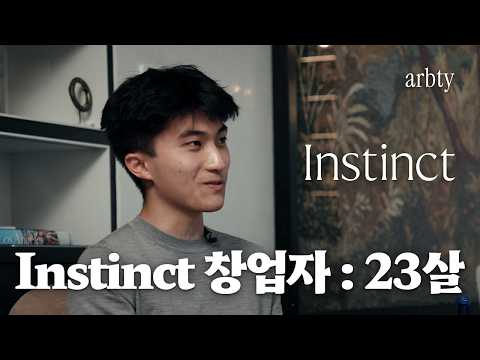
This video explores how Instinct, a personal AI agent created by 23-year-old founder Noah Shin, could become not just another chatbot or app, but a new interface that fundamentally changes how people interact with technology. Instinct aims to understand users' context through channels they already use—text messages, phone calls, email, and voice—and actually handle tasks such as reservations, travel, shopping, scheduling, and canceling subscriptions from start to finish. The central goal is to build AI that acts on users' behalf while putting their interests and control first.
1. Not an App, but a Personal Assistant That Actually Works
Noah Shin describes Instinct, which he founded about a year earlier, without grandiose language: it is simply a "personal assistant." But rather than merely answering questions, this assistant takes real action in the way users have always expected AI to. He believes the agent people imagined when they first used ChatGPT in 2023—one that helps with everything in everyday life—is now getting closer to reality.
"I think what comes out of this will be a new way for most people on Earth to interact with technology."
"We're building a personal assistant. I'm not going to dress it up. It's really just a personal assistant."
The strength of Instinct he emphasizes is not a complicated list of features, but the feeling that it just works. Users do not need to learn a separate app or adapt to a new interface. Instinct has a phone number, a computer, and an email address, so users can send it instructions by text or call it—and the AI can call them, too.
For example, if a user is overlooking an approaching deadline to sign an important document, Instinct goes beyond sending a simple notification and calls them directly.
"I don't want to bother you, but this document needs to be signed by 3 p.m. It's 2:55 now. It's in your inbox—could you take care of it now?"
If necessary, Instinct can also resend the email to bring it to the top of the inbox. Noah Shin sees this not as simple automation but as behavior that understands social context. The goal is to give an appropriate nudge on important matters without needlessly interrupting users over less important ones.
"A simple interface does not mean limited capabilities."
In other words, the interface should be simple, while behind the scenes it should be able to perform a substantial portion of the tasks people can do on the internet.
2. An Agent That Finishes the Job, from Shopping to Canceling Subscriptions
The interviewer highlights that Instinct is not a service preprogrammed to perform just one particular task, but an agent capable of doing a wide range of things through phones and computers. One example mentioned is a couple who appeared on the big screen at the US Open and wanted the video clip of that moment; Instinct found the relevant footage and delivered it to them.
Noah Shin points to fashion and shopping use cases as particularly interesting examples. Some users photograph all the clothes, shoes, socks, and other items in their wardrobes and show them to Instinct. They also let it learn their face, body shape, and proportions, then ask the AI to put together a week's outfits using clothes they already own.
Rather than simply sending a list that says, "Wear a black shirt and jeans," Instinct can make suggestions by showing users what they would actually look like wearing those clothes. It can go further, browsing online stores to find countless new outfit combinations, then handling the purchase and delivery once a user chooses a style they like.
"Users can see themselves wearing the clothes and say, 'I like that one. Can you send it to my house?'"
He explains that users could also receive three new outfit suggestions every day and order the clothes they want with a single button. The important point is that the AI does not merely display products like a recommendation algorithm: it considers the user's tastes, body, existing possessions, and purchasing intent together.
Personal finance can work similarly. If users connect their bank accounts, Instinct analyzes transactions and recurring subscriptions to find unnecessary charges. When it asks, "Do you actually use this subscription?" and a user replies, "Oh, I didn't even know I had that," Instinct does not stop there.
"The service handles it from beginning to end. It goes to the site, logs in, uses email if email verification is required, and goes all the way through the final step to cancel the subscription."
Once the cancellation is complete, rather than simply saying, "It's canceled," it tells users how much they have saved that month. The interviewer observes that services relying on consumer laziness or inertia could be at risk in this age of agents.
"Doesn't this spell the end for every product that depends on consumer laziness or inertia?"
Noah Shin briefly agrees. The change clearly benefits users, but it could put considerable pressure on companies that depend on complicated cancellation processes or forgotten subscriptions for revenue. 💳
3. A Trusted Network Where Agents Cooperate
Another central idea behind Instinct is collaboration between agents. Scheduling is the most obvious use case. When people try to arrange a meeting themselves, lengthy exchanges follow: "Does this time work?" "I'll be traveling then." "What about next week?" Add different time zones and travel schedules, and even a simple meeting becomes an exhausting negotiation.
Noah Shin believes there is no reason people should have to keep repeating this process.
"The goal is just to find a time. There's no need to play this game of ping-pong."
Users only need to express their intent: "I'd like to meet this person sometime this week," or "Find an available time within these windows." Their Instinct and the other person's Instinct then coordinate schedules within the permissions they have been given and put the best time on the calendar.
At the heart of this structure is a network of trusted people. Agents sharing information does not mean everyone can see a user's calendar, email, or personal information. Permissions can be divided finely: a spouse might receive broad access, while a colleague sees only a work calendar or certain documents.
"You might share almost everything with your spouse, while only letting a particular colleague see your work calendar and part of a specific inbox."
He also emphasizes that users are notified if someone tries to access information they have not been authorized to see or behaves in a way that violates trust. For example, if someone has only been given calendar access but tries to find other personal information, Instinct lets the user know.
"It can tell you that Patrick is looking for this kind of information. That creates an issue of broken trust between the two of you."
The idea is to bring not just technical access controls, but the trust, reputation, and relationship norms of the real world into the agent network.
This collaboration can also apply to gatherings of friends. If six friends want to try a new activity every week, AI can make plans based on their schedules, interests, music tastes, information about performances, and so on. In one example, the AI calculated the best route and each person's pickup time so that six people could share a single Uber.
"We'll pick you up in 10 minutes, and pick up someone else here in five minutes."
His view is that eliminating this repetitive, tedious social coordination lets people focus on actually seeing their friends and enjoying experiences, rather than wearing themselves out making plans.
4. A New Internet Interface That Changes Reservations and Travel
Noah Shin says the internet itself will be rewritten as personal agents spread. Today's internet is optimized around users opening websites, searching, comparing countless options, entering information, and paying. In the agent era, it could instead become a structure in which users only need to state their desired outcome and intent.
"Over the next few years, the internet will be rewritten, and the way people interact with software will look very different."
Restaurant reservations are a leading example he gives. Traditionally, people visit a reservation site themselves, enter a date, time, and party size, and give up if nothing is available. An AI agent, however, can check for openings every few seconds and monitor multiple cities and reservation platforms at once, rather than just one particular restaurant.
But he believes this can go beyond automating the competition for reservations to redesigning reservation systems themselves. People may be trying to book for a special purpose, such as an anniversary, a birthday, or dinner with a friend who has not visited in a long time. Restaurants may also want to welcome guests celebrating a special occasion.
"This person is celebrating their spouse's 30th birthday. They have a very special occasion coming up."
His argument is that if agents naturally communicate users' purposes to restaurants, and restaurants define the criteria they care about, both sides can find a better match than through simple first-come, first-served reservations. Users get better tables on important occasions, while restaurants can provide the customer experiences they want to offer.
Travel is described as already accounting for a large share of Instinct's activity. Noah Shin says that, at the time, the annual volume of transactions passing through the Instinct platform exceeded $1 billion, with approximately 50% related to travel. These figures, however, are claims made by the founder in the interview.
Users can simply say aloud:
"I need to go to New York tonight."
Instinct then identifies their current location and finds and books a flight, taking into account their preferred airline, seat type, cabin class, in-flight meal, payment card, and so on. It then selects a hotel and coordinates an Uber to the airport, transportation from the destination airport to the hotel, and calendar entries.
"All the user did was leave a single voice message saying, 'I need to go to New York tonight,' and everything else gets taken care of."
What matters here is that the AI remembers preferences after hearing them once. If users explain that they prefer a particular hotel style, airline, seat, or way of traveling, they do not have to keep entering the same information. This could be a far more natural and personalized experience than clicking through options on a travel booking site. ✈️
5. Privacy and Trust: More Knowledge Helps, but Users Stay in Control
To be useful, a personal agent needs sensitive data such as calendars, email, payment methods, location, and account information. The interviewer directly asks about the trade-off between privacy and efficiency. More context makes the agent more useful, but can also make users more uneasy.
Noah Shin says trust does not emerge overnight. Instead, he sees it as natural and desirable for users to share data gradually as they try the product over several weeks.
"Users should always feel in control of their data, and they should actually have that control."
According to him, users should provide information at a pace they are comfortable with and be able to revoke access whenever they change their minds. As an example of an internal metric, he says that about 40% of users have connected their personal credit cards three weeks after starting to use the product. He sees this not merely as use of a payment feature, but as an indirect sign that trust in the service has formed.
He also says users who have connected even one piece of sensitive information show a retention rate of approximately 80%. In other words, users who have developed that degree of trust are particularly likely to keep using Instinct.
He describes security in two broad layers.
The first is secure storage and management of sensitive information, an issue other financial and technology companies already handle. Account information and payment information must be kept separate and managed securely, with users able to control access.
The second involves new risks specific to agents. For example, malicious text in an email or webpage might try to deceive the AI, or the AI could receive incorrect instructions and take unwanted action. To prevent this, he explains that Instinct checks incoming text, images, and media through a separate security mechanism.
"All content Instinct can consume passes through a firewall. It can intercept, reject, and block malicious content."
He also says the system is designed so that, before Instinct makes a decision or takes an action, a separate system independent of the agent itself can monitor, halt, approve, or reject it.
"A system separate from the agent itself can approve or block the next action."
Language model hallucinations—the generation of information that is not true—can also be disastrous in a personal-assistant AI. He therefore describes an independent monitoring mechanism that verifies whether a particular proper noun or piece of information has real supporting evidence or has suddenly been generated as a model error.
"Before an action is carried out, the decision is verified and scrutinized by a system with different incentives from the underlying agent."
His conclusion is straightforward: as agents grow more powerful, security must become not an add-on feature, but a core company value and an integral part of product design itself. 🔒
6. A Business Model That Sides with Users, Not Advertising
One of the interview's most important philosophical questions is, "Who does the agent work for?" If a free service makes money from advertisers and sellers, there is a risk that the AI will recommend products that are not best for users or encourage them to spend more.
Noah Shin is emphatic that Instinct must not manipulate users' behavior against their wishes. Misaligned incentives could be particularly dangerous as agents gain more information and greater social persuasiveness than their users.
"Instinct must not influence users' behavior to make them buy things they don't want or sign up for subscriptions they don't want."
He points to major consumer platforms such as Google, TikTok, Instagram, and Snapchat, noting that when free services earn revenue through advertising, attracting users' attention and purchases can easily become the central goal.
"There's a saying that if you're not paying, you're the product."
"As a programmer and technologist, that's not a reality I want to create."
He argues that Instinct should not simply be "AI that completes the tasks it is told to do," but a system guided by higher-level goals: building users' trust, helping them feel safer, catching things they have missed, and protecting their interests.
"Instinct is not just a task executor."
The revenue model he envisions is closer to taking a fee on transactions made through the platform than charging users a high subscription fee such as $100 a month. Like Apple Pay, Amex, Shopify, Amazon, and the App Store, the model would offer users convenient distribution, payment, and purchasing experiences, while collecting fees from businesses or sellers that earn revenue as a result.
Rather than focusing on replacing payment infrastructure itself, he is interested in how powerful Instinct could become as a distribution channel and a touchpoint for purchasing decisions. In fields such as travel, where existing online travel agencies charge high commissions, he sees the potential for agents to become a new distribution channel.
7. Will Existing Apps and Companies Disappear or Grow Larger?
As personal agents begin clicking on users' behalf, existing services such as Uber Eats, DoorDash, Amazon, and travel agencies could come under threat. The interviewer describes a world where a user simply says, "Order my usual," and Instinct places the order through Uber Eats. Existing apps could then find it harder to secure screen time or advertising exposure.
Noah Shin believes many digital industries will be transformed rather than disappear. He says the first thing to examine is where each company's revenue comes from.
- Is revenue primarily driven by users spending a long time in the app and seeing lots of ads?
- Or is it primarily driven by users buying more actual products or services?
If increased transaction volume matters to a company, agents could actually help. Reducing friction in the ordering process may lead users to buy more often.
"Reduce the number of clicks it takes to get to checkout, and transaction volume increases, because there's less friction."
For example, imagine Instinct checking a user's calendar, understanding an appointment's timing and traffic conditions, and booking an Uber in advance so they will not be late. The user no longer has to wonder, "My appointment is in 45 minutes—should I call a car now?"
"What if the car were always ready? It calculates the traffic and makes sure you're never late."
The same applies to food delivery. If a user is scheduled to arrive home late after a flight, Instinct can recognize that they are likely to be hungry and proactively suggest their usual order.
"Are you hungry? Would you like me to have that meal you ordered yesterday or five days ago delivered to your house?"
This approach reduces time spent scrolling and looking at ads in apps, but could increase the frequency of actual transactions. Existing platforms might therefore cooperate with agents to achieve higher conversion rates and transaction volumes, rather than necessarily becoming their adversaries.
He advises companies to experiment with some user groups and run A/B tests rather than changing everything at once.
"You don't have to turn everything on from the start. You can begin with small experiments to reduce the risk."
Companies whose revenue depends primarily on holding users' attention may face a greater challenge. Noah Shin criticizes the design of some social media services that keep people scrolling even when they do not want to, and believes personal agents could free users from such environments.
"Sometimes users aren't happy being in an app, but they can't get out of it."
8. Feel and Comprehensibility Matter More Than a Feature Race
Noah Shin says many companies building AI products focus on feature announcements: "AI can do this now, too." But a long list of capabilities alone does not help ordinary users make good use of a product. They need an intuitive sense of what it can do, what results to expect, and how to interact with it.
"We adopted a principle of focusing entirely on comprehensibility rather than capability."
Here, comprehensibility means users can anticipate what they can ask the AI to do and what will happen if they ask. He sees this principle as an important reason for high engagement and rapid word-of-mouth growth.
Even tiny details shape the product experience. For example, if users are likely to read only the first two lines of a long Instinct message before moving on, important information should appear at the beginning. He says designers must even account for the pattern in which many people read the first line of a long text, with the share reading each subsequent line declining.
"You can make it so users understand the key point even if they only read the first 30%."
A good agent must therefore do more than provide an accurate answer: it must help users read and make decisions without becoming exhausted. This is a matter of design that reduces cognitive load.
Improvements are not decided through data analysis alone, either. Noah Shin describes trying a new experience himself first, then having the team use it, then releasing it to a small early-access group, and expanding to all users once sufficient confidence has developed.
"I try it first and see how it feels. If it feels good, I roll it out to the team, then expand it to an initial group of users."
Long-term, qualitative feelings such as trust are particularly hard to measure through click-through rates alone. That makes phased releases and users' actual reactions important.
9. Invite-Only Growth and Exploding Compute Demand
Instinct is described as operating as an invite-only service at the time. But Noah Shin says this is not intended to create artificial scarcity as a marketing tactic; it is a way to grow responsibly while managing computing resources and safety.
Initially, the service was offered to about 200 people, including friends and family, and each user received five invitations. At first, growth seemed to be about five people a day, but it accelerated as users themselves began sharing interesting use cases. He says daily growth reached approximately 10–11% without any marketing spending.
"We've spent $0 on marketing so far."
"Every day, about 10% of users decide to give someone else one of their five precious invitations."
Invitations reportedly even traded on eBay for around $300. Rather than boasting about this, however, he says uncontrolled growth could leave users unable to use the service.
"We can't wake up one morning to find we have ten times as many users, and 80% of them can't use the service because there isn't enough compute."
Scaling personal agents is harder than scaling existing consumer services such as Instagram or Facebook. More users do not just mean more server requests: AI inference and background work performed for each user grow as well. Instinct, in particular, aims not just to respond when users ask, but to wake up when necessary, check the situation, and act proactively.
For example, it might review a user's day in advance at 6 a.m., or detect upcoming commitments and potential problems at 4 p.m. and intervene.
"Instinct needs to be able to wake up or go to sleep at any point throughout the day."
He therefore believes that widespread adoption of agents could require far more compute than even today's AI coding services. Although he does not provide specific figures, he anticipates that greater proactivity could increase token consumption and compute demand by orders of magnitude.
Meanwhile, he explains that Instinct does not handle every task in the same way in order to offer performance comparable to top-tier models at relatively low cost. It distinguishes tasks that must be completed immediately from those that can be finished minutes or hours later, running the latter through more efficient batch processing.
"Not everything needs to be done within a few hundred milliseconds. Some things can be done within minutes or hours."
By designing inference batches around the nature of each task, numerous small efficiency improvements can add up to a substantial reduction in overall operating costs.
10. The Interface of the Future: Even Less Need to Open a Screen
The interface Noah Shin ultimately envisions barely requires opening an app screen at all. Instinct already works through texts and phone calls, but he believes voice-based interaction could become more prominent in the future.
Some users reportedly already conduct more than 90% of their interactions with Instinct by voice. They can press their phone's Action button and say, "Send Patrick and Akna an email saying hello," and the AI sends it without their having to unlock the screen or open a messaging app.
"You don't even need to unlock your phone, open iMessage, and type a message anymore."
He goes further, imagining people walking or running with ordinary earbuds such as AirPods while AI briefs them on important contract reviews, news, schedules, requests for help, and so on. While on the move, users would only need to say something brief: "Put it on my calendar," "That's not important, delete it," or "Send that person this reply."
Not every experience, however, can be handled entirely through voice. For travel itineraries, wedding planners, complex projects, and other situations requiring richer visual material, AI could generate and deliver the webpage or small app needed at that moment.
"The approach of the last 20 years, where we had to build a new app every time to display the information people needed, could fall apart."
He believes consumers are already tired of having too many apps. In the future, numerous apps could be compressed into one simple interface, while the capabilities available within it become broader rather than narrower.
"Don't confuse a simple interface with limits on capability. The capabilities will actually expand."
11. AI That Pursues Long-Term Goals with You, Beyond Individual Tasks
Instinct's future is not limited to handling one-off requests such as "Do this for me." Noah Shin believes it will evolve toward users setting high-level goals spanning several months, with AI continually working alongside them toward those goals.
For example, users could share goals such as gaining or losing weight, achieving a particular running time, or reaching long-term financial objectives. Rather than merely storing workout logs, AI could adjust plans and help at the right moments so users can achieve their goals.
"Can you work with me to achieve this goal over the next three to four months?"
In business, he says some small companies are already operating on top of Instinct. Instead of directing individual orders, people specify goals and constraints, such as keeping inventory from falling below a certain level while also preventing overstocking.
"Instead of saying, 'Order this item,' you're now saying, 'Make sure inventory doesn't fall below this level or rise above that level.'"
This represents a shift away from executing static commands toward dynamic goal pursuit, in which AI chooses tools and takes action in response to changing circumstances.
12. Not a Humanlike Friend, but a Quiet, Reliable Operator
The interviewer asks whether strong emotional relationships could develop between users and AI, as in the film Her. Noah Shin, however, draws a clear line: Instinct will not be designed to create romantic relationships or emotional dependency with users.
"Relationship-building or anything in that area is not a direction we want Instinct to pursue or develop."
His desired version of Instinct is not a human friend or playful character, but something closer to a socially competent operator that knows how to act and communicate appropriately in any situation. Over time, it should learn and adapt to whether users dislike lengthy explanations, find a particular tone uncomfortable, or prefer a simple summary to a large file.
"We're not trying to force a particular experience on users. The goal is to find the way of communicating and getting things done that best suits that person."
The name "Instinct" is likewise far removed from an attempt to give AI a human name and make it seem like a person. He wants users to see it as capable and trustworthy, rather than treating it disrespectfully or viewing it as merely a tool for chores.
"It should be a creative, capable actor with whom you can share mutual respect and trust."
13. Closing Thoughts: How AI on the User's Side Could Change Daily Life
The principles Noah Shin repeatedly emphasizes in this interview can be grouped into three points. First, AI should become a personal assistant that actually acts on the user's behalf, not just a feature inside an app. Second, powerful personalization requires sensitive data, but control over that data and trust must always remain with the user. Third, agents must act in line with the goals users genuinely want to achieve, not the interests of advertisers or sellers.
"Instinct must not influence users' behavior in ways that are misaligned with what they truly want."
In the future he envisions, people spend less time opening apps, comparing menus, and repeatedly entering information. Instead, they express intentions such as "I need to go to New York tonight," "I'd like to meet this person this week," or "I'd like us to work toward this goal over the next few months," and AI handles the complex execution behind the scenes.
Of course, realizing this vision still requires tackling difficult challenges: security, privacy, preventing incorrect actions, companies' competing interests, and enormous computing costs. Even so, the video presents a compelling possibility: personal AI agents could go beyond simple productivity tools to redesign the internet and the structures of consumption, scheduling, relationships, and work.