Korea's Accelerator Industry Could Produce Its Own OpenAI Success Story 🚀
1. Company Builders: A New Turning Point for Korea's Startup Ecosystem
-
What is a company builder? A company builder doesn't merely invest in startups — it provides hands-on support from the very earliest stages, including idea development, business formation, seed capital, and specialized talent.
- The textbook example is Y Combinator, the world's largest accelerator, which discovered and nurtured OpenAI.
- Also known as a venture studio, this model differs from conventional investing in that the builder participates directly in management and secures a high equity stake (at least 10%).
-
Why do we need company builders now? As the venture investment winter drags on, more and more early-stage startups are collapsing before they can gain traction due to funding shortfalls.
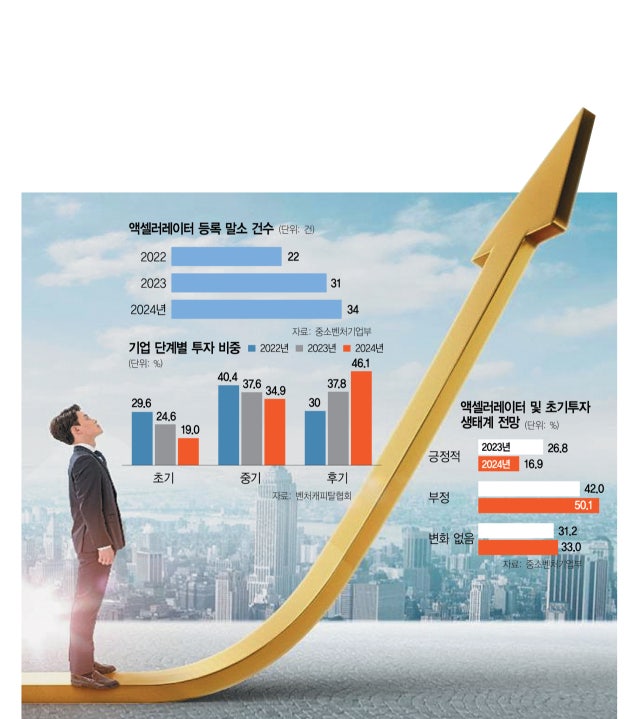
- Early-stage startup investment as a share of total VC activity stood at 24.7% in January of last year, but plunged to 10.4% by January of this year.
- Late-stage investment, meanwhile, rose from 35.6% to 54.1% over the same period.
- This environment has made a new investment model to improve early-stage survival rates urgently necessary.
2. Government Deregulation: Allowing Company Builder Formation
-
Proposed amendment to the Venture Investment Promotion Act The Ministry of SMEs and Startups is pursuing a revision of the enforcement decree of the Venture Investment Promotion Act to permit the formation of company builders.
- Under current law, startup incubators (accelerators) are restricted from making management-control investments.
- The revision would relax this, allowing management-control investments even in companies the accelerator did not directly incubate.
- If enacted, more than ten accelerators are expected to explore setting up company builders.
-
Industry expectations One industry insider put it this way:
"Because management-control investments were strictly limited to companies directly incubated by the accelerator, there was a strong perception in Korea that company builders were effectively illegal." "If the regulations are eased, we can expect a surge in technology-based startups and a positive feedback loop throughout the ecosystem."
3. Advantages of Company Builders: Faster Growth and Higher Survival Rates
-
Potential for faster growth Company builders can dramatically shorten the time it takes startups to scale compared with conventional investment.
- According to the GSSN Data Report 2022, company builder alumni reach Series A 41% faster than typical startups, and the time to IPO is 31% shorter.
- This is possible because accelerators directly inject capital and specialized personnel.
-
Strengthening global competitiveness Jeon Hwa-seong, chairman of the Korea Accelerator Association, emphasized:
"Y Combinator — the world's largest accelerator — discovered OpenAI, the developer of ChatGPT, through its venture studio program." "Regulatory relief was urgently needed so that domestic accelerators could operate as company builders and compete on the global stage."
4. Current Crisis and Challenges Facing Korea's Accelerator Industry
-
Management crisis among accelerators According to the Ministry of SMEs and Startups, the number of accelerator license cancellations last year hit 34 — a record high.
- Notably, 12 of the cancelled accelerators were newly licensed firms that had obtained their licenses in 2022–2023.
- This illustrates that the accelerators responsible for early-stage investment and incubation are experiencing an unprecedented management crisis.
-
Need to ease mandatory early-stage investment ratio rules Industry players argue that regulations around the mandatory early-stage investment ratio must also be relaxed in order to improve startup survival rates.
- Currently, individual investment partnerships formed by accelerators could only invest in companies less than three years old, but last October this was expanded to less than five years old.
- However, a condition still applies — "further investment is not permitted in companies that have already received investment" — creating constraints on follow-on investment.
- One industry insider explained:
"You might make an initial investment in a startup in its second year, then find yourself needing to make an additional investment in its fourth year. But if even one investment has already occurred, follow-on investment becomes impossible."
5. Expected Impact: The Possibility of a Korean OpenAI Being Born
-
Revitalization of technology-based entrepreneurship The head of an accelerator in Daejeon said:
"Daejeon has more than 30,000 master's and doctoral-level researchers, yet the entrepreneurship rate remains very low." "If company builders multiply, technology-based startups will flourish and we can expect a virtuous cycle."
-
The birth of a Korean OpenAI There is growing hope that, if regulations are eased and company builders take hold, a success story on the scale of OpenAI will become possible in Korea as well.
- This could go beyond simply energizing the startup ecosystem, ultimately giving rise to globally competitive, innovative companies. 🌟
💡 Key Terms
- Company builder: A model in which the builder directly participates in management while supporting early-stage companies with idea development, capital, and specialized talent.
- Venture Investment Promotion Act amendment: Pursuit of relaxed restrictions on management-control investments.
- Y Combinator & OpenAI: A global accelerator and its landmark success story.
- Decline in early-stage startup investment: Sharp drop from 24.7% to 10.4%.
- Accelerator crisis: Record high number of license cancellations (34 cases).
- Revitalization of technology-based entrepreneurship: Virtuous cycle effects expected from deregulation.
The day when a "Korean OpenAI" is born may not be far off! 😊