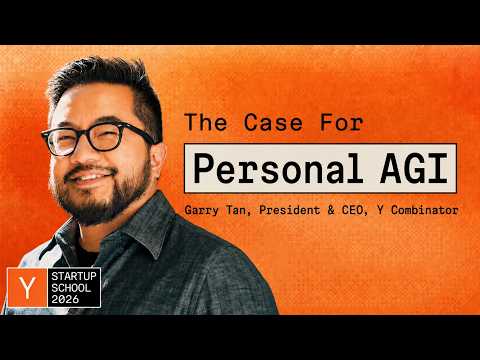
Beginning with the life of Spinoza, Garry Tan argues that AGI is not a divine entity that will suddenly appear one day in a giant data center. It has already begun to arrive inside individuals' context, memory, and working procedures. His central message is that we should not stop at temporarily subscribing to powerful AI models. We should build Personal AGI that accumulates our own knowledge and judgment, allowing us to "own" rather than merely "rent" intelligence. He recommends assembling markdown files, a personal knowledge library, skill files that perform recurring work, and infrastructure under our own control.
1. What Founders Can Learn from Spinoza
Garry Tan opens with a joke that people on the internet call him "one of the most AI-pilled people alive," then turns to the philosopher Baruch Spinoza, one of the most thoroughly "canceled" figures in history. He sees Spinoza not merely as a philosopher, but as a founder-like figure who refused to surrender his thought or his tools under pressure and isolation.
In 1929, a New York rabbi sent Einstein a telegram asking, "Do you believe in God? Answer in 50 words or fewer." Einstein replied that he believed in Spinoza's God. This was not a being that intervened in every human fate and action, but one revealed through the order and harmony permeating the world.
"I believe in Spinoza's God, who reveals himself in the lawful harmony of the world, not in a God who concerns himself with the fate and the doings of mankind."
Spinoza's own community, however, did not accept him. In 1656, at the age of 23, he was excommunicated from Amsterdam's Sephardic Jewish community. The decree called for him to be cursed by day and night and prohibited anyone from speaking with him, doing business with him, or reading his writing. Even among roughly 40 similar excommunications at the time, his uniquely contained no provision allowing him to return after repentance. Formally, it has never been lifted.
"Cursed be he by day and cursed be he by night; cursed be he when he lies down and cursed be he when he rises."
Spinoza had committed no violence or crime. He had voiced ideas the community prohibited. For holding "evil opinions," he was effectively deleted from his social world.
More strikingly, the community tried persuasion first. They offered him 1,000 guilders a year if he would occasionally attend the synagogue and remain silent. Tan translates the offer into the language of founders: "We'll pay you a salary if you stop building." Spinoza refused. He wanted truth more than comfort.
"In effect, they offered him, 'We'll pay you a salary if you stop building.' He refused."
Around that time, a fanatic attacked him with a knife. The blade tore his cloak, but Spinoza survived. He kept the torn cloak without mending it for the rest of his life, as a reminder of the cost of carrying an idea forward.
Spinoza later spent his days grinding lenses and building precision optical instruments. His lenses were good enough to be sought by leading scientists across Europe, tools that allowed human eyes to see what had previously been inaccessible. At night, he wrote books too dangerous to publish while he lived. His lungs damaged by glass dust from lensmaking, he died at 44, leaving instructions to send the desk containing his manuscripts to a publisher. His posthumous works attracted attention across Europe and profoundly influenced Enlightenment philosophy.
Tan makes the point explicit. A person rejected by everyone, offered money for silence, and nearly killed for his work still made precision tools during the day and wrote dangerous books at night.
"Without anyone's permission, alone, he made precision instruments by day and wrote the most dangerous book in Europe by night."
Spinoza called the force that sustained such a life conatus. It is not a résumé, title, or job, but the impulse in every living thing to survive, increase its power to act, and keep moving forward: a drive toward self-preservation and expansion. Tan says his entire talk is about tools that amplify this conatus.
2. AGI Will Arrive as Personal Infrastructure, Not an Event
Spinoza did not see God as a personal ruler on a throne, but as a presence distributed throughout nature. Tan says people make a similar mistake about intelligence today. Everyone waits for AGI to be announced one day as a giant event, a "God in the data center."
"Everyone is looking at the sky. But the thing they're waiting for is already in this room."
The AGI he describes is not one event descending from above. It is already spreading in the form of terminal windows, markdown folders, work that runs itself, and agents that read and act on our own context. AGI is not emerging after crossing one threshold; it is arriving as infrastructure distributed through a user's life and work.
Tan calls it Personal AGI: not general intelligence delivered to everyone simultaneously, but general intelligence operating for one particular person.
"Personal AGI is not artificial intelligence for everyone. It is general intelligence for one person: you."
He connects this idea to Vannevar Bush's dream of the Memex, a machine that would extend the human brain and the self. Tan's personal AI, however, is not a $20-a-month chatbot, slightly improved autocomplete, or an assistant that knows only your calendar. Those are services supplied by a company. Users do not "own" them; they subscribe to and rent them.
He describes the limitation of corporate AI this way:
"It resets when you close the tab. It knows only what everyone knows, and when the company pivots, your assistant gets lobotomized on someone else's schedule."
Personal AGI, by contrast:
- Runs on your own infrastructure.
- Reads a personal memory and knowledge store you own.
- Performs procedures and skills you authored and improved.
- Accumulates understanding of your life and work, becoming better with continued use.
Corporate AI improves when the service company ships a new feature. Personal AGI improves every day as the user contributes knowledge, judgment, and work experience. One is a product you consume; the other is an asset whose value compounds over time.
"One is a product you consume. The other is an asset you build."
Tan emphasizes that intelligence should be owned, not rented. If individuals have a structure that lets them control their own intelligence, the AI era may avoid becoming a dystopia of surveillance and control.
"This kind of intelligence should not be rented. You should own it."
3. How AI Agents Change One Person's Productivity
Tan believes Personal AGI is possible today because of agents' ability to execute. Coding agents in particular are visibly changing the limits of human productivity.
He recalls working as a YC partner in 2013 and building the internal social network Bookface at night. At the time, he shipped about 14 useful lines of code per day, roughly the median reported in programmer-productivity research. Today, even while running YC full time and needing to pick up his child at 5 p.m., he calculates that he produces about 400 times more output.
He acknowledges the problems with measuring productivity by lines of code. Agents can generate verbose, unnecessary code, and his own estimate may be inflated. Yet even under the strictest conservative assumptions, he still finds at least an 8x increase, and considerably more under ordinary assumptions.
"No matter how much you torture the number, it remains large."
The change extends beyond coding to nearly all knowledge work, including design, product management, growth, and research. Tan cites an internal YC observation: in the Winter 2025 batch, roughly one quarter of the companies had codebases that were 95% AI-generated. Those companies use agents across many functions, not only code, and appear likely to become a fast-growing, highly profitable batch.
Tan does not assert that AI directly caused the growth; he explicitly refuses to confuse correlation with causation. His observation is that the fastest-growing founders do not treat AI as autocomplete. They treat it as a workforce, or even an entire organization.
"The fastest-growing founders don't treat AI like autocomplete. They treat it like labor."
Using the same Claude model, weights, API, and context window, one person may get 2x leverage while another gets 100x. The difference lies not in the model itself, but in the quality and relevance of the context supplied to the agent and the stage at which it is provided.
Borrowing Spinoza's definition, joy is the feeling of an increase in one's power to act. When an agent completes a week's work in an afternoon, the feeling is not mere convenience. It is joy because the person's real capacity for action has expanded.
"When an agent does a week's worth of your work in one afternoon, it doesn't feel like convenience. It feels like joy."
Sadness, conversely, is the feeling that one's power to act has diminished. The helplessness some people feel on Sunday night—as if their ability to affect the world were disappearing—may be a sense that their conatus has weakened. Tan believes AI can either make individuals more powerless or greatly expand their ability to act.
He offers this equation for the next decade:
Rentable frontier model + context unique to me + a harness connecting the two = an extension of me that acts quickly
The model becomes a commodity available to everyone and cheaper over time. The user's experience, relationships, judgment, and history of work remain unique assets. Connect them through a harness such as OpenClaw, Hermes Agent, Claude Code, or Codex, and the result is not a simple chatbot but "another me" that works with extraordinary speed.
"You rent the quality of the model, but you own your brain."
Paul Graham's familiar advice—"Make something people want" and "Do things that don't scale"—still applies. What has changed is that agents now allow one founder to do unscalable work at scale.
4. The Library of a Life and a Personal Knowledge System
Tan says that if Spinoza built lenses that extended human sight, we can now build lenses for the mind. Describing his own personal AI system, he identifies the main problem as the limit of human working memory.
Humans can hold roughly seven items in mind at once, the familiar "7±2" limit. It relates to the historical length of telephone numbers and why the eighth item on a shopping list is easy to forget. Checklists, organization charts, filing cabinets, and stand-up meetings are all institutions humans built to compensate for this cognitive limit.
An AI agent can handle about one million tokens at once, roughly a thousand pages. Tan compares it with laying three Harry Potter books open simultaneously, instantly finding a needle of information inside them, and synthesizing the result.
"Three Harry Potter books versus a human's seven digits."
A thousand pages sounds like a lot, but one person's entire life is not three books. It is a library: every email, meeting, decision and its rationale, relationship, past conversation, failure, and lesson.
The central question becomes, "Which three books should be open on the desk right now?" Selecting them is a critical function of the brain. Tan defines his GBrain as "library + librarian."
"The question that separates a genius agent from a goldfish is this: Who, or what, decides which three books should be open now?"
His GBrain runs on a personal OpenClaw and contains a knowledge wiki of roughly 220,000 markdown pages. It is a 25-year journal of his life, including email, meetings, notes, photographs, drafts, and judgments that proved wrong. Agents organize, curate, and search much of it. What matters is not merely the volume of data, but accumulated experience that prevents him from answering a previously solved question from scratch.
When a founder sends an email describing a crisis, Tan's agent retrieves previous conversations with that founder, portfolio companies that faced similar problems, and the responses that actually worked—before he has even finished reading the message. The agent acts against the background of Tan's actual experience, not generic information.
"Whatever the agent does, it does knowing everything I know. That is the difference between an assistant and a colleague."
While he sleeps, the system does more than sort email: it processes it. It distinguishes urgent founder messages, sales mail, and mailing lists he never unsubscribed from. For important messages, it adds the history of the relationship and conversation, the real need beneath the surface wording, and why it matters to him. He wakes to a briefing, not a pile of messages.
Before a meeting, he receives a preparation document covering who he will meet, prior conversations, what changed afterward, and questions he should ask. A research topic that intrigued him at night is organized by morning. When something interesting happens in the world, it is read and connected to his interests before he has coffee. ☕️
5. The Role of Markdown Skills and Code
The foundation of Tan's system is surprisingly simple. His agent coding framework GStack has received significant attention, but its actual structure consists largely of skill files and a browser the agent can manipulate. He describes the architecture as "thick skills, thin harness."
"It's markdown, not magic."
A skill file is a markdown document explaining how the agent should perform a particular job. For example, when a meeting recording arrives, it might instruct the agent to transcribe by speaker, extract every commitment along with the responsible person and deadline, link every person mentioned to the personal library, and flag rather than overwrite anything that contradicts an existing belief.
"When a meeting recording arrives, transcribe it with speaker labels. Extract commitments, owners, and deadlines. Link every person mentioned to the library. If anything contradicts existing information, flag it instead of overwriting it."
That is a skill. It is a procedure a smart intern could read and follow, which Tan says is precisely the standard: if a smart intern can perform the work, an agent can execute it.
He repeats a deliberately provocative claim:
"Markdown is effectively code. If you can write clear instructions in English, you are a programmer. The compiler is the language model."
Programming is therefore no longer confined to engineers. At YC, people on media, events, and finance teams who previously almost never opened a terminal now create skill files and scheduled jobs. One finance employee consolidated about 100 Excel workbooks into a single app using an internal agent. Tan calls that person not a programmer, but an agent manager.
Not every calculation should be delegated to a language model, however. Tan says many agent systems fail because they confuse where computation should happen.
- Latent space is appropriate for interpreting ambiguous requests and work requiring taste and judgment—for example, reading a person's vague request and inferring what they want.
- Deterministic space is appropriate for arithmetic, SQL queries, large-scale seat assignments, and data processing that require correctness and reproducibility.
An agent can use judgment to seat five people at a table. To assign customized event schedules to 6,000 participants, it should use code and a database. The experience of people at this event was itself built on a structure where markdown files call code and databases.
"Models fail where humans fail. The solution is to make the model calculate the way humans do: combine latent judgment with deterministic computation."
Tan offers his preparation for the Spinoza talk as another example. Five days before the talk, he had an agent acquire and read three Spinoza biographies totaling about 1,500 pages. It produced a timeline, disagreements among biographers, quotations organized by chapter, and ten scenes suitable for telling onstage, complete with delivery notes.
"Fifteen hundred pages became a stage-ready story I could edit."
He calls this a compendium skill and uses it daily, considering it a deeper and more personally tailored form of research than the deep-research features of corporate AI products.
The beginning need not be grand. Tan's system did not start with 220,000 pages. It began with a few markdown files about companies he worked with and people he emailed frequently. A library is not built all at once. It grows a little every day as the agent organizes it.
"Nobody builds the warehouse first. You build one shelf."
6. Agent Organizations and the New Economics of Startups
Tan does not see sitting across from agents as merely coding. It is managing a workforce built from markdown. One skill file resembles one employee assigned one capability and one job. The resolver that decides which skill file handles incoming work resembles an organization chart.
"A skill file is an employee: one capability and one job, written clearly enough that a new person can execute it."
Even before incorporating a company or finding a co-founder, logo, or pitch deck, one person can operate an organization consisting of themselves and agents. The person is founder and executive; the headcount below them grows as far as they choose to design it.
Tan argues that this change is breaking conventional business economics. He gives YC examples: Emergent reached roughly $100 million in annual revenue within eight months of public launch, and when it passed $15 million in annualized revenue it had 15 people. Retail reached about $60 million in annualized revenue with a team of around 40. Tan says this level of revenue per employee was previously rare even in software, oil, or railroads.
He presents these outcomes not as miracles belonging to a few exceptional companies, but as companies designed from the beginning under new laws of physics. Each started with one or two people connecting agents in the manner described above.
"This is not the future. It is the standard expected in this batch now."
Software itself also becomes less "precious" in the AI era. A person can build a tool for private use in a weekend. Instead of "solving my own problem and hoping a market exists," the low cost of solving the problem makes it sensible simply to solve it. If other people then ask to borrow the tool, it can become a company.
"The cost of solving my own problem is now almost free, so I can simply solve it."
Personal knowledge systems come with an important warning. An unmanaged brain can become a landfill with excellent search. The agent may retrieve outdated facts in a voice of complete confidence, and a poorly written skill file can permanently automate a bad process.
The basic unit of Personal AGI is therefore not memory alone, but memory + hygiene. Every piece of information should have provenance. Conflicts between new and old information should be reviewed, and a "librarian" should remove unnecessary or obsolete records.
"Treat your brain like production infrastructure and it compounds. Treat it like a trash can and you get a confidently wrong agent in ways you can't even trace."
7. Five Steps for Building Personal AGI
To keep his talk from remaining only philosophy and examples, Tan offers five practical steps. Following them, he says, can put someone ahead of people who simply nod along and move on.
1. Run an Agent on Your Own Computer
First, choose a harness that suits you and run the agent in your own environment. Tan uses OpenClaw, Hermes Agent, and GBrain, but says tools such as Codex or Claude Code can meet most needs.
No single repository or product is the essence. The important concept is connecting your context to the model.
"The concept matters, not a particular repository or product."
2. Begin with a Small Library, Not a Giant Archive
Create a folder of markdown files over a weekend. Export your notes and, if possible, your email. Make one page for each active project and person you work with. Record what you are building together, what the other person cares about, what you owe them, and what was said in your last conversation.
No internet model possesses this information by default. It exists only in your mind, email, notes, and records. Tan says people already have five to ten years of personal history sitting somewhere in their inboxes.
"That is your moat. It is just sitting there, unindexed."
The turning point comes the first time the agent answers using your real context rather than generic internet knowledge.
3. Turn Your Most Hated Recurring Task into a Skill File
Choose one job you repeat every week and dislike most: expense reporting, meeting notes, weekly status reports, or competitor research. Explain the task to the agent in plain English or natural language as if you were describing it to a smart friend on their first day.
The agent may get it wrong at first. When it does, add rules and exceptions. Keep recording details such as "Oh, and do this too" in the file. The finished document becomes a reusable employee.
"Let it be wrong. Fix it when it's wrong. Add every rule, every exception, every 'Oh, and this too.'"
4. Connect It to a Recurring Schedule
Schedule the skill to run at a set time, such as 7 a.m. every day or every Friday. Waking up to work completed while you slept changes your perception of time.
"The first time you wake up to work completed while you slept, something in your head changes permanently."
From that point, a day is no longer the unit of work. The new unit is the scale of what you can imagine and want to create in the world.
5. Never Leave One-Off Work as a One-Off—Turn It into a Skill
The most important discipline is to never let something done once remain a one-time act. Many people ask an agent for something, close the window, and discard the context. Tan says that after every job, ask the agent to "skillify what we just did."
His skillify process extracts the workflow into a reusable markdown file, turning one solved problem into a permanent asset in the personal system.
"If you have to ask for something twice, you have failed."
People who record what they learn become smarter every day. Those who begin every morning having forgotten yesterday's work cannot fully exploit even dramatically better models.
Tan predicts the 90-day progression:
- Week 1: It may feel like a toy. The library is thin and the skills clumsy, so correcting them may take more time than they save.
- Week 4: The flywheel begins to turn. The agent starts answering from personal context, morning automation becomes worth reading, and the first successful skill encourages the creation of more.
- Week 12: You may have a library that prepares answers before you finish the question, several skills handling work you once hated, and one or two tools other people want to borrow. In YC terms, that can become a startup.
"The curve looks like every compounding curve: flat, flat, flat—and then suddenly it isn't."
Most people will quit in the second week. That is exactly why those who continue feel, by week 12, that their extraordinary advantage resembles cheating.
8. If You Do Not Own the Skills, Your Work Gets Extracted
Tan now enters the political and uncomfortable part of the talk. Spinoza's sadness—the feeling that one's power to act has diminished—can emerge when a person's professional judgment is extracted and owned elsewhere.
A skill file is not merely a document. It is a person's way of working and judging, pulled out of their head and made executable. The problem is that the same file creates completely different futures depending on who controls it.
He offers the fictional example of Maya, a support engineer. Over two years, Maya teaches 40 skills: triaging a P0 incident at 2 a.m., calming a customer about to churn, and writing a postmortem that prevents the next incident. Those files contain two years of Maya's accumulated judgment.
In the first scenario, the files are in Maya's personal repository. She can take them when she changes jobs and use years of accumulated judgment on her first day at a new company. The asset continues to grow. Tan calls this ownership. She can even build a company around the expertise; a collection of markdown files can now become a startup.
In the second scenario, the files sit in the company's repository under its IT policy. Maya leaves with nothing. The company continues executing her judgment without her, and the record may not even preserve her name.
"She did not build a career. She was extracted."
The person, skills, and files are identical. Control alone changes the outcome completely. Tan's principle is uncompromising:
"The skill files are yours. Own the skills, or your job becomes the skill file."
Craft workers of the past were free in part because they owned their tools. The factory system changed this by making productive equipment such as looms the property of the factory. Knowledge workers assumed they were safe because their tools and knowledge lived in their heads. In the AI era, cognitive ability can also be extracted, stored, versioned, and made into someone's asset. The question is no longer whether this is possible, but who owns it.
Tan compares the 1,000 guilders offered to Spinoza with comfortable employment today. Any comfortable arrangement in which your judgment and skills accumulate in someone else's repository may be a modern 1,000-guilder offer: "Come to work, remain quiet, and do not build your own thing."
In 1673, Spinoza was offered a professorship at Heidelberg University: salary, legitimacy, an academic title, and freedom to philosophize—provided he did not disturb the established religion. He refused, saying he could not know where the limit on that freedom lay.
"I do not know within what limits the freedom to philosophize should be confined."
Tan compares it to reading the terms of service and declining the acquisition. Spinoza wanted to act "under his own power," not under another's.
"Personal AGI is how you remain under your own power in the age of agents."
Tan therefore recommends storing your brain and skills in a repository you control from day one, before a platform or acquirer develops an opinion about them. Spinoza's locked desk drawer was his repository. A modern person's equivalent should be a personal repository containing their own knowledge and skills.
9. Better Models Make Personal Context More Valuable
Tan answers three predictable objections.
The first says models are improving so quickly that building a harness or personal system will soon become pointless. He responds that as models improve, differentiation moves toward context.
"When everyone's engine has 1,000 horsepower, the race is decided by the driver and the map."
Model weights and capabilities become available to everyone. A personal library remains uniquely yours. Better models extract more meaning from the same library, increasing rather than decreasing the value of the personal knowledge system. Every time an AI lab releases a new model, the agent workforce you own receives a free upgrade.
The second objection is, "Isn't this just RAG?" Tan agrees, but says retrieval is not the whole product. The core questions are what to record, how richly to connect it, what to maintain as immediately available "hot memory," what to keep as reference-only "cold memory," and who reconciles conflicting facts.
"Retrieval is easy. Becoming an entity worth retrieving is the product."
The third objection is the most important: what if a system containing an entire life—email, meeting records, even children's schedules—is breached? Tan's paradoxical answer is that the risk makes it even more important for the system to be yours.
His system runs on personal infrastructure, repositories, and keys. Privacy is not the default today. People's lives are already scattered across many clouds owned by companies whose interests may not align with their users. To Tan, consolidating context does not create a new risk; it means assuming custody and control over already dispersed data.
"I did not create risk by consolidating context. I took responsibility for its custody. Custody is the security model."
10. Open Source and Leverage for Everyone
Tan also explains why he open-sourced his harness, brain architecture, skills, and personal operating system. On a practical level, his position at YC means he does not need to monetize his personal infrastructure. More fundamentally, he believes the tools of powerful people should be public.
Every era has had leverage technologies available to a few and denied to many. For a long time it was literacy, and later it was capital. Today, he sees systems such as personal libraries, agent harnesses, and markdown workforces in that role. People who possess them already work quietly at a different scale from those who do not, and the gap grows every month.
"When powerful things remain private, you get a priesthood. When they are shared, you get a Renaissance."
He knows which world he wants to inhabit and presents his beliefs almost as a creed:
"Say what others don't say.
Invest in people others don't invest in.
Build what others don't build.
Write and share the code others neither write nor open.
Leave behind institutions others do not."
Building publicly brings mockery and attack. Tan says that when he explains that agents write most of his code, ridicule arrives before lunch. Yet when he looks at the critics' actual output, they too are usually using agents deeply.
"First they quote-tweet you and mock you. Then they clone you."
Tan suggests ridicule can be a signal that the adoption curve has begun. Like Leibniz, who publicly rejected Spinoza while privately obsessing over his ideas, people may resist powerful ideas and tools before ultimately absorbing them.
11. Personal AGI for One Child and the Founders of the Future
The talk's most emotional example is a father whose son has a rare form of epilepsy. Without a lab, funding, or permission, he acted directly. He created a repository containing 80,000 markdown files about his son's condition.
The system indexes and links specialist visits, research papers, seizure records, drug interactions, and other information specific to the condition. When a new doctor suggests a treatment, the father can determine within minutes whether it has been tried and what happened.
"One father, one laptop, one library. That is Personal AGI."
For Tan, Personal AGI is not a benchmark score or polished demo. It is a library-and-librarian system organized around one problem you love, opening the right materials at the right moment.
"Nobody was coming to build it for him, so he built it. And nobody is coming to build yours for you. That is the good news."
Tan says people once believed they needed a team, funding, permission, credentials, and experience because one person could hold only about seven things in mind and work only 16 hours a day. Those constraints have now been mechanically reduced.
"You can fly now—not metaphorically, but mechanically."
Problems for which you wanted but could not hire someone, records too large to read, data too complex to organize, and work dismissed as "too vast to attempt" can now be tried again.
"Now we can boil the ocean."
Tan ends with a sentence he treats as a principle of life:
"Everything is made up. But you can make it up."
Every institution was created by someone in the past. Even the institution that cursed Spinoza was not created by people smarter than today's audience. Previous generations of founders had to gather dozens of believers before they could build anything. Today, an individual can begin with a laptop and several years of personal history they have already accumulated.
Tan sees the roughly 7,000 people at the event as 7,000 individual instances of conatus—struggle and drive. Historically, most such struggles disappeared before reaching the world while waiting for money, labor, permission, or someone else's belief. Personal AGI can allow that drive to work directly without intermediaries.
"One person. No intermediary. No permission."
Spinoza ended the Ethics with nine words:
"All things excellent are as difficult as they are rare."
Tan believes AI agents and Personal AGI have broken down a significant portion of the difficulty. What remains is deciding what you will be rare enough to build and under whose power you will place your intelligence and judgment.
Conclusion
This talk is not merely advice to use more AI tools. It is closer to a declaration: Build a personal knowledge system containing your memory, relationships, judgment, and working methods, and control it yourself.
Personal AGI is not primarily about choosing the strongest model. It is about recording daily experience, preserving recurring work as skills, and allowing that accumulated intelligence to compound under your own repository and rules.