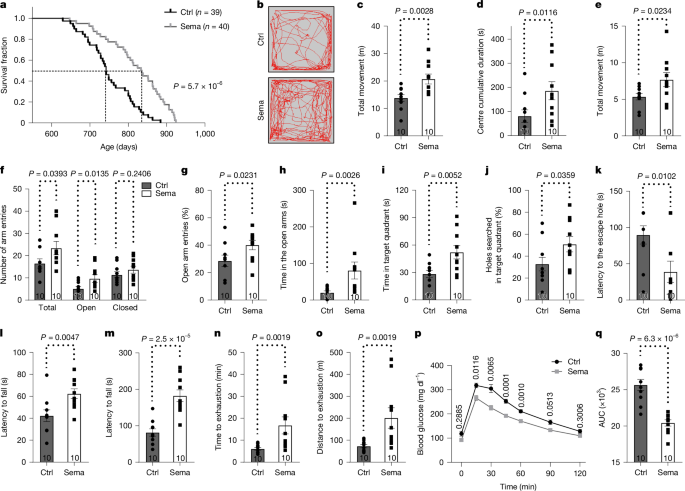
This study reports that giving semaglutide, a GLP-1 receptor agonist, to twenty-month-old female C57BL/6 mice reduced age-related functional decline and extended median lifespan from 742 to 834 days. Semaglutide reduced food intake by roughly 24 percent and produced molecular and physiological effects resembling calorie restriction, while outperforming calorie restriction in some measures, including memory and glucose control. This was, however, a preclinical study in one strain of female mice. It does not demonstrate human lifespan extension, which would require long-term trials in older people.
1. The Starting Question: Can a Drug Reproduce Calorie Restriction?
Calorie restriction, reducing energy intake without malnutrition, is known to slow ageing and extend lifespan in several animal species. It may also benefit a wide range of metabolic, neurodegenerative, oncological, and immune conditions. Sustaining it for long periods is difficult for people.
The researchers therefore sought a calorie-restriction mimetic capable of reproducing its benefits. Semaglutide mimics the action of GLP-1, a hormone secreted in the gut. It supports insulin secretion when glucose is high and suppresses appetite. It is already used to treat type 2 diabetes and obesity, with benefits observed in cardiovascular, kidney, and liver disease and some neurodegenerative conditions.
Their central hypothesis was:
"We hypothesized that GLP-1 drugs could mimic calorie restriction, slow ageing, and alleviate multiple age-related diseases."
The study focused not on preventive treatment in youth, but on whether treatment could still work when started in already-aged mice.
2. Late-Life Treatment and Lifespan Results
The researchers gave twenty-month-old female mice daily subcutaneous injections of either semaglutide or saline control. Twenty months represents advanced age in mice. In the lifespan experiment, treatment continued until death; separate groups used for physiological, molecular, and cellular analyses received it for three months.
Food intake fell by 24 percent in the semaglutide group. After adjustment for body weight, overall activity, oxygen consumption, carbon-dioxide production, and energy expenditure did not differ clearly. Weight loss was therefore not simply caused by greater movement or higher energy use.
Body weight declined, but mostly through loss of fat. Except for white adipose tissue, the relative weights of major tissues did not fall substantially. Fat represented a smaller share of total body weight while lean mass represented a larger share.
The most important lifespan results were:
- Control median lifespan: 742 days
- Semaglutide median lifespan: 834 days
- Extension of median lifespan: about 92 days, or roughly 12 percent
Deaths in several categories unrelated directly to tumors also tended to occur later in the semaglutide group. This suggests the possibility that the treatment broadly delayed age-related decline across several organs rather than preventing only one disease.
"GLP-1 receptor activation initiated late in life improved physiological function and extended lifespan in an ageing mouse model."
3. Improvements in Behavior, Strength, Memory, and Glucose Control 🐭
Aged mice typically decline in exploration of new spaces, motor coordination, muscle function, glucose regulation, and spatial memory. After three months of semaglutide, the researchers conducted several behavioral, exercise, and metabolic tests.
Treated mice moved more in an open field and spent longer in its center. In the elevated-plus-maze test they also moved farther and entered the open arms more often. These measures indicate improvement not only in activity but also in exploratory and anxiety-related behavior.
In the Barnes maze, which measures spatial memory, treated mice spent more time in the target area, explored its holes more often, and found the escape hole faster. Spatial learning and memory had improved.
Exercise and muscle function also improved:
- Mice stayed longer on a rotating rod, indicating better motor coordination.
- They held onto an inverted wire grid longer, indicating greater strength and endurance.
- Time and distance to exhaustion increased on a treadmill.
Weight-adjusted analyses still found significant improvements, making it unlikely that the results arose only because the animals were lighter.
In a glucose-tolerance test, the semaglutide group processed glucose more efficiently. Increased AKT protein activation in liver and adipose tissue also supported improved insulin responsiveness.
4. Less Stem-Cell Ageing and Greater Neurogenesis
The researchers also examined loss of stem-cell function, a hallmark of ageing, beginning with hematopoietic stem cells (HSCs) in bone marrow. These cells generate blood and immune cells. With age, their number increases abnormally while their regenerative ability declines and differentiation becomes biased toward inflammatory myeloid immune cells.
Semaglutide reduced the number of bone-marrow stem cells while preserving the total number of marrow cells. At the same time, the number of colonies formed from stem cells decreased while colony size increased. The researchers interpreted this as each stem cell proliferating and regenerating more efficiently.
The treatment also reduced the myeloid differentiation bias common in ageing. The shift toward inflammatory myeloid cells declined in bone marrow and peripheral blood, moving the immune system toward a more balanced state.
In the brain, the team examined the dentate gyrus of the hippocampus, which is important for learning and memory and where neural stem cells continue producing neurons in adulthood. Semaglutide increased BrdU-positive cells, a marker of proliferation, and DCX-positive cells, which represent newly differentiated neurons.
This suggests semaglutide may reduce neural-stem-cell ageing and promote neurogenesis even late in life. The researchers proposed that these changes may relate to the improved spatial memory observed earlier.
"The restoration of neural stem cells and neurogenesis in aged mice was particularly striking."
5. Changes in Inflammation, Cellular Senescence, DNA Damage, and Mitochondria
The team analyzed whether semaglutide broadly alleviated multiple hallmarks of ageing, which include chronic inflammation, cellular senescence, accumulated DNA damage, mitochondrial dysfunction, and loss of protein quality control.
Expression of inflammatory cytokines declined in liver and muscle. The number of macrophages producing large amounts of the inflammatory signal IL-6 also fell, as did monocytes predisposed to become inflammatory macrophages. This represents a reduction in the chronic low-grade inflammation that rises with age, often called inflammaging.
The cellular-senescence markers p16 and p21, along with SA-β-gal staining used to identify senescent cells, decreased. Senescence describes cells that remain alive but no longer divide properly and secrete inflammatory factors. Reducing it may help preserve function across tissues.
The number of cells positive for γ-H2AX, a marker of DNA damage, also declined, suggesting a possible improvement in genomic stability.
Expression of mitochondrial and oxidative-stress-defense genes rose. ATP increased in muscle, while reactive oxygen species decreased in stem cells. In simple terms, cellular energy production and protection against oxidative stress improved.
Proteostasis, the system that maintains protein quality, also improved. Misfolded proteins can accumulate in mitochondria and the endoplasmic reticulum of aged stem cells or liver, excessively activating stress responses. Semaglutide reduced markers related to those responses.
6. Calorie-Restriction Mimicry at the Gene Level
RNA sequencing of liver tissue confirmed that semaglutide broadly changed age-related gene expression. It downregulated pathways related to lipid metabolism and inflammation, while upregulating pathways involving adaptive immunity, insulin response, and protein quality control.
Age-elevated genes that semaglutide reduced were concentrated in inflammation and lipid metabolism. Conversely, genes that normally decline with age but rose again under semaglutide were associated with adaptive immunity, DNA repair, and glucose and insulin response.
A direct comparison showed substantial overlap with calorie restriction:
- Both interventions reduced genes related to inflammation and lipid metabolism.
- Both increased genes related to adaptive immunity, glucose and insulin response, and proteostasis.
- Both tended to reverse several molecular features of ageing.
Semaglutide also changed metabolic signals associated with ageing regulation. Concentrations of NAD+, important for cellular metabolism and DNA repair, and the NAD+/NADH ratio increased in liver and muscle. Expression of the longevity-associated sirtuins SIRT1 through SIRT7 rose in several tissues.
Meanwhile, IGF-1, a signal involved in growth and ageing, decreased—a pattern often observed under calorie restriction. Expression of Oser1 also increased. This gene is influenced by the FOXO pathway, reduces oxidative stress, and has been associated with lifespan extension in several organisms.
"Semaglutide appears to act as a calorie-restriction mimetic, influencing nutrient-sensing systems and genetic regulators of ageing in ways similar to calorie restriction."
7. Direct Comparison with Calorie Restriction
To determine whether the effects arose simply because semaglutide made mice eat less, researchers divided twenty-month-old females into three groups: control, semaglutide, and a 24-percent calorie-restriction group matched to the semaglutide group's reduction. They followed the animals for five months and compared function at baseline and after two and four months.
The semaglutide and calorie-restriction groups had similar daily intake, weight loss, and fat loss. Their patterns of eating and associated behavioral and metabolic rhythms, however, differed clearly.
Calorie-restricted mice rapidly ate their daily allocation and then remained fasted for a long period. Just before the next feeding, activity rose in food-seeking behavior. Their relative carbohydrate use rose after eating and fell during fasting, creating a pronounced metabolic rhythm.
Semaglutide-treated mice ate more slowly throughout the day and did not show the same hunger-driven activity and metabolic cycles. The two methods reduced total intake similarly but produced different physiological states along the way.
Both interventions slowed age-related decline relative to control. Semaglutide preserved function to a similar degree as calorie restriction in:
- Total activity in the open field and elevated-plus maze
- Motor coordination on the rotating rod
- Strength in the wire-hang test
- Treadmill endurance
For some outcomes, semaglutide was more favorable. Time spent in the center of the open field, Barnes-maze spatial memory, and glucose tolerance improved beyond pretreatment baseline under semaglutide. Calorie restriction generally maintained baseline performance.
"Semaglutide may do more than slow age-related functional decline; it raises the possibility of reversing some deterioration."
8. Study Design and Interpretive Cautions
The lifespan study included thirty-nine control mice and forty semaglutide-treated mice. Semaglutide was injected subcutaneously each day at ten nanomoles per kilogram of body weight, and health was monitored daily. The researchers reported no clear drug-related adverse effects within the outcomes they observed.
The experiments used random assignment and extensive blinded analysis. Full blinding during data collection was difficult for the calorie-restriction group because its feeding method was obvious. Most experiments, including tissue, cellular, and behavioral tests, were repeated twice, and separate cellular and molecular analyses supported the RNA-sequencing findings.
Several limitations must remain explicit:
- The subjects were female mice only; it is unknown whether the results reproduce in males, other strains, or other animals.
- Longer lifespan in mice does not mean longer lifespan in humans.
- The dose, administration, treatment duration, and genetic background differ from real human clinical settings.
- Determining whether semaglutide changes human ageing, healthspan, dementia, cancer, or sarcopenia over the long term requires long-duration clinical trials in older adults.
- The Regents of the University of California, the authors' institution, filed a patent related to using GLP-1 receptor agonists for healthy ageing.
9. Closing
The central finding is that semaglutide begun in already-aged female mice simultaneously produced lower intake, fat loss, longer lifespan, preserved physical function, better memory and glucose control, restored stem-cell function, and less inflammation and cellular senescence. It reproduced much of calorie restriction, while providing additional brain and glucose-regulation benefits that reduced food intake alone may not explain.
The most accurate conclusion at this stage is: semaglutide showed the potential to alleviate age-related changes and extend lifespan in aged female mice, but the same effect has not been demonstrated in humans.