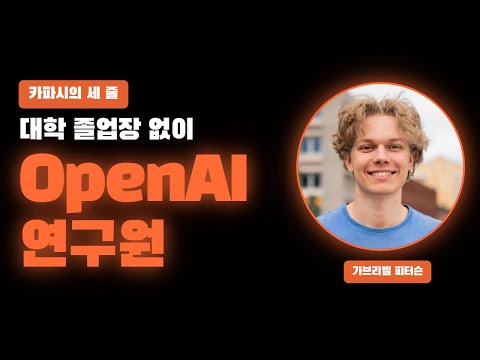
This video explains an effective way to study in the AI era, as described directly by OpenAI researcher Gabriel Petersson. In particular, it emphasizes top-down learning and the active use of an AI tutor instead of the traditional bottom-up learning method, making the striking claim that material that once took six years to learn can be covered in three days. Gabriel presents specific ways to use AI not merely as a tool for getting answers, but as a tutor that helps you understand, and says this will fundamentally change the future of education.
1. Andrej Karpathy's Advice and the Change of Era 🐦
In November 2020, Andrej Karpathy, OpenAI cofounder and former head of AI at Tesla, posted three core pieces of advice on Twitter about how to become an expert. His advice was:
- "Pick a concrete project and learn the necessary knowledge as you need it."
- "Summarize what you learn in your own words and teach it to someone else."
- "Compare yourself only with your past self."
At the time, this advice may have sounded idealistic. To learn the necessary knowledge as you needed it, you needed a one-on-one teacher beside you, and such a person was hard to find. But now, in 2026, the situation has completely changed. Because everyone now has an AI tutor that never gets tired, Karpathy's advice can become reality. The story of Gabriel Petersson, who actually practiced this advice and became an OpenAI researcher with only a high-school education, proves the point.
2. Gabriel Petersson's Learning Method: Top-Down Learning 🚀
Gabriel Petersson points out the inefficiency of the traditional bottom-up learning method and emphasizes that top-down learning is much faster and more effective.
2.1. Top-Down Learning vs. Bottom-Up Learning
Gabriel explains that the fastest way people learn is through a top-down approach.
- "I think the fastest way people learn is a top-down approach."
- "You start from a problem, read everything you need to solve that problem, find another problem and read again, and keep digging into the core of the problem."
Schools, by contrast, traditionally stick to the bottom-up method. For example, if you want to learn machine learning, you spend four years building foundations such as math, matrix multiplication, and linear algebra before you are allowed to approach actual machine learning.
- "In school, everyone has this mindset: 'You have to start from the basics.' For example, if you want to do machine learning, don't even dream of doing machine learning for the first four years. You have to do math, matrix multiplication, and linear algebra."
Gabriel says this bottom-up method takes an enormous amount of time and is very inefficient. One reason is that top-down learning used to be hard to scale because a teacher had to be beside you at all times to explain the knowledge you needed. But now, thanks to AI such as ChatGPT, that constraint has disappeared.
2.2. ChatGPT's Impact on Education 🎓
Gabriel is convinced that the arrival of ChatGPT will fundamentally change education. He goes so far as to say that he cannot take universities seriously if they do not include ChatGPT in the curriculum.
- "Because of ChatGPT, all of this is changing. People always say education will change, but it is hard to take universities seriously if they do not teach ChatGPT as part of the curriculum."
- "The university monopoly on foundational knowledge is gone now. You can get any foundational knowledge from ChatGPT."
Now we can start from a problem and dig into the necessary foundational knowledge recursively. For example, if you want to learn machine learning, you can ask ChatGPT to recommend a project, have it write code, and then learn while fixing the bugs that arise.
- "If you want to learn machine learning, you ask ChatGPT, 'What project should I do? Please write the project.' When bugs appear, you start fixing them and make it work."
- "Then you ask about specific parts of the machine-learning problem: 'What is happening here? Can you explain the intuition for why this module trains the model?' Then ChatGPT will explain it."
This method of asking AI for foundational knowledge whenever you need it and filling the gaps as you go is the essence of Gabriel's top-down learning.
3. How to Use AI Like a Tutor 🤝
Gabriel emphasizes that AI should not be used merely like a search engine, but like your own personal tutor. In particular, he says it is important not only to receive the answer, but to understand the process.
3.1. Ask for the Process, Not Just the Answer 🧐
He explains how to use AI through the example of diffusion-model code.
- "If I ask it to write all the diffusion-model code, the AI writes all the code. At first, I have no idea what is going on."
- "Then I get the code working and debug it together with the AI, and I start gaining intuition: 'Oh, this part works like this.'"
What matters in this process is asking AI to explain in detail what each line of code does. For example, you ask about a specific part such as a ResNet block, and after the AI explains it, you keep asking follow-up questions such as, "What does that mean? What does it mean that it learns more efficiently?"
- "You have to keep asking the model questions until you really understand. And once you think you understand, you can ask the model, 'This is my understanding. Is this completely correct?'"
In this way, you can acquire deep knowledge through the process of constantly questioning AI, asking for explanations, and checking your own understanding.
3.2. Ask It to Explain Like You Are 12 👶
He also gives a useful tip for understanding difficult concepts: use the prompt "Explain this concept like I'm 12 years old."
- "Please explain this concept as if I were 12 years old. This method is really good."
- "AI will connect every AI-related concept to real-world concepts, such as assuming you are in a bookstore and comparing embeddings to other books in the bookstore."
This request makes AI explain complex concepts through intuitive and easy-to-understand analogies, which is a major help in learning.
3.3. Using AI to Summarize and Understand Papers 💡
Gabriel also uses AI actively when reading papers. Instead of reading every word of a paper, he asks ChatGPT to identify the paper's core.
- "Of course I don't read papers word by word. I use ChatGPT. I give instructions such as, 'Give me a list of what this paper does differently from previous work.'"
- "Because many papers add something new on top of earlier techniques, I ask AI to tell me very specifically what exactly this paper did differently compared with the previous technique."
Using AI this way lets him grasp the core idea of a paper quickly and save time when deciding whether it is worth implementing.
4. Rejecting "Vibe Coding" and the Importance of Deep Understanding 🤔
Among some developers, "vibe coding" has become popular: simply copying and using code written by AI without deeply understanding it. Gabriel strongly rejects this.
- "I am not a vibe coder. I am very stubborn when it comes to coding."
- "You cannot just throw code in. You never know what will happen."
He emphasizes that even if AI writes the code, you must personally read and understand every line. As a researcher working at the frontier of a new field, he says understanding all the foundations is more important than anything else.
- "I want to understand all the fundamentals."
- "You can delegate the work to AI, but don't delegate the understanding."
This section delivers a strong message: use AI, but never forget the importance of critical thinking and deep understanding. AI is only a tool; the final understanding and responsibility remain with the human.
5. Three Days vs. Six Years: A Critique of the Education System 💥
Gabriel criticizes universities for failing to keep pace with change in the AI era.
- "Universities want to have a monopoly on your learning. If you are a professor who has spent your life telling people that going to university matters, then if suddenly that is no longer necessary, you will do everything you can to preserve the old way."
- "What happens when the smartest people start teaching themselves? Then the smartest people will not go to university, and that will lower the status of universities."
He argues that the traditional education system resists change because it tends to preserve its vested interests, and that this ultimately undermines educational efficiency. One interviewer agrees with Gabriel's point by using his own experience as an example.
- "I spent 10 years in education and I have $400,000 in debt. I successfully defended my PhD dissertation. And Gabriel Petersson is saying, 'I am currently doing work that traditionally only PhDs do, with no machine-learning or math background, with the help of ChatGPT.'"
Gabriel makes clear that he is criticizing concepts that come from an old way of thinking, not belittling the accomplishments of existing professors or PhD holders. He argues for the need to change the education system by using the analogy that a diffusion model can be learned in three days through a top-down method, while the bottom-up method takes six years.
- "It takes three days to learn a diffusion model in a top-down way. In a bottom-up way, it takes six years. That is the perfect analogy."
- "If you want to learn diffusion models after university, you will probably only encounter them after at least six years of education."
This is a vivid example of how revolutionary AI-assisted learning can be.
Closing Thoughts
Gabriel Petersson's story offers powerful insight into how we should learn and grow in the AI era. Moving away from the traditional bottom-up learning model and adopting problem-solving-centered top-down learning, while using AI as an active learning partner, will become a core capability for future talent. In this way, AI is not merely a tool for automating work. It is likely to become a catalyst that radically changes how we learn and how we think. 🌟