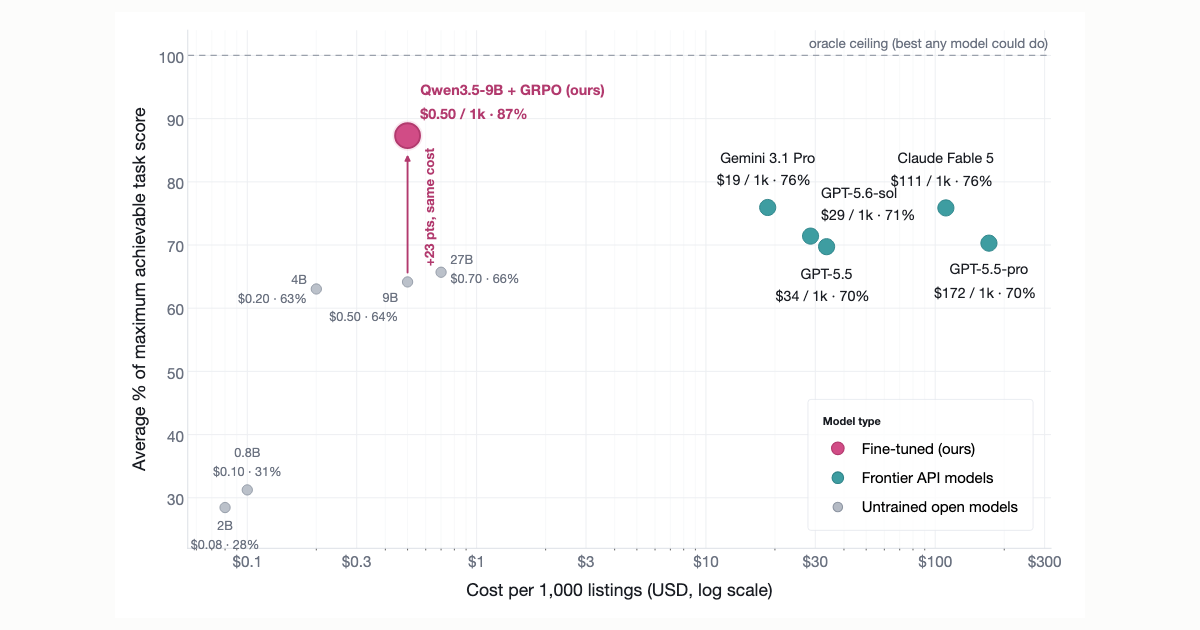
This article argues that companies should move beyond renting general-purpose frontier AI on every call and begin owning specialized open-source models trained on their own data, tools, and evaluation criteria. In an experiment involving e-commerce catalog review, a nine-billion-parameter open-source model fine-tuned with GRPO achieved greater accuracy than the strongest frontier configuration while reducing the cost to $0.50 per 1,000 items. The central idea is that when a task occurs frequently and its outcome can be graded clearly, reinforcement learning can encode a company's distinctive judgment into model weights.
1. Why Some Companies Get More Value from AI
Since ChatGPT appeared in 2022, companies have repeatedly asked, "What can AI do for us?" Early use cases centered on low-risk tasks: summarizing documents, drafting emails, and producing first drafts for people to refine. Adoption then expanded into higher-value knowledge work such as software development and content creation. The furthest-reaching efforts now aim to build a "company brain" connected to internal knowledge, data, and tools—one that coordinates work and autonomously performs parts of business operations.
Yet most companies have failed to produce measurable results at scale despite spending heavily on time, money, and tokens. A smaller group that reorganized itself around an AI-first approach has reported substantial gains in productivity, revenue, and cost efficiency. According to Ramp data published in July 2026, revenue at the top quartile of companies by AI spending more than doubled between November 2022 and December 2025, while companies with no AI spending grew by only about 15%.
"Over the same three years and under the same economic conditions, the companies adopting the most AI more than doubled their revenue, while companies spending nothing on AI grew by roughly 15%."
The article argues that the difference is not simply whether a company selected a "good model." What matters is how deeply AI has been integrated into the structure of the work and the way the company operates.
2. Five Practices Shared by AI-First Companies
Drawing on research, the article identifies five areas in which companies producing real AI results behave differently.
Redesign the Work Itself
Adding AI to an existing people-centered process is not enough. Companies must reconsider what requires approval, who reviews which outputs, and where human intervention belongs. If the workflow remains unchanged, existing bottlenecks absorb the productivity gained from AI before it can reach the bottom line.
McKinsey's 2025 survey of organizations using generative AI found that workflow redesign had the strongest correlation with EBIT impact. Even so, only 21% of the organizations surveyed had redesigned at least one workflow.
Reward Experimentation
Models, tools, and best practices change every week. The best approach last quarter may no longer be the best approach today. Companies should reward not only people who ship results quickly, but also those who test new methods and share what failed. Technical teams are often a good place to begin because they tend to notice recurring problems across departments first.
Supply Company-Specific Context
Prompt engineering and retrieval-augmented generation can inject company information into a model at inference time. Doing this well requires access controls, a retrieval system capable of finding the right evidence, and careful management of the context window. A longer context does not mean the model will use every piece of information equally well.
Measure Usage and Real-World Impact
Eventually the CFO will ask, "What did this AI spending change, and was it worth the money?" Many AI projects lack the infrastructure needed to track model performance, the cost of decisions, and changes in operational efficiency. Self-reported estimates of time saved also tend to exceed the savings found through direct measurement.
"Without score-based evaluation on your own data, the strongest claim you can make is that it feels as though the system works well."
Move Toward Reinforcement Learning on Open Models
The article's main recommendation is to train open-source models with reinforcement learning on proprietary business data. This approach directly addresses the problems of company-specific context, performance measurement, and operating cost at scale. Training on a company's own data, tools, and procedures can create expertise that no external API can easily reproduce.
3. What It Means to Own Intelligence
The phrase ownership of intelligence does not mean canceling every ChatGPT or Claude subscription. The article considers frontier models the right place to begin automation. They let a company test what is technically possible, while records of task inputs, model decisions, and human corrections create the data needed to train a specialized model later.
Priorities change once a prototype enters large-scale production. At that point, consistent performance and cost per call become crucial, making small, inexpensive models specialized for a particular task more attractive. A general-purpose frontier model can delegate subtasks requiring internal knowledge to a specialist. The specialist, in turn, can call a frontier model only when a task requires broad general intelligence. Both directions can coexist in a hybrid architecture.
A model learns the company's environment through the following cycle:
- It uses company tools and data to perform a task.
- An answer key or evaluation rubric grades the result.
- The score becomes a reward signal that updates the model weights.
- The cycle repeats across tens of thousands of work examples.
- Company-specific judgment accumulates in the weights, while facts that change often—prices, inventory, and policies—remain in tools and databases.
"Business knowledge placed in a prompt is rented again on every call. Business knowledge learned through training is purchased once and retained in the model weights."
4. Specialized Models Already in Production
The article emphasizes that this is not merely a theoretical proposal. The approach already appears across industries. The recurring pattern is to establish a baseline with a frontier model, then use the resulting data and evaluation criteria to reinforce an open model until it becomes better at one specific task.
Bridgewater Associates: Judging Investment Documents
The large hedge fund Bridgewater reviews articles, filings, and emails to decide whether each document is relevant to an investment thesis and which passages are merely conventional or boilerplate. Here, "relevance" does not carry its ordinary meaning. It refers to the judgment applied by Bridgewater's own investment professionals.
Even highly detailed prompts could not reliably instill that standard in frontier models, so the company trained an open-source model using labels created by its investment experts. The trained model reportedly made about 30% fewer mistakes than the strongest frontier model and cost much less to run.
Harvey: A Legal Agent
Legal AI company Harvey works on long, multi-stage tasks such as transaction due diligence and legal memorandum writing. These tasks require searching large collections of documents, and small errors early in the process compound in later stages. Even top frontier models struggled to meet the required quality bar.
Harvey applied reinforcement learning to an open-weight model and reported that the resulting legal agent outperformed both GPT-5.5 and Claude Opus 4.8 on the company's own evaluation criteria.
Intercom: The Fin Apex Support Model
Intercom's support agent Fin resolves roughly two million customer issues every week. At that scale, per-call frontier pricing accumulates quickly, while even a small increase in resolution rate can have a large business impact.
Intercom post-trained Fin Apex, a vertically specialized model, on billions of customer-support interactions. The company says the model resolves more issues than the strongest frontier models while operating at lower cost.
The article identifies similar patterns in software development, telecommunications support, recruitment matching, medical coding, telephone service, email support, search, and criminal-record classification.
5. Why Catalog Integrity Matters
The article's central experiment concerns product catalog integrity on e-commerce platforms. Every listing must be assigned to the correct taxonomy, while attributes needed for search, filtering, recommendations, and operations must be extracted accurately from images and descriptions.
Misclassified products become harder to find and weaken recommendations. Missing a policy violation or counterfeit exposes customers and brands to fraud. Blocking legitimate sellers too aggressively, however, increases review queues and frustrates merchants.
"Missing a counterfeit exposes customers and brands to fraud, while excessive flagging creates expensive review queues and frustrates legitimate sellers."
The volume is enormous. eBay has roughly 2.5 billion active listings, and Shopify catalogs receive more than 10 million product changes every day. Walmart has said that completing its AI-assisted catalog work with people alone would have required about 100 times its current workforce.
Incorrect product information also affects sales. In one survey, 71% of consumers said they had returned an item because it differed from the listing. Review itself is expensive as well. The article estimates that a mid-sized marketplace handling about ten million product creations or updates each day might spend roughly $500 million per year using frontier models alone. A fine-tuned specialist could perform the same volume for approximately $10 million.
Shopify similarly uses fine-tuned open models for around 40 million inferences a day, noting that commercial APIs cannot economically support that scale.
6. A Digital Twin of Catalog Review
The authors built a digital-twin environment resembling a real e-commerce platform. Their goal was to let the model do more than produce an answer: it could call tools, make mistakes, receive a score, and learn again as it would in an operational setting.
The base material came from real product images and listings in the Amazon Berkeley Objects dataset. From it, the authors created 177,767 review episodes. Each included a product image, title, description, claimed brand, and regional information. They deliberately added policy violations, image-description mismatches, conflicting brand claims, and difficult negative examples that looked suspicious but were actually valid.
The model could use three tools:
search_taxonomyto find the right classification among roughly 13,000 product categorieslookup_brandto determine whether a brand was registered and protectedget_attribute_schemato retrieve the required attributes for a selected category
For a listing such as "black PU-coated work gloves, size 10, AmazonBasics brand," the model would search for the safety-work-glove category, check the brand, retrieve the relevant attribute schema for color, material, and size, and submit its category, attributes, and policy decision in a structured format.
The evaluator scored category accuracy, attribute accuracy, and policy judgment, while penalizing unnecessary tool calls. To reflect actual business risk, it assigned seven times more cost to missing a real violation than to raising a false alarm.
"The model learns that the two kinds of error are not equal: missing a true violation costs seven times as much as issuing a false warning."
7. The Frontier Baseline and Its Limits
Before training, the authors evaluated five frontier models under identical conditions: GPT-5.5, GPT-5.6-sol, Gemini 3.1 Pro, Claude Opus 4.8, and Claude Fable 5. Every model received the same images, tools, evaluator, and limit on conversation turns.
They tested two approaches:
- A zero-shot setup using only the base prompt
- An optimized prompt of roughly 2,800 characters containing extraction rules, lookup procedures, and examples
The optimized prompt improved some results, but only to a point. Scores for the optimized frontier models converged within 0.1 points of one another. Gemini, the strongest zero-shot extractor, did not improve when given the additional instructions.
The best frontier configuration reached 76.9% of the maximum achievable score. The nine-billion-parameter model trained with GRPO reached 87.3%. That is roughly 13.5% better in relative terms than the strongest frontier configuration and about 36% better than the same 9B base model's pre-training score of 64.2%.
The article does not attribute this gap to a simple difference in general intelligence. On every task, a frontier model must infer the company's taxonomy, attribute conventions, and rules for ambiguous policy cases from scratch. A prompt can compress some of that knowledge, but it cannot enumerate every subtle exception that affects the score.
Long instructions also carry a recurring cost. Depending on the model, the 2,800-character prompt increased input-token spending by 28–55%, and that expense returns on every call.
8. Reinforcement Learning for About $500
The training infrastructure was relatively modest. The authors rented two RTX PRO 6000 GPUs. One generated rollouts—the model's attempts to perform the work—while the other computed gradient updates. They used the open-source prime-rl framework.
The full run involved:
- Optimization steps: 1,000
- Training time: about three and a half days
- GPU cost: about $500
- Base model: a nine-billion-parameter open-source model
- Method: GRPO-based reinforcement learning
After roughly 250 steps, or about one day of training, the model had already moved beyond the performance range of the frontier models. The remaining steps raised the ceiling further. On the strict final benchmark, it scored 0.626, or 87.3% of the maximum possible score. The training monitor showed about 0.671 at step 1,000 because it used a different sampling method, but the article uses the stricter 0.626 benchmark for the final comparison.
The model did not simply memorize correct answers. Across thousands of graded examples, it learned how the category system, internal tools, policies, and reward structure relate to one another. A general-purpose model distributes its capabilities across an enormous range of problems; a specialist concentrates on the action space of one environment and develops a better decision pattern there.
The system also compounds rather than ending with a single training run. When a stronger open base model becomes available, the same method can be transferred to it. Decisions and corrections collected in production become supervised fine-tuning data for the next round. The model, evaluator, and dataset improve together, making later training more precise and potentially less expensive. 🔁
9. Higher Accuracy at Lower Cost
The experiment's largest claim is that a specialized model can escape the usual tradeoff between quality and cost. Typically, reducing cost means accepting lower quality, while seeking better performance requires frontier-model pricing. Here, the trained 9B model achieved the highest performance and nearly the lowest operating cost at the same time.
The key figures were:
- Trained 9B specialist: about $0.50 per 1,000 products
- Cheapest frontier configuration, using Gemini: about $19 per 1,000 products
- Most expensive frontier configuration, using GPT-5.5-pro: about $172 per 1,000 products
- Strongest frontier comparison: about $34 per 1,000 products
- The specialist was about 68 times cheaper than the best-performing frontier model.
- It was about 40 times cheaper than even the least expensive frontier configuration.
- It was about 340 times cheaper than the most expensive frontier configuration.
The trained model improved performance by roughly 23 points over the same 9B base model without changing its serving cost of about $0.50 per 1,000 items. At a Shopify-like volume of 40 million inferences a day, the article calculates that the difference between $34 and $0.50 per 1,000 would become approximately $500 million versus $7 million per year.
"Every other option forces a choice between quality and cost. The trained specialist ends that tradeoff by delivering the highest score we measured at close to the lowest price."
10. Which Tasks Are Good Candidates for Specialized Training?
The article is explicit that fine-tuning is not the right answer for every task. Two questions matter most:
- How frequently does the task occur?
- Can the outcome be verified objectively?
The strongest candidates are high-frequency tasks with verifiable outcomes. Per-call expenses and the cost of errors accumulate at high volume, while rules, tests, and rubrics make automatic grading possible. For work that occurs rarely, it is usually better to rent a well-prompted frontier model. When no objective standard exists, human reviewers must remain involved.
If the problem is changing factual information, the solution is retrieval or database access, including RAG, regardless of task volume. Prices, inventory, and policy documents change too often to be embedded in model weights; the model should retrieve their current values from external tools.
The article suggests considering fine-tuning when one or more of the following conditions apply:
- The task occurs often enough that inference costs and errors accumulate into meaningful financial expense.
- Rules, tests, or rubrics can grade every output automatically.
- Experts generally agree on what the correct answer is.
- An already capable model succeeds sometimes but not reliably enough.
- A model cannot pass by occasionally guessing the correct answer.
- The work has several stages, such as reasoning, tool use, and a final decision.
- It relies on company-specific tools, schemas, or policies.
- Different kinds of error carry different costs.
- Sensitive data must not leave the company's own infrastructure.
That final condition matters for security as well as performance and cost. A model running on internal infrastructure does not need to send prompts and logs to an outside AI vendor.
"If you can grade a decision, the model can practice it. If the decision can only be debated, the model cannot practice it."
11. Appendix: Evidence Across Industries
The appendix collects company-reported examples in which specialized models outperformed frontier models on performance, cost, or speed. The figures are limited by the fact that they come from the companies themselves, but the article uses them to show a recurring pattern across industries.
- Cognition: The company says its model for writing and modifying software in production environments beat GPT-5.5 on a standard coding benchmark and delivered frontier-level results at a lower serving cost.
- AT&T: A specialist that summarizes 900,000 customer-support calls a day and detects personal information reportedly achieved 17% better personal-data detection than GPT-4o. Fraud-case review ran 12 times faster at similar accuracy.
- LinkedIn: A model matching job seekers with openings was said to be 4% more accurate than the previous GPT model, 75 times cheaper than GPT-4, and six times cheaper than GPT-4o.
- Ambience Healthcare: A medical-billing-code model reportedly outperformed 18 physicians on a gold-panel exam and scored 12 points higher than the prompt-based o4-mini system from which it began.
- Phonely: Its phone-support model reportedly achieved 99.2% accuracy compared with GPT-4o's 94.7%, while responding 73% faster than the previous GPT-4o configuration.
- OpenPipe: An agent handling email and support tickets scored 93% on a support-quality evaluation, compared with 50% for OpenAI o3, while costing 64 times less and running five times faster.
- Perplexity Sonar: The company claims its citation-providing search-answer model performed at roughly the level of GPT-4o in a blind user evaluation while operating about ten times faster.
- Checkr: A model classifying criminal-record entries for background checks reportedly beat GPT-4 on difficult cases while costing five times less and running 30 times faster than the earlier GPT-4 setup.
12. Conclusion
The article reaches a direct conclusion: when work occurs at high volume, has a clearly gradable answer, and depends heavily on company-specific data, tools, and policies, training and owning a specialist may be better than paying for a frontier call every time.
In the catalog-review experiment, the authors spent about $500 and a few days on training to exceed the best frontier configuration while reducing inference cost by as much as several hundredfold. They present this not merely as a cost-saving technique but as a compounding competitive advantage: the company's evaluation standards and operating data accumulate over time as better model performance.
"The era of asking which decisions to keep renting is ending. The question now is which decisions you will no longer rent."