1. Questioning the Purpose of Statistics
The piece opens with the author's friend — a statistics PhD — who had never once asked herself:
"What does statistics even exist for?" That realization is the starting point. The author puts it this way:
"If you don't know its purpose, you won't know when it stops being useful to you."
The author also points out that many professors never clearly explain the meaning of statistics — and so steps in to do exactly that.
2. What Is Statistics?
The author defines statistics like this:
"Statistics is the science of changing your mind under uncertainty."
In other words, statistics is a tool that helps you update your beliefs or conclusions in response to new data, even when the information you have is incomplete or uncertain.
Two key concepts emerge here:
- A pre-specified action
- A prior belief
What if your mind isn't made up yet? What if there are no options on the table at all? What should you do then?
3. Estimation and Data
The author's advice:
"For now, just estimate the most plausible thing you can, given what you know."
Estimation means taking your available information and making your best guess about what's most likely true. This doesn't require complex formulas — if you've ever used a spreadsheet like Excel, you've already done it.
"The good news is, your intuition can actually make a pretty decent estimate. No fancy formulas needed."
4. Uncertainty and Making the Best Choice
But someone might object:
"What if you're wrong, though?"
The author's response:
"Sure, you might be wrong. That's what uncertainty means. There's no magic formula that turns uncertainty into certainty. Your estimate might be wrong — but it's still the best estimate you can make. Any other estimate is worse than 'best,' and more likely to be wrong."
The point: uncertainty is unavoidable. What matters is making the best possible choice within it.
5. How Much Data Is Enough?
Another question comes up:
"Wait, don't I need to know whether I have enough data?"
The author pushes back:
"Enough for what, exactly?"
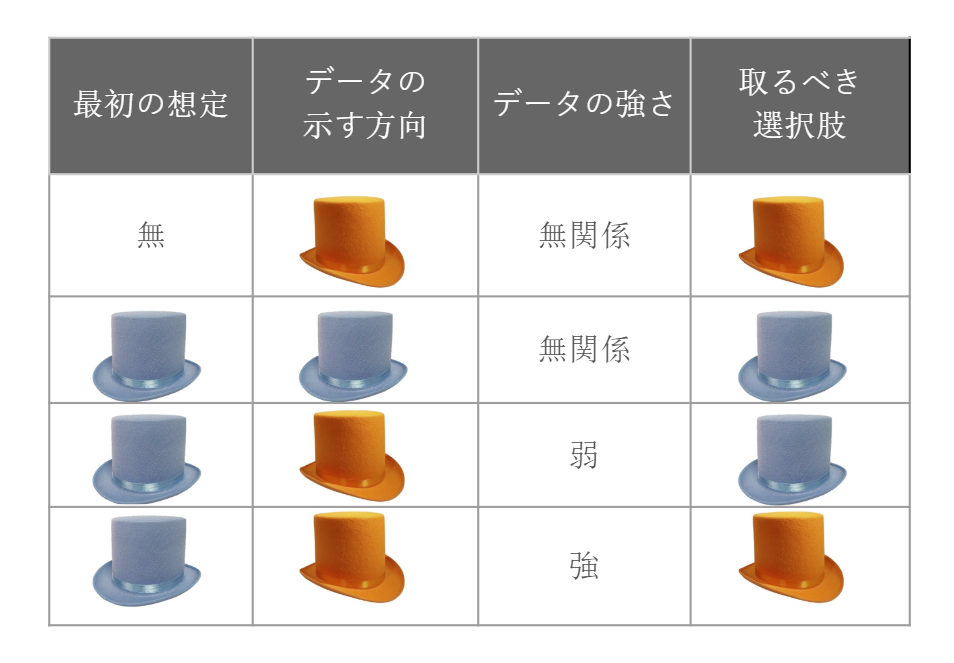
To illustrate insufficient data, the author asks you to imagine choosing between a blue hat and an orange hat.
If you don't care either way, and your data shows a slight preference for orange — even with just 3 data points, even if orange is only 0.0000000000001% more likely — there's no reason to pick blue.
"You'd just pick orange, right? No formula needed."
The takeaway: common sense is the foundation of statistical judgment.
6. Evidence Enough to Change Your Mind
But what if you already preferred the blue hat? Then you need to ask whether the data is strong enough to change your prior belief.
"Math isn't magic — it's just common sense formalized."
This is precisely when statistics becomes necessary.
"Welcome to the world of statistics."
7. When Statistics Is Actually Needed
The author uses a simple table to explain:
- When evidence aligns with your original belief, you can decide immediately — no statistical calculation needed.
- When evidence contradicts your belief, you need statistical calculation to judge whether to update your thinking.
And again, the core point:
"Statistics is the science of changing your mind."
8. Statistics vs. Analytics
Finally, the author explains that statistics is called for under uncertainty when the stakes of your choices differ — for example: "Will this machine learning system perform well on tomorrow's data?"
"Otherwise, you'll just wear yourself out processing a bunch of numbers for no real reason. In that case, analytics is the better tool."
To sum up:
- Uncertainty + important decisions → Statistics
- Just wanting to see something in your data → Analytics
9. Closing: The First Step in Statistical Thinking
The piece ends by emphasizing that the first step in statistical thinking is simply asking the question: "What is statistics?" — and points readers to a related video.
Key Concepts at a Glance
- The purpose of statistics: The science of changing your mind under uncertainty
- Estimation: Guessing the most plausible situation from what you know
- Uncertainty: There are no perfectly certain answers — making the best choice is what counts
- Enough data: Common sense comes first; you need enough evidence to shift your prior belief
- Statistics vs. Analytics: Use statistics when there's uncertainty and meaningful decisions at stake; use analytics otherwise
💡 Lines Worth Remembering
"Statistics is the science of changing your mind under uncertainty."
"There's no magic formula that turns uncertainty into certainty."
"Math isn't magic — it's just common sense formalized."
This piece breaks down the essence of statistics — what it is, what it's for, and when to use it — in a clear and accessible way. Feel free to ask if you have any questions 😊