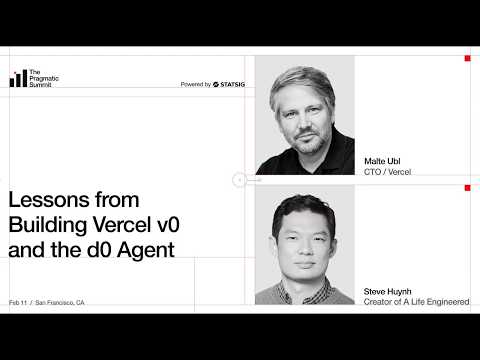
Vercel CTO Malte Ubl shared insights at The Pragmatic Summit on coding agent evolution, Vercel's internal data agent d0, and their public service Vercel v0. The talk covers practical lessons on how companies should adapt and innovate in the rapidly changing AI era, with deep dives into the impact of AI agents on software development and operations, and the potential for future organizational transformation.
1. Rebuilding Vercel's Internal Data Agent d0
Malte Ubl emphasizes that "humility" is important in the coding agent field because it keeps changing. What was best practice in summer 2025 may be irrelevant today. Unlike website building with 30 years of established methods, the agent field is just entering its third year, requiring constant readiness for new approaches.
Vercel's internal data agent d0 is a text-to-SQL engine that answers questions in Slack by querying Snowflake databases. He highlighted how a salesperson once asked d0 to find S&P 500 company CTOs and engineering VPs who had personal Vercel accounts and deployed during Christmas—demonstrating d0's utility for complex queries.
The initial version used traditional "Tools in a Loop" infrastructure, but it wasn't as magical as expected. So Vercel scrapped everything and rebuilt using a coding-agent-like approach with just Bash and SQL execution tools—the entire code was only 50 lines but brought transformative business impact.
The rebuild was possible because as models became more intelligent, building agents that rely entirely on "emergent behavior" became more feasible—no need for complex prompts or hard-coded rules.
2. The Era of Business Users Building Apps and Vercel v0's Evolution
Vercel v0 launched in 2023 with the goal of helping non-engineers build applications and prototype. But it evolved differently than expected—it initially became a tool for backend engineers (who could fix issues themselves) rather than non-engineers, because 2023-era models lacked stability for general users.
When Anthropic released Sonnet 3.5, enabling full-stack app building from the same prompt, it dramatically shifted v0's direction. A key "aha!" moment came when an engineer added "Use Tailwind" to the prompt, which vastly improved results because the model handled inline reasoning much better with everything in one place.
Vercel v0 now targets "tech adjacent" users—PMs, designers, product owners, and business stakeholders. Malte notes that as AI models improve and agents generate better code, the importance of a platform for reliably running that generated code only grows.
3. Stability and Speed: Evolution of Development Organizations and Architecture
Malte stresses that stability and speed aren't opposing concepts. Vercel's approach involves improving both the "inner loop" (development speed) and "outer loop" (deployment speed).
Vercel's architecture runs 20 core regions where each region is autonomous. Configuration changes are applied in waves, not simultaneously, so if a new setting causes issues in one region, it gets rotated out without affecting the entire service.
Developers receive unlimited tokens, though one engineer did create a custom coding harness that bypassed caching and cost 10x more. As CTO, Malte personally makes production code changes two to three times per week, and Vercel's CEO deploys apps daily.
4. Organizational Evolution: Role Changes and Staffing in the AI Era
Malte observes that software developer roles are already shifting from individual contributor (IC) work toward management. The most senior ICs benefit most since they already performed similar management roles; the most junior engineers adapt quickly to new technology.
The challenge lies with mid-level engineers who must learn to adapt. Vercel is actively investing in internship programs and junior engineer cohorts.
Currently at 750 people, Vercel semi-jokingly aims to cap at 1,024 employees—suggesting that growth may not require more headcount. They've already automated 87% of support inquiries and automated sales lead qualification through open-source agents.
The ultimate question is whether cheaper software creation will require more or fewer software engineers. Using the YouTube analogy—when video creation became accessible to everyone, the amount of content exploded, and the number of professional video creators actually increased from 20 years ago.
Malte references Ben Thompson's comparison to the 1960s mainframe introduction, where jobs called "computers" (human calculators) were lost, but long-term societal wealth increased. AI-era changes may cause pain for some jobs but will ultimately benefit society as a whole.
5. Conclusion
Malte Ubl's core message is that "software is now free." Like a free puppy, free software comes with the burden of "maintenance." He emphasizes that agents will play crucial roles in software maintenance and automated production management. Engineers can now accomplish instantly what used to take months, and how to leverage this new capability is the biggest challenge ahead.