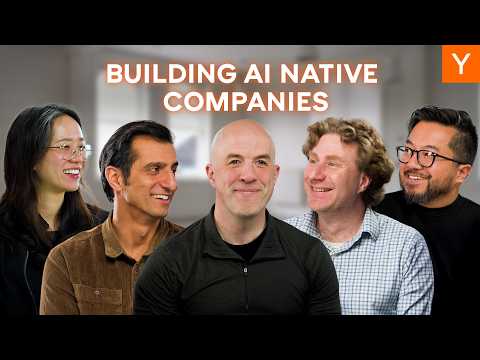
In this video, Y Combinator partner Pete Koomen shares YC's experience building internal AI agent infrastructure and explains how to use AI not merely as a tool, but as an operating system for the entire organization. Through concrete examples, he describes how much changed when AI agents were given database access, and how self-improving skill loops can become smarter overnight. The discussion offers deep insights into how AI can maximize the capabilities of companies and individuals in the era of personal AI.
1. YC's AI Shift and Pete Koomen's Role
Y Combinator partner Garry Tan introduces Pete Koomen, YC's special guest and fellow partner, explaining that Pete played a central role in building YC's internal AI agent infrastructure. Pete Koomen previously founded the A/B testing company Optimizely and contributed to building every system YC uses internally for AI.
Garry Tan emphasizes that after ChatGPT, YC drew on the knowledge and experience it gained from investing heavily in AI companies and began actively adopting the same AI tools used by startups inside YC itself. This had a major impact on turning YC into an AI-native organization, and Pete Koomen was at the center of that work. Garry says this is the first time YC has spoken publicly about everything it built internally, expressing excitement about the episode.
2. The AI Agent Journey Began With Solving Finance-Team Problems
Pete Koomen says YC's adoption of AI agents began about a year earlier, when the finance team was dealing with an inefficient software development process. At the time, the finance team had to explain complex financial tasks, such as recording accounting entries or pricing rounds, to software engineers, and the engineers then built custom software based on those explanations. Pete recalls that the process felt extremely inefficient.
"This felt really inefficient. And at the same time, agentic coding tools were really starting to take off."
Remembering how powerful agentic coding tools such as Windsurf, Cursor, and Claude Code felt, almost like giving him superpowers, he came up with the idea of applying those tools internally at YC. The goal was to let the finance team control its own workflows through English prompts, rather than forcing engineers to translate finance knowledge into custom software. It was an innovative approach that freed engineers from unnecessary translation work while letting the finance team build software without learning complex code.
3. Giving SQL Access: The Moment That Changed Everything
Garry Tan recalls that some of the earliest AI companies YC invested in tried using LLMs to write SQL queries but did not succeed. Against that history, he was surprised by how effective Pete Koomen's SQL query agent became. He was especially impressed that even finance-team members without technical backgrounds could use the tool to ask complex questions.
Pete says that at first he only gave the system limited tools, but then he secretly built and deployed an agent tool that could run read-only SQL queries against the database. He describes how radical that experiment felt at the time.
"So I thought, what if this had full access to the database? This could ruin everything, but I kind of secretly deployed it late at night."
Surprisingly, it worked very well. The experience showed him that excessive concern about security and privacy can sometimes limit AI's potential.
4. The Power of One Database Containing Everything
Since its founding, YC has operated on its own software, and all important data is integrated into one PostgreSQL database. This was decisive for the success of its AI agents. The database contains every company YC has invested in, founder information, financial transaction records, notes from the internal CRM, and essentially all context needed to run YC.
Pete explains that this allowed agents to answer complex questions such as, "Show me all the investors who invested in space companies over the last four batches." When all the context is gathered in one place, and the agent has a little extra information about the schema, it can answer nearly any question about YC's business.
Garry Tan emphasizes that this is a good example of Jevons paradox. In the past, asking a complex question required requesting help from the data science team and waiting a long time, so people often avoided asking at all. Once AI agents made questions easy to ask, both the number and complexity of questions increased exponentially.
5. GBrain: Optimizing Data for Agents
How can older companies move as quickly as YC? Garry Tan suggests an approach like GBrain as one answer. It is the process of reorganizing data scattered across many systems into a single denormalized schema that agents can understand and use easily. Just as Google optimized data through Bigtable, companies now need to transform data into formats optimized for agent search and understanding.
GBrain uses various search techniques, including retrieval-augmented generation, graph RAG, and hybrid RRF, so agents can understand user intent and answer questions as if they were humans who knew the user well. Garry says such systems let agents "look around corners," interpret what the user meant, and provide surprisingly useful answers.
"If you give an agent a soul, give it data, and let it know you and what you care about, suddenly it gets enormous wings."
6. The Single-Player Era of Agents and the Multiplayer Challenge
Over the past year and a half, AI agents such as Claude Code, Codex, OpenClaw, and Hermes have become popular in single-player environments for individual users. These agents allow individuals to do almost everything on a single machine and give users tremendous power.
But the larger challenge YC faced was building a multiplayer environment that could extend those superpowers to a team or entire organization. Pete Koomen identifies two core elements legacy organizations should focus on to use AI effectively.
- A shared context layer: Build a data warehouse where all important internal context is gathered. YC's single database played this role very well.
- An internal tool registry: Create a registry of tools specific to YC. What began with about 20 tools has now grown to more than 350. These tools support every important YC workflow, from finance-team ledger entries to office-hour management and event operations. They can be used not only by internal agents but also by personal agents such as Claude Code.
7. Skills, Resolvers, and the Dream Cycle of Self-Improvement
Garry Tan explains that YC's tool registry is similar to OpenClaw's idea of "skillify," where an agent learns a new task and turns it into a reusable skill. These skills are registered in a list called a resolver, which defines what capabilities an agent can use.
He names two important principles for building an effective resolver table: DRY, or Don't Repeat Yourself, and MECE, or Mutually Exclusive, Collectively Exhaustive. DRY means avoiding duplication, while MECE means the items should be mutually exclusive and collectively cover the whole space. Following these principles helps agents choose and use the best skill.
Pete Koomen describes how these skills evolve inside YC through an autonomous self-improvement loop. For example, YC's general-purpose agent reads employees' agent conversations every night and looks for places where it could have handled things more efficiently, or for pieces of context that would have helped if they had been provided in advance. Garry calls this the dream cycle, a mechanism through which agents learn and improve from their own experience.
"We have this general-purpose agent. Every night, it reads the agent conversations employees had and looks for things it could have done better, or pieces of context that would have let it work more efficiently if they had been given beforehand."
8. The Two-Sentence Pitch Skill: How Superintelligence Accumulates
One of YC's shared skills, the two-sentence pitch skill, helps founders explain their businesses clearly and concisely. It does more than generate text. It contains years of YC partners' know-how about effective communication.
The skill improves in the following way. Meeting notes from YC partners giving founders feedback on their two-sentence pitches are provided to the agent. The agent studies those notes and receives the instruction to improve the two-sentence pitch skill. As a result, the skill has improved noticeably and can now write better pitches than Pete Koomen himself.
"Now this skill is better than I am. I can argue that this skill is better than me."
Garry Tan emphasizes that this small process of improving a two-sentence pitch skill is a core example of how superintelligence emerges inside an organization. Just as Jack Dorsey is trying to make Block into a payments-related mini AGI, YC is applying these automated improvement loops across thousands of small tasks to build organization-wide superintelligence.
9. The Organizational Brain That Records and Shares Everything
The key to becoming an AI-native organization is to go beyond using AI as a simple copilot and instead use it as a building layer for everything. To do that, organizations need to record all artifacts. In the past, recording meetings might have felt awkward, but we now live in an era where Zoom meetings and similar interactions are recorded by default.
Pete explains that these records can be used for more than meeting coaching.
"If you organize them in a way that helps everyone in the organization get better at what they do, it becomes incredibly powerful by using the collective skill and intuition of the people they work with."
For example, an effective two-sentence pitch skill does more than generate text. It contains years of YC partners' communication know-how. It becomes something like a shared organizational brain, letting individuals access and use other people's experience and knowledge. This can shorten the six-month ramp-up period for new employees and allow people to apprentice themselves to experts through AI.
10. A Culture of Trust by Default and Overcoming Safetyism
YC made agent conversations visible by default to all regular employees. This required a lot of discussion at first, but it ultimately produced positive effects.
- Faster learning: Employees learned new ways to use agents by seeing how others used them.
- Social control: Because conversations were public, employees naturally became more careful about sharing private information, which made a more relaxed approach to internal security possible.
Garry Tan explains that this approach is a prerequisite for building a truly agent-based, 1,000x superintelligent organization. In other words, the organization needs a culture that is relatively egalitarian and trusts by default. Many companies lock down context and prevent employees from freely accessing AI in the name of safetyism, but doing so limits AI's potential.
YC is willing to spend $100,000 to $1 million a year on tokens to build these systems. Garry says this is like time travel, experiencing early a technology that will become common in the future. Just as companies in the 1990s gained advantages by giving employees computers, companies that invest in AI now will gain competitive advantages.
11. Horseless Carriages and the Era of Just-In-Time Software
In his essay "Horseless Carriages," Pete Koomen criticized the problems with AI software development at the time. Many companies were simply adding AI as a feature inside existing software, such as an email-writing tool in Gmail. He argued that this approach fails to make full use of AI's potential.
He emphasizes that AI's real potential lies in transferring control of software from developers to users. In the old model, developers hid how AI worked and controlled everything, but this limited the user's superpowers. Pete describes the future direction of AI software this way.
"The better we build AI-native software, the more it will look like AI wrapping deterministic tools. It will not be deterministic software wrapping AI."
Garry Tan argues that the chat interface is the best form for AI agents. He was skeptical at first, but as AI agents became more reliable, users became able to delegate more work through chat without complex UI. Chat is the form closest to human language and thought, and modern chat interfaces that can accept multimodal input such as voice, images, and files make AI even more powerful.
Drawing on his own experience, Garry also predicts the arrival of just-in-time software. Complex web applications that once required hundreds of thousands of lines of code can now be dynamically generated and modified with far less code, markdown, and AI agents.
"This is actually the dawn of just-in-time software. And I can see it now."
12. Centralized vs. Decentralized AI: The Personal AI Revolution
Garry Tan raises an important question: will AI development become centralized, or will it become decentralized? Centralized systems like Google's Gmail, where users cannot change AI prompts, could lead to a future in which a small number of companies monopolize AI. That would resemble the 1960s and 1970s, before personal computers existed, when only a small "priesthood" controlled giant mainframes.
Garry does not want that future. Instead, he supports a personal AI revolution similar to the personal computer revolution. Just as Steve Jobs and Steve Wozniak built the Apple I in a garage, now is the time to discover new AI primitives and give them to individuals.
He believes tools such as OpenClaw, Hermes Agent, and YC's GBrain can lead this personal AI revolution: a future where users can run their own software, change prompts, keep personal repositories, and choose the models they want.
"I want a billion people to actually control and program these things for themselves. This should be an extension of you. It should be an extension of what you care about, not what Meta, Alphabet, or even OpenAI or Anthropic cares about."
Pete Koomen emphasizes that AI will not replace humans but will become a tool that strengthens individual capability. The history of technology, from mainframes to PCs to the internet, has always been tied to empowering individuals, and he is optimistic that AI will follow the same pattern. But for that to happen, organizations need to choose a new mode of computing that is open by default and based on collaboration rather than command and control.
Conclusion
This video vividly shows YC's innovative approach to integrating AI not as a simple tool, but as a core operating system that builds organizational superintelligence. Granting agents broad access to a single database, building an internal tool registry, and introducing self-improving skill loops all offer concrete ways for companies to maximize productivity and innovation through AI. The message that companies should move beyond safetyism, build trust-based cultures, transfer control of AI from developers to users, and aim for a personal AI revolution rather than centralization offers important insight for companies and individuals entering the future AI era.