This piece draws on the phenomenon of the claw-code repository receiving extraordinary attention in a very short time to offer insight into what developers should learn in the AI era. Going beyond the simple fact that AI writes code quickly, it emphasizes how critical agent system design and collaboration are, along with a human's clear vision and judgment, and points to the values developers should focus on amid the changing tech industry.
1. The Stunning Arrival of claw-code and Developers' Reactions 🤯
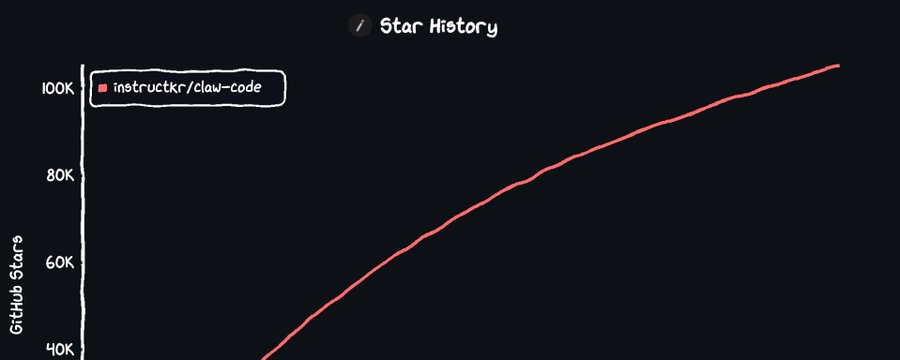
When the claw-code repository appeared, many developers were left speechless with shock and astonishment. It rewrote an existing complex agent system from scratch in Python using a clean-room approach in just two hours, then shipped a Rust version (0.1.0) the very next day. In the early hours of March 31, 2026, claw-code hit 50,000 GitHub stars within two hours of launch; the count has since surpassed 117,000.
Developers were enormously excited by that pace, but some also felt fear. Watching a massive codebase be rebuilt so rapidly made some people think "something has gone wrong with the timeline." To some it looked like a superpower they wanted to learn; to others it felt like a termination notice.
"People are stunned that the clean-room Python rewrite of
claw-codetook only two hours. And the Rust rewrite was done in a single day (0.1.0 shipped!)."
2. What Is the Real Core of claw-code? 🔍
The author argues, however, that people in this reaction are focusing on the wrong layer. The core of claw-code was not the generated Python files or the subsequently ported Rust code. The author says claw-code was designed as a showcase from the start.
"But if you're staring at the generated Python files, you're looking at the wrong layer. The code is a byproduct. The Rust port that followed is also a byproduct. What is worth studying in the
claw-coderepository is the system that produced all of it."
What truly deserves attention is the agent collaboration system built on clawhip that constructed all of this while the developer slept. The system actually worked like this:
- A simple directive from the developer: A person opens Discord on their phone, types a single sentence, and puts the phone down. (e.g., "Implement the core runtime.")
- Autonomous work by agents: The agents read the message, break the task into sub-tasks, and assign roles among themselves.
- Code writing and verification: They write code, run tests, argue with each other and fix things when problems arise. Once all tests pass, they push the code.
- Checking the finished result: The person checks the next morning and finds the porting work complete. ☕
Throughout this entire process, the developer used no terminal, no IDE, no SSH session. They issued instructions solely through the chat app Discord. The author emphasizes this is the part many people overlook: the README does include terminal screen captures, but those are the agents' terminal sessions, not something the developer operated directly.
3. Three Core Tools That Made claw-code Possible 🛠️
Behind the success of claw-code are three core tools. Each handles a different problem domain and they function in organic combination.
3.1. OmX (oh-my-codex)
OmX is a workflow layer built on top of OpenAI's Codex CLI. It provides reusable keywords (for analysis, for implementation, for structured planning) and supports complex workflow modes.
_loopmaintains a continuous execution loop until a task is complete._orchestratecoordinates multiple agents to work in parallel on different parts of the same problem. When the developer typed "Implement the core runtime" into Discord,OmXtranslated that single sentence into a structured, multi-step workflow and distributed it to the agents.
3.2. clawhip
clawhip is a background daemon that acts as a notification and event router. It monitors Git commits, GitHub issues and PRs, tmux sessions, and agent lifecycle events, then sends status updates to the appropriate Discord channels. A key design decision is that clawhip handles all monitoring work outside the agents' context windows. This means when agents are deep in complex implementation work, they can focus on actual code rather than filling their limited memory with notification logic or message formatting.
3.3. oh-my-openagent
oh-my-openagent provides the coordination logic between multiple agents. For example, when the Architect agent's plan conflicts with what the Executor agent has built, oh-my-openagent manages that disagreement. It also handles information sharing between agents, task handoffs, and output validation loops.
The author stresses that none of these three tools in isolation could have shipped claw-code so quickly. Together they form a closed development loop — the human sets the direction and the agents supply the labor — and that combination was the key.
4. Agent Team Roles and the Cycle 🔄
The agent team within the claw-code system has clearly defined roles and operates according to a specific cycle.

- Architect: Reads the directive and draws up a plan. Analyzes the structure of the target system, identifies what needs to be built, and writes a step-by-step sequence.
- Executor: Takes the Architect's plan, writes the code, runs tools, and generates tests.
- Reviewer: Reviews the Executor's output and sends feedback when problems are found. If the feedback is serious, the process loops back to the Architect to replan.
This cycle repeats until all checks pass. Throughout all that time, the person who initiated the work may be sound asleep. The agents report updates to the Discord channel, and if something blocks them they mention the developer. If nothing blocks them, they keep going.

5. A Lesson from Past Hackathons: Why Agent System Design Matters 💡
The author notes that those who attended events like Ralphthon or OmOCon would already know this idea well. The philosophy of those events was clear and practical: Stop spending hackathons manually typing code all night long. That era is over. Instead, spend your energy designing agent systems and setting up the coordination between them. You sleep; they work.

Among Ralphthon participants, the ones who understood this produced more than those who tried to compete with machines. People who built good agent coordination, gave clear instructions, and then stepped back woke up to working products. Those who tried to micromanage every line of code crashed from exhaustion through the night and shipped less.
The lesson was simple and clear. The bottleneck is no longer how fast your fingers produce code.
6. Human Capabilities That Become More Valuable in the AI Era ✨
If a system can port an entire codebase in an hour, what becomes expensive?
- Knowing what to build.
- Knowing why.
- Understanding how each piece should fit together.
- Having a clear mental model of the target architecture, knowing how to decompose it into tasks agents can execute, and knowing how to set up coordination so multiple agents remain productive in parallel.
These capabilities become more valuable as agents grow stronger. A faster agent does not reduce the need for clear thinking — it increases it. A fast but misdirected agent team will produce a great deal of wrong code very quickly.
The developer of claw-code had a precise vision of what the final system should look like. He knew which parts could be parallelized and which had dependencies. He set the constraints, gave the agents room to work, and stepped back to stay out of the way. That is what produced the result; the Python files are merely the evidence.
Right now the developer community harbors a fear that AI will make humans unnecessary by typing faster than they can. On the surface, claw-code seems to confirm that fear. But the author says to look at what the developer actually did during that time. He typed perhaps ten sentences into a Discord channel.
The skill that produced claw-code was not typing speed. It was architectural clarity, task decomposition, and system design. These capabilities do not become less important as agents advance. They become scarcer.
7. The Question claw-code Raises: New Ways of Competing in the Tech Industry 🏆
After claw-code crossed 100,000 stars, the author noticed a change in his social life. Suddenly many people started reaching out. He points out that he is the same person he was two weeks ago — he did not get smarter overnight. What changed was the social dynamic once the repository went viral.
The author compares this phenomenon to the case of Cluely, a Columbia University dropout whose product went viral: once it did, every conversation about him shifted to fundraising and press coverage, while the product itself became secondary.
"In San Francisco this pattern keeps repeating. People competed on what they could build. Code quality, infrastructure reliability, architectural elegance — those were what distinguished people. That's no longer the case."
Now that everyone has access to the same intelligence through the same APIs, the code itself is no longer a differentiator. A junior developer with good prompting instincts and clear specifications can now accomplish in an afternoon what a senior engineer would have taken a week to do. The gap between what one "can build" and what one "cannot build" is shrinking fast.
So what will people compete on? The author answers: Noise, Visibility, and Social positioning. The San Francisco tech ecosystem has transformed into a status game in which the goal is to be loud enough to make people assume you matter.
GitHub stars once carried a specific meaning. Before AI-assisted development became widespread, building a repository with thousands of stars required genuine engineering effort — people had to write, debug, and maintain the code themselves. Star counts were a rough but honest proxy for product quality. But with claw-code crossing 50,000 stars in two hours, those assumptions are collapsing. Stars now reflect virality, not months of careful engineering work. The author warns that old signals are losing their reliability.
8. Jobs That Will Survive the AI Era and the Future of Developers 🚀
There is currently a conversation in the developer community about four types of roles that will survive in future tech companies.
- Vibe coders: People who use AI tools to move fast and think from a product perspective.
- Security and infrastructure specialists: People who connect everything and keep it running stably. The enormous volume of output AI generates requires serious operational attention.
- People-facing roles: People who can engage with others pleasantly and deliver good experiences.
- The "adults" who slow organizational growth: People who pump the brakes just enough to keep an accelerating organization from flying apart — legal, finance, human governance, and the like.
The author thinks this list is roughly right. What these four categories have in common is that none of them are about writing code. They are about judgment, taste, stability, and human connection — things AI does poorly, things that cannot be compressed into a prompt.
So when intelligence becomes a commodity, what remains in the tech industry? The author says he keeps arriving at the same answer.
- Conviction about what is worth building.
- The ability to look at a problem and know which parts matter and which are noise.
- The patience to design systems that work correctly even when no one is watching.
- The honesty to acknowledge plainly what is a demo and what is an actual product.
claw-code is a demo. The author said so from the start. It is a showcase of what a coordination layer can do. The 117,000 stars are just a meme. The really interesting question is what you will build once the meme fades and the DMs dry up. That is when the real work begins, and that work has nothing to do with how fast an agent can type.
Conclusion 🌟
The case of claw-code makes it clear that humans can no longer hold an advantage over AI in the race to write code faster. At the same time, it underscores that the distinctly human capacities of vision, architectural thinking, problem-solving, and system design matter more than ever. Going forward, developers need to focus not merely on writing code but on effectively directing AI agents, designing complex systems, and cultivating sharp insight into what to build and why. claw-code was not simply a case study in fast coding — it was a powerful message about how the role of the human developer must evolve in the AI era.