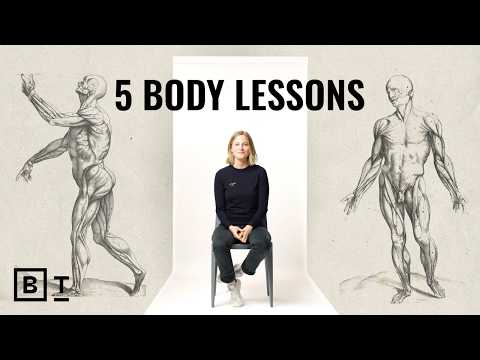
In this talk, Dr. Giulia Enders draws on her book Organs Speak: What Really Means to Listen to Our Bodies to explore the wisdom that five major parts of our body — the lungs, the immune system, the skin, the muscles, and the brain — teach us about life. She stresses that by discarding the outdated view of the body as merely something to be optimized, and instead understanding the distinctive character of each organ and what it means, we can live healthier, happier lives. The talk helps us gain insight into many aspects of life through the messages each part of the body sends us.
1. The Lungs: The Power of Softness 🌬️
Dr. Giulia Enders says that after writing her first book, about the gut, she worked in a hospital and came to realize that all the organs of our body are connected to one another. We often hold an outdated view of the body, and it can sometimes get in the way of healing and growth. In Western society, for example, toughness, assertiveness, and relentless effort are treated as virtues — but the lungs behave quite differently from those values.
The lungs are a strikingly soft and passive organ. They take in air passively, following the movement of the surrounding muscles, and they hold their place without complaint even when slightly squashed by other organs. At first glance this looks like weakness, but it is precisely this softness and flexibility that allows 20,000 breaths a day, which is essential to keeping us alive. Had the lungs been stiff and hard, breathing would have required an enormous amount of energy. Dr. Enders explains that through the lungs we can learn how important the role of people who pursue softness and harmony — easily overlooked socially — is in family, work, and personal life.
"The lungs are very soft, very passive, they just go along with what the surrounding muscles do, they accommodate everyone, and they're even a bit squashed by the other organs. And that sits at the very center of our body."
We commonly think of achievement in terms of just two things: ideas and effort. But the lungs point to a crucial third element — the capacity to receive. Being willing to accept and take in what our effort has earned matters as much as having ideas and working hard. The intricate structure of the lungs is precisely this architecture of receiving.
She recalls the advice her grandmother often gave her, "do mozzy" (be soft). As a child she took it to mean simply "relax," but studying the lungs made her realize its true meaning. The lesson is that when facing life's difficulties, rather than merely tensing up and burning energy, using softness lets you go further. Even on a stressful day, she advises, briefly softening and letting yourself relax rather than tensing is a way to use energy efficiently and get through the day better.
"Life can be hard, and challenges can be rough. And if we only respond to that energy by tensing up, the energy won't be enough. Sometimes we have to use softness to make it all the way through."
Breathing has a unique property that sets it apart from our other organs: it can be regulated by both the conscious and the unconscious mind. Unlike the kidneys, which you cannot tell to stop producing urine, or the gut, which you cannot tell to stop digesting, we can consciously control our breathing. This ability can be put to good use.
The influence of consciousness on breathing can be positive or negative. We regard conscious thought as excellent, but when it comes to regulating the body, the unconscious does a far better job. Under stress, or when you focus too hard on your breathing, dysfunctional breathing can result, consuming a lot of energy and causing dizziness, headaches, and more. 😮
But when the unconscious is not working properly — when you are anxious or stressed — conscious control of the breath can help. Consciously slowing your breathing steadies the heart rate and lowers stress hormone levels, which can contribute to easing anxiety. Conversely, when you are tired you can breathe quickly to activate the brain and nervous system. Regulating the breath is like a game of moving back and forth between stress and relaxation.
The way to resolve dysfunctional breathing is to hand breathing back to the unconscious. You can lower the tempo of your breathing through practices like meditation — simply observing the breath, or exhaling and then waiting until you feel the urge to take the next breath. This can also help people with asthma.
Dr. Enders compares modern society to a breathless sprint. We have made enormous progress since industrialization, but in the process waste products such as carbon dioxide have accumulated — just as carbon dioxide is generated in the muscles when the body sprints. Our body uses additional energy to clear this waste. Exhaling, for example, normally costs no energy, but after a sprint it consumes about 5% of your energy. Remarkably, the cost of addressing pollution caused by climate change is estimated at about 5% of global GDP — revealing a parallel between the body and society. 😲 It is an intriguing perspective: perhaps we can borrow the body's wisdom and apply it to social problems.
2. The Immune System: A Metaphor of Understanding and Cooperation, Not War 🛡️🤝
When we talk about the immune system, we often use words like war, fighting, and killing. Such metaphors do describe one aspect of immune function, of course, but Dr. Enders says they do not accurately convey the whole picture. In place of this metaphor she offers a different perspective through the story of Bill, a pianist who was a friend of her grandmother's. Bill's home was a space where people of many backgrounds could gather and express themselves safely and comfortably. Bill tried to understand people with curiosity rather than judgment.
The immune system is similar. It patrols the cells of our body constantly, seeking to investigate and understand, as if asking, "How are you doing? What's happening here?" The immune system acts intelligently — for instance, it does not immediately attack a virus in the optic nerve, since doing so could cause blindness. It also simply tolerates certain microbes rather than wasting energy on unnecessary inflammation. This is the immune system's wisdom in avoiding unnecessary inflammation that would waste energy and create risk, as in allergies or autoimmune disease.
"Our immune system really goes around to the cells of our body every second and asks, 'How are you doing? What's happening here? How are things going over there?' So that safety can be ensured."
The immune system also actively cooperates with microbes beneficial to us — our commensal microbes. The microbes on our skin and in our gut produce antimicrobial peptides and supply vitamins, playing a role essential to our safety. Seen this way, the immune system is a complex system that does not simply attack and destroy invaders but understands, cooperates, and intelligently maintains safety.
Our perception of bacteria is often full of misconceptions. Of the countless bacterial species, only a tiny fraction actually cause disease. You could compare it to only six people in all of humanity being bad — most bacteria are neither dangerous nor harmful. Their main roles are exchanging genes, aiding digestion, and protecting against harmful bacteria.
So why do some bacteria turn harmful? Dr. Enders explains this by analogy with negative traits in human society:
- Robbery: Bacteria that steal something our body vitally needs can be harmful. Bacteria that take scarce nutrients such as iron, for example, are likely to be pathogens. During infection our body hides iron away from the blood so bacteria cannot use it.
- Violating boundaries: Bacteria that fail to respect boundaries and invade are harmful. Good bacteria stay on the mucous membrane, but bad bacteria can invade cells and cause serious infection.
- Immune evasion (gaslighting): Some bacteria deceive or evade the immune system. They conceal their presence or disguise themselves with our body's own proteins to avoid an immune response. This can cause dangerous infections.
- Toxin production: Some bacteria, like those causing diarrhea, produce toxins that trick our body's regulatory mechanisms. They exploit our body's defense mechanisms to create conditions favorable to their own reproduction.
Some bacteria turning bad is also due to our own behavior. Stress, attacks on the immune system, and environmental destruction can cause bacteria to reveal their harmful traits. New pathogens emerge as destroyed forests push animals into cities, and food spoiling likewise reflects changes in bacteria. In the end, we can be a factor that makes microbes worse.
"What we do to other people, and to microbes, can sometimes make them more malicious or turn them against us. So we are a factor too."
The immune system shows a far more discerning perspective when judging whether something is 'bad' or 'good'. Humans once regarded all bacteria as bad and made mistakes such as removing the colon. But as science advanced, we learned that it is not that an entire species is bad — even within the same species, individuals can have different traits. Genetically near-identical E. coli, for example, can be harmless in one case and cause life-threatening infection in another.
The immune system does not simply classify; it looks into the details of the interaction — what the microbe steals from us, whether it violates our boundaries, whether it evades the immune system. It even understands that a microbe's behavior may be merely a survival strategy. This insight is influencing the development of new antimicrobial therapies, moving toward blocking harmful proteins or inducing bacteria to behave more mildly rather than simply killing them.
"I think it can be a lesson for the bad things in life too. Rather than just lashing out or trying to push them away, looking at the underlying reason can sometimes offer a good solution."
Doctors often tell patients diagnosed with autoimmune disease that "your immune cells are attacking your own body." Dr. Enders points out that this phrasing is not scientifically accurate, and stresses that the immune system is not simply aggressive and stupid. On the contrary, immune cells have the single goal of keeping us safe, and sometimes, like an overprotective parent, they simply overreact and make mistakes.
For instance, when a patient who had suffered a severe intestinal infection was diagnosed with chronic inflammatory bowel disease, she explained that the immune system was overreacting because it had been through something so dangerous — now responding too strongly to what it had failed to respond to before, and even attacking harmless gut bacteria. This perspective helped the patient adopt a gentler attitude toward their illness.
"The immune system doesn't make mistakes because it's aggressive and stupid. It went through something truly terrible, and now it's trying to protect you at any cost, and it goes a little too far."
The immune system teaches us that safety does not mean having no risk at all — it means finding solutions, staying flexible, and finding a way. The immune system has memory cells and responds flexibly to bacteria in various places — wounds, the optic nerve, the gut — finding solutions rather than simply avoiding dangerous things. This way of thinking, Dr. Enders says, can help reduce our anxiety about safety in our own lives. 😌
3. The Skin: How Wounds Teach Us About Healing 🩹❤️🩹
Through her patients and her own experience, Dr. Enders says, we sometimes feel emotions different from what we think we ought to feel. When her beloved grandmother died, she felt numb rather than sad. Sometimes people are not as excited as they expected upon a promotion, or do not immediately fall deeply in love when their first child is born. People in these situations think, "Is something wrong with me? Am I strange?" — but she says no. Humans are far more complex than films and social media portray. 🎭
When she felt numb after her grandmother's death, she was reading about wounds and suddenly had a realization. When skin tissue is torn, at first a numb scab forms and covers the wound. On the surface nothing appears to change, but in fact a complex process is underway beneath it: cells reorganizing, cells that aid healing gathering, and new structures forming. This realization gave her room to cry again, and helped her understand that her emotions were part of a complex healing process. Just as our body draws in the cells and factors needed to heal a wound, we too can naturally find what we need to heal life's wounds.
"It's like tissue being torn from the skin. And then a scab forms and covers the spot for the first few seconds. A numb scab, like what I was feeling. And sometimes, days later, you look down at it and it looks exactly the same as it did two days ago — but the illustrations in medical textbooks show everything that's actually happening beneath that numb scab. It's reorganization. It's drawing in the cells that can repair this, or genuinely finding a new structure to resolve the situation."
Human touch can sometimes have effects similar to medication. We think we have to go to the pharmacy for treatment, but not everything has to come in the form of a drug. Research on premature infants in particular has shown that skin contact lowers stress hormones, improves metabolism, and leads to more flexible coping with stress later in life. Touch is fundamental to humans, and for people who feel lonely especially, touch such as massage can greatly help relieve anxiety. 💆♀️
A good example of the effect of human touch in everyday life is interpersonal synchronization. In one experiment, one person lies inside a tube while someone close to them sits outside holding their hand. They cannot see each other, yet their heart rates synchronize, stress decreases, and blood pressure and stress hormone levels come down to the level of the calmer person. This means that skin contact alone can transmit a settled nervous system to another person.
"Through skin contact alone, we can transmit a settled nervous system to each other."
Beyond ordinary loneliness caused by disconnection from other people, Dr. Enders explains, there is a kind called 'self-loneliness'. It concerns how you treat yourself, how you speak to yourself, how you care for yourself. We often focus so much on the external world that we forget to build a relationship with our own inner world.
When people are tense they touch their own face, which is like saying, "Hello, I'm still here." Just as some people scrub themselves roughly in the shower while others are gentle, the way we speak to ourselves also differs. Whether we disparage our body or treat it with warmth suggests that medically, too, a hostile attitude toward oneself can lead to self-loneliness. This can show up at every level — touch, thought, and behavior.
Humans are genetically capable of healing wounds in two ways. One is the way we generally know, which eventually leaves a scar. In this mode immune cells act aggressively to protect the vulnerable area, sometimes producing aggressive substances to block invaders, and leaving a scar. But in the fetal stage, healing occurs without scarring. A fetus heals simply by stitching the tissue on both sides together, leaving no scar. 👶
If a wound is well managed and kept clean and moist, the immune system feels safer and can use a different healing technique, so less scarring may result. This is known as 'moist wound dressing'.
The way scars form during wound healing is strikingly similar to the process of psychological healing.
- Excessive scarring (hypertrophic scars, keloid scars): This is like overreacting after being injured. Just as someone robbed installs five locks on the door, or someone cheated on constantly checks their partner's phone, the body produces more tissue than necessary, creating hypertrophic or keloid scars. Keloid scars can even keep growing without outside intervention.
- Sunken scars (atrophic scars): The opposite of hypertrophic scars, these sink below the surrounding skin. This resembles people who, after a tragic loss, blame themselves — "What could I have done differently? Was it my fault?" — and endlessly relive the past. Immune cells go to the damaged area and keep attacking the tissue that is trying to recover normally, so the skin sinks in. Vaccination scars and acne scars are examples.
These analogies can help us look at whether, when we are struggling and hurt, we are overreacting or blaming ourselves excessively. For a wound to heal beautifully, you must reduce outside interference, minimize stress, and supply calm and ample nourishment so the cells can do their work. 😌
The outermost layer of the skin that wraps our body consists of dead cells. This reveals the paradoxical truth that death is life's armor. Because dead cells are not sensitive, scratching or moving them causes no pain. And since viruses can only replicate in living cells, dead cells are like a chair or a floor to a virus, serving as an invisibility cloak that protects the body from viruses. Only the wart virus can infect the skin, and even that requires a small break in it. 🩹
This dead skin layer also has no blood flow. A very shallow cut does not bleed. All these properties form a defensive barrier protecting the living cells beneath. Dr. Enders suggests that this shows how death can be the limit needed to cherish and protect life.
4. Muscles: Strength Is Not Simply Physical Force 💪🧘♀️
Dr. Enders points out that our way of thinking about strength and achievement is outdated. When we think of muscles and strength we picture lifting something heavy, like Popeye, and we tend to assume that because men have more muscle than women they are stronger and better at the work. But looking at how muscles actually work reveals that strength has far more dimensions.
She takes her own mother as an example. Raising children as a single mother, she achieved something great in ways society does not recognize. Her mother always poured in 150% of her energy and would fall asleep exhausted on the sofa at night. It was not outward success or the strength to lift something heavy, but with a resilient attitude she overcame many hardships.
Muscles are the same. Beyond the concentric contraction that lifts an object, there is also the strength to hold a posture and the strength to resist and hold firm. There is also the way of using force to keep something from moving in the direction it wants to go, as when lowering a heavy object slowly.
Our body contains a wide variety of muscles exerting force in a wide variety of ways. The masticatory muscles that move around the mouth are among the strongest, exploiting perfect angles. The eye muscles excel at changing direction extremely fast, which is another kind of strength. The bladder muscle operates efficiently on little energy, slow but remarkably resilient. Through this diversity, Dr. Enders stresses, we learn that strength does not appear in only one form, and that we should recognize diverse forms of strength in work and in society.
"My mother poured 150% of her energy into raising her children. And sometimes at night I would see her asleep on the sofa. The day had been so hard that she fell asleep a little early. And as a child I always liked that — I thought, 'Ah, she looks peaceful.' But now I understand it was because doing all of that was truly hard."
It is well known that exercise offers countless benefits for brain health, metabolism, and more. But Dr. Enders points out that these wonderful effects occur not during exercise but in the 'downtime' of rest and regeneration afterward. This teaches us that time for rest and reflection matters as much as action and effort.
During rest the heart muscle grows stronger, the lungs become more powerful, and the muscles replenish energy and prepare for the next day's challenge. The brain also responds very sensitively to exercise, forming new receptors and adapting. We commonly think that at work or in exercise we must 'give our best', 'shoulder the burden', and 'push past our limits' — but this makes it easy to overlook the recovery phase where exercise's true benefits arise.
The same holds at work. Short breaks, lunch hours, weekends, and evenings are not simply about 'recharging the battery' but an important stage in which the body replenishes its resources, adapts, and changes to operate more efficiently. When professional athletes design a training plan, they weigh not just training volume but the time required for recovery. Only with sufficient recovery can they perform better in the next session. 🏃♀️
This perspective can also help people experiencing burnout syndrome. If you dismiss the importance of rest and try to keep working, productivity actually falls, and you end up doing less — as if 'overtraining'.
"Athletes will plan their training schedule around the time recovery takes rather than around what they actively do. That way they can train again and do more. And at work it can be very helpful in situations like burnout syndrome — because people no longer treat rest as important and think they have to do more."
At the same time, though, over-relaxation can also be a problem. Without exercise muscles shrink, and lying in bed for a long time due to illness causes dangerously large muscle loss. People losing their sense of purpose and becoming listless after retirement is also related to over-relaxation. Appropriate challenge and activity are necessary.
Science recently discovered a protein called titin. This protein solved the long-standing puzzle of why muscular exercise and success are not simply proportional to 'effort'. Life is dynamic, and unexpected obstacles exist. Our body knows this, and through the spiral protein titin it stores energy and releases it when needed, providing an 'extra spring in the step'. 🤸♂️
The reason Olympic sprinters jump before they run, and the reason yoga and Pilates make already-strong athletes stronger, is precisely the action of titin. This suggests that understanding and working with dynamism, not merely working hard, matters for success.
Dr. Enders used to find exercise strange, regarding it as 'unnecessary movement'. She held the critical view that modern people work only with their heads and, their bodies having lost their work, do a kind of 'occupational therapy' at the gym. But as she researched exercise more deeply she discovered some interesting facts.
Harvard researcher Hammond Pona showed that people in traditional tribes who hunt, gather plants, and move a great deal in nature need only 2,000 calories a day — the same as a modern person sitting at a computer. The conclusion, then, is that exercise does not burn calories; it makes metabolism more efficient and resource-efficient.
When you start exercising you may lose weight for the first six months or so, but after that the body adapts and changes how it distributes energy. It produces fewer sex hormones and immune cells and reduces energy stores to secure the energy needed for activity. These changes bring the effect of reducing the risk of certain cancers, metabolic disease, and obesity.
She suggests that exercise can be 'a playful game with stress'. Exercise triggers stress responses resembling illness — raised body temperature, increased heart rate, elevated blood pressure — but this is stress you can stop at any time and that is not dangerous. She points out that the social pressure to exercise, and the message that it is your own fault if your health or appearance suffers when you do not, is unnecessary. Instead, exercise can be seen as the pleasure of moving and feeling your body without any obligation. 🤸♀️
This kind of enjoyable stress experience teaches the body not to perceive stress responses such as raised temperature or fast breathing as threats, and to return quickly to a relaxed state. This can strengthen the bones and improve overall physical capacity. This perspective can make sport more enjoyable and more beneficial.
"If we didn't take exercise so seriously — or didn't listen to the voice saying, 'If you don't exercise you're not healthy, and it's your fault your mental health and your looks are getting worse.' I really don't like that pressure. Because exercise can be a playful game with stress. Stress that isn't genuinely dangerous. Stress you can stop whenever you want. Stress where you can even burst out laughing, or just enjoy moving your body. Where brain and muscle work together, and you don't have to give the work meaning or take responsibility for it. Just moving and feeling. And a playful game with stress is actually a very good idea."
In conclusion, strength is more than lifting something heavy. It is a way of converting energy — turning energy that originated in the Big Bang into movement. From lifting something heavy to holding an upright posture, resisting force, moving fast or slow, all of it is strength. This diversity of strength reflects differences in how energy is used, and our body applies force in a way perfectly suited to each situation. In other words, what matters is not who is strongest but who is in the most appropriate place. 💪
5. The Brain: We Are More Than Machines 🧠✨
Dr. Giulia Enders says that when writing about the brain she often thought of her younger sister. Like their relationship, with its different strengths and abilities, the brain's various regions work in a similar way. We often value being awake over being asleep, treat being emotional as lesser than rational thought, and regard addiction as worse than motivation. This binary way of thinking shows up in the relationship between brain and body too, casting the brain as a 'head chef' issuing orders to the body.
But the brain is about relationship and connection. It connects different capacities and strengths to produce the best result. Not one of them is less important than another. Just as you need sleep in order to be awake and need wakefulness in order to sleep well, every region is complementary.
"The brain is about relationships, about connecting different abilities and strengths and drawing the best out of them. There's never a case where one is worse or less important than another. You need sleep to be awake, and you have to be awake to get really good sleep."
Amid the recent fervor over artificial intelligence, Dr. Enders says we tend to overestimate AI's capabilities. Citing the immunologist Irun A. Cohen, she notes that comparing AI with the immune system reveals the difference in complexity. AI forms networks through millions of data connection points, whereas the immune system operates with trillions of cells connecting information and forming patterns. This is far more complex than any AI in existence.
Cohen says the immune system is in fact more similar to human consciousness through its informational connections with the nervous system. Only 10–15% of what the human brain does can be imitated by AI. The remaining 85–90% is the phenomenon of being alive, of feeling, of experiencing taste and smell and connecting it all to experience. Fascinated by machines and AI, we overlook these essential human dimensions.
"All of this is the phenomenon of being alive, of feeling, of tasting, of smelling, of connecting all of it to experience. And I think we're sometimes so fascinated by machines, computers, phones, and AI that we ignore the fact that we are so much more than this."
However far AI advances, it will not become a living being — a being that has consciousness and experiences. This fact means we are not stupider, more broken, or less capable than machines, but works of genius. We should take pride in ourselves.
In an era when the world is so noisy and outside voices dictate so much about how we should see ourselves and how we should feel about our bodies and our lives, Dr. Enders casts fresh light on the value of the body. If we were to rebuild our body perfectly, using all its living cells, delicate blood vessels, and nerve fibers, it would come to tens of trillions of dollars. That is comparable to the combined value of the ten most valuable companies in the world today, or to all the buildings in New York or London combined, or to the value of every artwork on the market. 💰
These figures carry an important message. Rather than being swayed by the values of the external world and the messages constantly poured into us, we should recognize the value of our own living body, perfected over millions of years of evolution. She says she felt a deep sadness watching patients at the end of life in the hospital finally realize how precious and marvelous their bodies had been, and regret it.
"Sometimes in the hospital we see patients realize only when they are truly ill, or even at the very end of life, that they had this precious body, this wonderful body. A body that sometimes makes mistakes, but that let them be alive through this delicate, ingenious thing. And now they know it will soon be gone. And suddenly they realize its value. And they realize they had ignored it, or never really tried to understand it, or never tried to cooperate with it more lovingly."
We are trapped in such a cognitive world, clinging to phones and screens and losing contact with reality. This disconnection can lead to mental health problems such as anxiety, depression, and irritability. Might society as a whole be too far removed from the authenticity of life, from what we need in order to live, from good relationships, from feeling safe?
Dr. Enders believes that the body can bring us back to reality and root us again in the truth of life. For the brain to learn about its own organs, to understand their genius and strengths, and to know how to care for them and cooperate with them better is deeply worthwhile. Our body is not simply something to function and be optimized, but a being that holds deep wisdom.
The wisdom of softness the lungs show, the wisdom of cooperation and tolerance the immune system shows, and the wisdom of diverse and subtle strength the muscles show existed long before the systems and values humans created, and they can offer a firm, warm, and respectful strength to our lives. 💖
In Closing
Dr. Giulia Enders' talk leads us away from seeing the body as merely a biological machine and toward discovering the deep wisdom of life each organ holds. We learn the value of flexibility from the softness of the lungs, grasp the importance of understanding and cooperation from the immune system, understand the stages of psychological recovery through the skin's healing process, and redefine the meaning of true strength through the many forms of muscular force. Finally, through the relationship between brain and body, we come to recognize that we are far more complex and marvelous beings than artificial intelligence. All of it points toward a path of listening to the body we have forgotten amid our busy modern lives, loving ourselves more, and recovering the essential values of life. 🌿