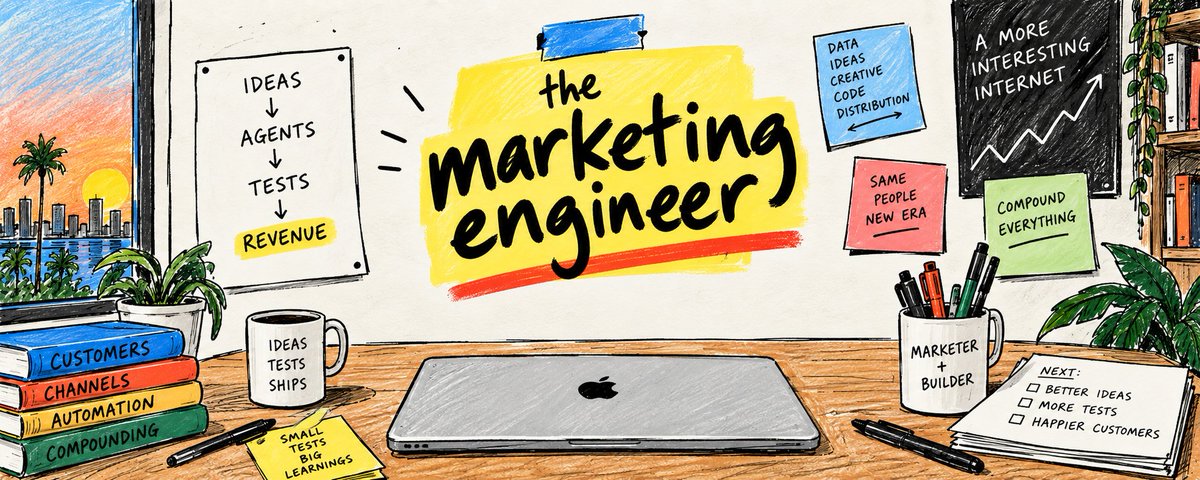
This article explains the marketing engineer who connects customer research, content and ad production, campaign execution, and performance analysis into an automated system. The point is not merely faster AI drafts. It is structuring customer data and practical knowledge for AI, then rapidly running and learning from dozens of experiments. The author predicts that organizations understanding customers best and executing fastest will beat those relying on large budgets or teams.
1. The Marketing Engineer as a New 10x Talent
Greg Isenberg calls today's marketing engineer the equivalent of a "10x" contributor. Becoming one, or hiring one, may be the biggest growth lever for a startup, established business, or side project. He considers this perhaps the most exciting marketing era since Google AdWords, or even in marketing history. 🚀
For 20 years, execution was harder than ideas. Sales knew why customers bought; support knew why they left. Turning that knowledge into campaigns required briefs, designers, developers, analysts, and meetings. Many ideas died in Slack.
"Marketing ideas were easy. Execution was hard."
He believes this execution bottleneck has collapsed. Agents can quickly read last week's sales calls, turn customer statements into landing pages, run ads, stop poor performers, and identify campaigns that acquired paying, retained customers.
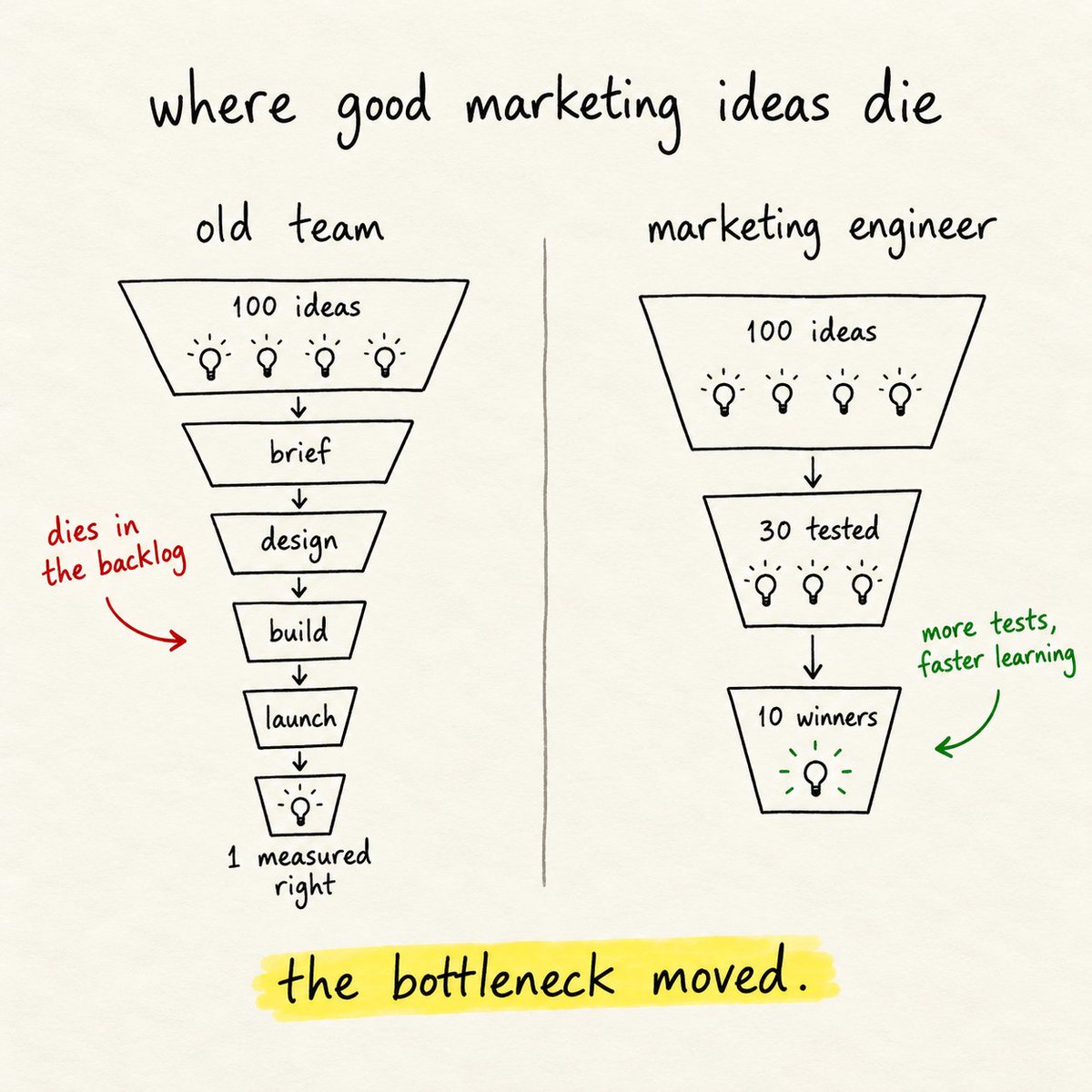
The marketing engineer connects those agents into one machine. Part marketer, maker, developer, and operator, this talent may come from founders, engineers, operators, and solo makers as well as traditional marketing roles.
2. Marketing History Is the Falling Cost of Experiments
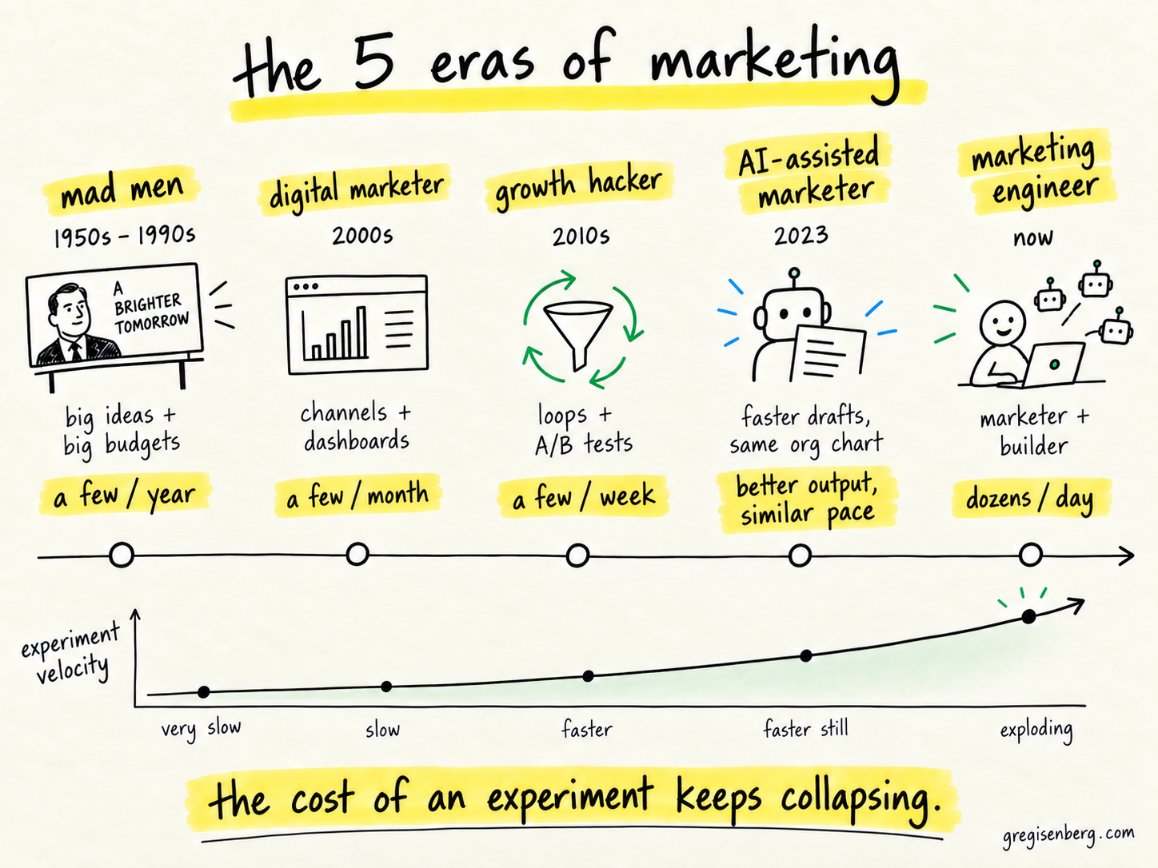
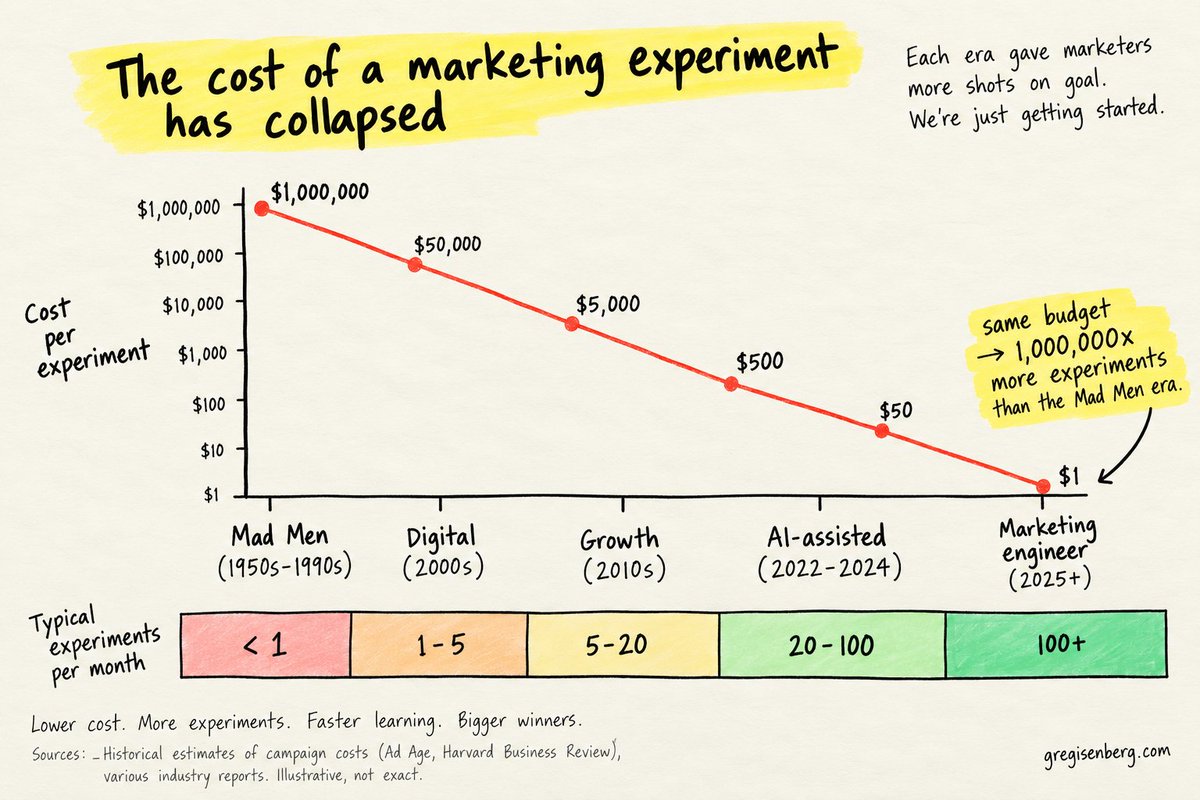
He describes marketing's evolution as a continuing fall in the cost of running good experiments.
In the Mad Men era, from the 1950s through the 1990s, marketing centered on print, television, radio, and billboards. A major campaign cost millions, took months, and yielded results a quarter later if fortunate. With only a few substantial attempts each year, marketing depended heavily on taste, persuasion, and intuition.
Google AdWords in 2000 and Facebook ads in 2007 made clicks measurable and produced the digital marketer. Managing SEO, search ads, email, and display channels mattered; those who understood platform dashboards best won. Still, experimentation was limited to perhaps a few tests monthly.
In the 2010s, Sean Ellis's growth hacker combined product and marketing: Hotmail's email-footer referral message, Dropbox's referral rewards, and Airbnb's cross-posting to Craigslist. Funnels, loops, and A/B testing became central. Yet good ideas needed engineers tied to the product roadmap, leaving growth hackers filing tickets and waiting.
ChatGPT's arrival in late 2022 brought the AI-assisted marketer. Copy and images became faster, but org charts, meetings, and six-week execution cycles remained. He thinks most teams are still here.
Next comes the marketing engineer: the person with the idea also implements it. One person researches customers, builds pages, generates creative, connects data, and runs tests. The work unit becomes a system continually producing campaigns, rather than an isolated campaign, making dozens of daily experiments realistic.
"Whoever runs the most good experiments learns fastest, and whoever learns fastest wins."
3. Extract the Customer Knowledge Buried Inside the Company
Every company sits on an underused gold mine. Sales knows recurring objections. Support knows which promises lead to refunds. Founders have strong views on markets and competitors. Analytics knows which pages attract retained customers.
That knowledge is scattered across CRM systems, support tools, call recordings, and founders' minds, and rarely reaches campaigns.
Small ideas can be valuable: a price calculator for a niche, an ad from yesterday's sales call, or a message to old prospects when a requested feature launches. Previously, design, development, analytics, and meetings buried these in backlogs.
A marketing engineer can launch them in an afternoon. As narrowly targeted marketing becomes cheap, deeper customer understanding wins. Hourly-service agencies may feel pressure first; large marketing organizations may look like slow committees. Founders and solo marketers can produce an entire department's output.
He mentions a partner's recently launched service. Its premise is turning what companies already know about customers into clear offers, useful landing pages, and follow-up that converts. A marketing engineer can build the full flow, find drop-offs, and improve the system as customers accumulate.
4. Build the "Company Brain" Before the Agents
Start with an AI-agent workspace such as Claude Code, Codex, or Cursor. Think of it as a very fast junior employee living in a computer folder: reading and writing files, running code, and using connected tools.
MCP, the Model Context Protocol, is particularly important. He compares it to a universal plug for AI. HubSpot, Stripe, Notion, and Slack offer MCP servers, letting agents read CRM records or retrieve last week's revenue. If a tool offers only an API, an agent can generally write code to call it.
Agents can also run on schedules. Instead of complex Zapier or n8n workflows, ask a coding agent:
"Run every Monday at 7 a.m., post a report to Slack, and send nothing until I click an approval button."
The agent can implement the schedule, Slack message, approval button, and code gated on approval. Persistent background agents such as Hermes or OpenClaw are another option. Everything lives in one's folders and code and can be changed through natural-language requests.
Many people immediately create ten agents, get generic output without context, and conclude AI marketing is overrated. The problem is poor context, not agents.
"It's like hiring a smart marketer and skipping onboarding."
First build the company "brain": a folder explaining the business as to a capable employee on day one.
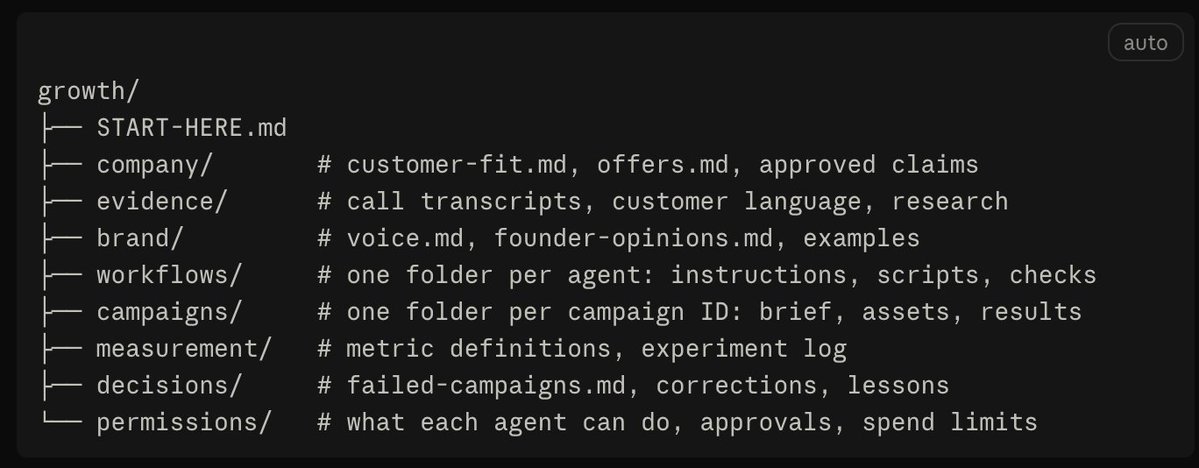
He proposes six key files:
-
START-HERE.md
A one-page starting point every agent reads first: what the company does, whom it helps, quarterly priorities, and where other materials live. -
company/customer-fit.md
Describe who buys, stays, and can be served profitably. Avoid broad labels such as "small businesses." Be specific: "Shopify stores with $1–10 million annual revenue, where the founder still handles bookkeeping and has been disappointed by a previous bookkeeper." -
company/offers.md
Record products, prices, permissible promises, and claims requiring approval before external use. -
brand/voice.md
Abstract phrases such as "friendly but professional" do not help. Include three approved emails or ads with reasons, and two rejected examples with reasons. If an ad promised results within 30 days that the company could not guarantee, state why it was rejected. -
brand/founder-opinions.md
Capture the founder's strong views on markets, customers, and competitors. Everyone may use the same models, but a founder's perspective is hard to copy: an unfair advantage. -
decisions/failed-campaigns.md
Record lessons paid for with real losses: free audits attracting only tiny companies without purchasing power, or LinkedIn generating leads but few deals. One line can prevent repeating a $20,000 mistake.
A crucial rule: agents may add hypotheses to evidence/, but may not move them into company/ before human review. This prevents one agent's guess quietly becoming company policy.
5. Connect Customer Data and Performance Measurement
Give the company brain "eyes" by connecting sources of real customer voices:
- Gong and Fathom sales-call recordings
- Intercom and Zendesk support tickets
- HubSpot and Salesforce deal records
- PostHog and Google Analytics behavioral data
- Stripe revenue data
Start with read-only access everywhere. An agent reading CRM is useful on day one; permission to modify it must be earned.
Another tedious but decisive step is assigning a campaign ID to every campaign. Put it in link UTM tags, ad names, email-sequence names, and CRM deal fields. Create a Supabase table, or initially a spreadsheet, with:
- Campaign ID
- Ad spend
- Leads
- Qualified calls
- Closed deals
- Revenue
- Churn
Most companies know clicks by campaign and revenue by customer without connecting them. Linking this table lets agents answer the important question:
"Which marketing brought customers who actually pay and stay?"
Start by making one agent excellent, rather than connecting many. Six agents talking on day one may leave you debugging a group chat all weekend.
6. The First Agent: Find the Customer's Language
Start with a customer-language agent, because all other marketing begins with the words customers actually use. Its job is to find their exact descriptions of their problems.
Put transcripts of 20–50 recent sales calls in evidence/calls/ and have the agent read them all. Initial output may be only about 70% right. It may overweight one talkative customer or describe segments in marketing jargon. Review it, revise instructions, and save corrections in decisions/. After three or four iterations, it may read calls better than many teammates.
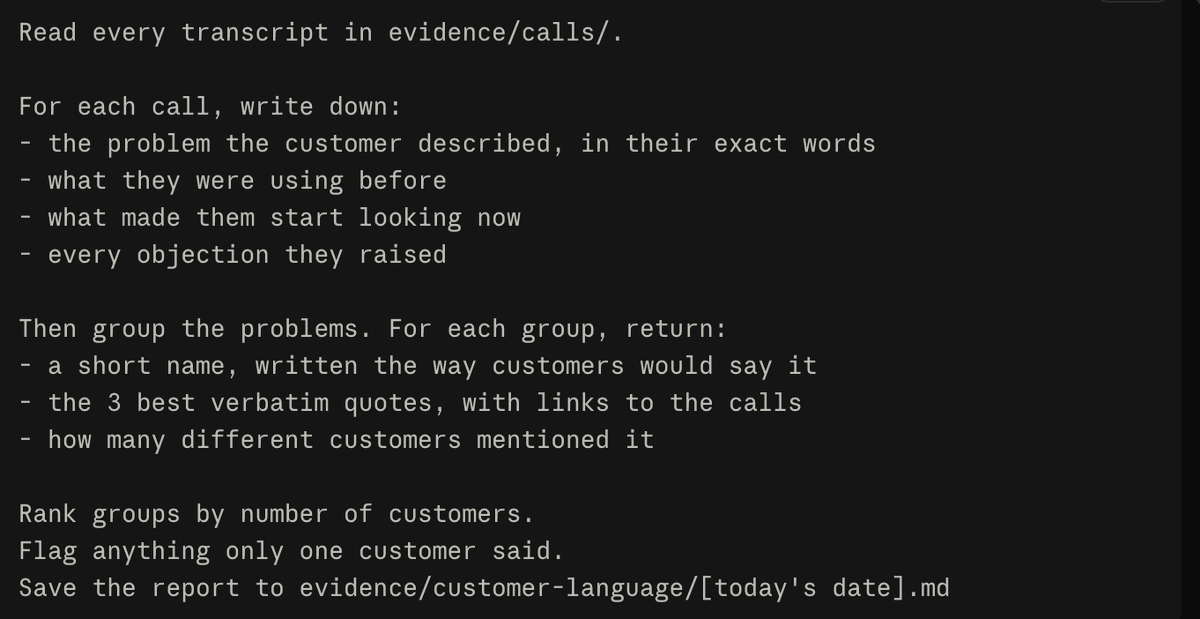
Suppose you sell scheduling software to plumbing or HVAC businesses. The agent may notice customers repeatedly saying:
"I'm tired of answering the phone during dinner."
This is more powerful than "automated scheduling." It can become ad copy, a landing-page headline, or the start of a sales conversation. People often buy to solve an uncomfortable situation, not for features themselves.
Once reliable, schedule it each Monday to read the prior week's sales calls and support tickets and write to evidence/customer-language/. Marketing then uses what customers actually said last week, not guesses someone made last year.
7. Core Agents That Turn Customer Language Into Action
Once the customer-language agent is stable, add other agents individually. Each needs its own folder, instructions, and schedule inside workflows/.
Buying-Trigger Agent
The buying-trigger agent finds events suddenly creating demand: a second location, a move into wholesale, a startup raising funding and hiring salespeople, or a new feature in an integrated tool.
Use Clay to list companies fitting customer-fit.md, with columns tracking hiring, funding news, expansion, and new website pages. Apollo can supply contact data.
For each signal, check CRM to exclude companies already talking to sales, then complete:
"This event creates this problem, and our product solves it in this way."
If vague, hold the account. If precise, draft a short email opening with the event for human review. This sentence makes outbound feel like well-timed help, rather than spam.
Search Agent
The search agent finds questions people ask just before buying and builds the internet's best answer page. Its three inputs are:
- Google Search Console data
- Recurring sales-call questions
- Industry answers from AI search tools such as ChatGPT, Claude, and Perplexity
The third is new and underestimated. Ask likely buyer questions weekly, recording recommended companies and sources. This reveals what models trust and where your company is absent.
Genuinely useful pages beat mere optimization in AI search. A commercial kitchen equipment company could offer a first-restaurant guide and a calculator based on space and budget. These can earn rankings and AI citations, and buyers save them. An agent can build a calculator in a day and deploy through Next.js and Vercel, or Framer.
Creative Agent
The creative agent creates and tests ads. Supply the latest customer-language report, approved claims from offers.md, real product videos and screenshots, and liked ad examples. Ask for different reasons to buy, not 50 variations of one headline.
Test distinct angles:
- Showing an actual problem being solved
- A customer success story
- A raw product demo
- A founder's blunt opinion
- A competitor comparison
- Content challenging a common misconception
Names such as BK014_dinner-angle_ugc_v2 capture campaign ID, hypothesis, and format. A month later, "the dinner-time message beat price" becomes reusable learning; "video_final_7 won" is less useful.
Upload ads through Meta Ads API in paused status only, with a human publishing them. A script can check daily and stop ads with CTR below 1% after a defined spend. Set budget, duration, and success criteria first, or 200 ads will produce 200 inconclusive experiments.
Lost-Deal Agent
The lost-deal agent may repay the cost of the whole system. Pull lost deals, notes, and call transcripts from CRM, recording the actual loss reason and conditions for renewed contact.
"Not interested" is usually a lazy summary. Actual reasons might be:
- A competitor was chosen, with renewal in March.
- SSO is required.
- The internal champion left the company.
Monitor those conditions. When the changelog announces SSO, draft personalized follow-ups referencing the original calls with prospects who requested it. Approaching renewals or champions moving companies also create opportunities. Always respect opt-outs and contact preferences.
Performance Agent
The performance agent reads the campaign table each Monday and writes a short, sharp analyst's memo.
"The profitability-review page converted at 4%, but half the leads were companies too small for us to serve."
"The dinner-angle ad has the lowest cost per qualified call."
"Retargeting spent $3,000 and produced only two sales conversations."
Each statement must end in a keep, stop, change, or test further decision. Connect results beyond leads and deals to retention, refunds, and profit. Cheaply acquired customers leaving after 60 days may flatter the dashboard while harming the business.
8. Guardrails and Human Approval
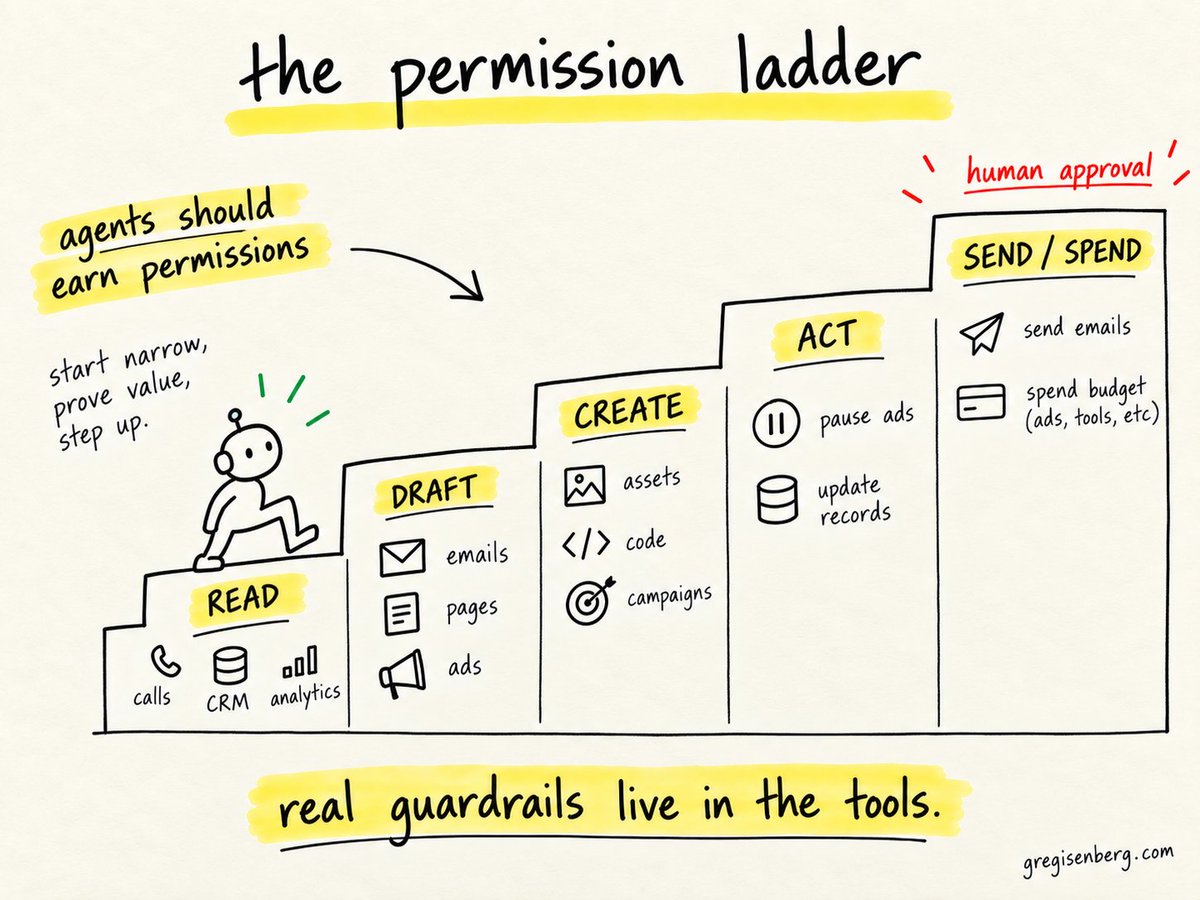
Do not trust the prompt "Always ask before sending." It is only a polite request to a model. Real safeguards belong inside tools and code.
"Real guardrails live in the tools."
Grant each agent only the minimum permissions. Outbound agents may draft, not send. Ad agents may create paused ads; humans control budgets.
Implement approval in code, such as requiring a Slack button before execution. Use ordinary code for exact rules such as spending limits, suppression lists, and deduplication. Use models for judgment such as account fit or brand voice.
Each agent also needs a short work contract describing its role, allowed actions, restrictions, and output standards. "Done" must include checking every data source within the defined scope and reporting broken sources.
One agent saying "This source failed today" is better than ten silently skipping data.
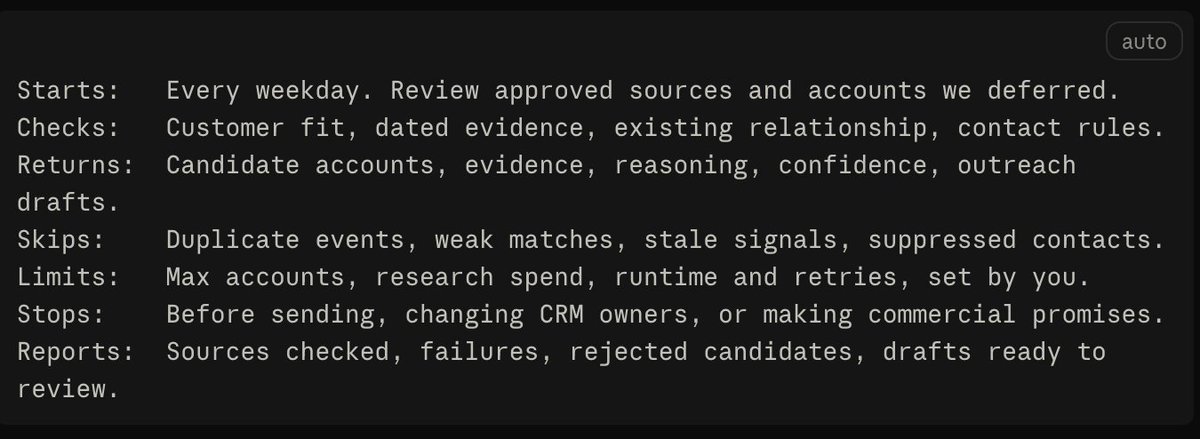
9. Example: An Ecommerce Accounting Firm's BK014 Campaign
The author demonstrates the system with an accounting firm seeking ecommerce clients.
On Monday, the customer-language report finds something online store operators repeated over the past month:
"After returns, shipping, and fees, I don't know whether I actually made money."
Eleven customers said something similar. The marketer asks the delivery team whether it can solve this. It is the first issue they solve for every new client. A free profitability review for stores with $1–10 million annual revenue is approved in offers.md.
The campaign receives ID BK014, used in every ad, landing page, email, and CRM record.
On Tuesday, the creative agent develops three angles using the customer's words:
- Where profit disappears
- A sample monthly report
- A short real-customer story
The search agent builds a simple profit calculator using figures verified by the firm. The lost-deal agent finds 60 prospects who said they would reconsider after year-end and drafts personalized messages. The buying-trigger agent identifies stores newly selling on Amazon, where multichannel sales complicate bookkeeping.
On Wednesday, a human reviews everything together, removes an ad guaranteeing savings, approves the rest, and starts a $2,000 test.
Two weeks later, the performance agent connects spending, booked review calls, and closed deals. The calculator converted best, and the Amazon-expansion list generated the most calls. It also warns that the sample remains small.
The crucial feature is that original customer language survives the entire process. Normally, research summaries, briefs, and revisions flatten insights into generic copy. Here, the quotation travels with the campaign folder so every agent sees the same vivid language.
10. Daily Work and the Learning System
Once built, the marketing engineer acts more as editor and decision-maker than hands-on producer.
- Monday: Read performance notes and decide what to keep, stop, or change.
- Tuesday and Wednesday: Build tests and fix workflows that produced weak results last week.
- Thursday: Talk with sales and support, where next week's good ideas are hiding.
- Friday: Review agent output and update company-brain files.
A review queue sits at the center. Each item should be decidable within a minute: "Approve this revised offer? It affects two ads and one email." Show what changes, where it matters, and the evidence.
The system improves by improving inputs, not merely fixing output. Record why an ad was rejected. If it attracted companies too small, change customer-fit.md. If prospects misunderstood the offer, add a check for that misunderstanding.
Keep recording:
- What was tested
- Why it was tested
- What happened
- What happens next
Keep ten example inputs with expected results per agent. Rerun them whenever instructions change to detect regressions.
If you fix output all day, the problem is upstream, usually in the company brain or agent contracts.
"If you spend all day fixing agent output, the problem is upstream. Almost always, it's the company brain or the contract."
11. Advertising's Shift From Targeting to Creative
He argues creative is the new targeting. Meta's Andromeda finished its global rollout in late 2025 and reads images, opening lines, and scripts to decide whom to reach.
Creative now performs work previously done by interest targeting. This disadvantages lazy advertisers. Andromeda groups similar-looking ads, so 50 headline variations may achieve little more reach than one ad. Winning ads also fatigue faster, typically within two or three weeks.
The answer is a steady flow of truly different ideas. A creative engine can now do what previously required a production team.
Feed voice.md and the current customer-language report to Claude or GPT. Ask for eight to 12 distinct concepts, each with two or three hooks: problems, actual use, customer stories, founder opinions, comparisons, and myth-busting. Spend the most time here; this is the strategy.
Nano Banana, GPT Image, and Midjourney can create images. Supply real product photos to preserve product accuracy while models change backgrounds, scenes, and context.
Veo, Kling, and fal can turn scripts or stills into short videos. Arcads, HeyGen, and Creatify supply AI actors reading scripts in multiple languages. ElevenLabs handles voice; CapCut and Captions handle editing.
His strategy is:
"Test with AI actors. Pay humans to win."
AI actors enable cheap testing of 20 scripts a day. Once a script works, a real person may deliver more trust and better results. Follow platform requirements for labeling AI content.
Agents upload paused ads, humans approve publication, scripts stop poor performers, and the performance agent reports winning concepts and next hooks weekly. Humans judge ideas and taste; the system handles volume.
12. Organic Content and Wider Growth Opportunities
Paid ads attract attention, but organic social can be a quiet advantage: free distribution and the cheapest creative laboratory.
Use it as a test kitchen. Post ten hooks to TikTok, Reels, and X, observe which the algorithms favor, and spend only on proven content. Free feedback directs budgets toward ideas with demonstrated potential.
A podcast, webinar, or founder's walking monologue can yield 20 short clips. Opus Clip finds strong moments and adds captions; agents can schedule across platforms.
Faceless formats also scale. Turn customer-language findings into TikTok and Instagram slideshows or carousels. Agents write slides, models create images, and a human batch-approves them on Sunday.
Listen first. Have agents analyze Reddit, X, TikTok comments, and competitor reviews for weekly complaints, questions, and hopes. Draft helpful replies where the product is genuinely relevant, with humans publishing. Authentic human-written Reddit answers can beat ads; spam can get accounts banned.
Real founder perspectives become scarcer as AI content proliferates. Generate daily drafts from founder-opinions.md, then have the founder edit and publish in their own voice.
Follow two rules:
- Label AI-generated people and scenes when platforms require it.
- Have a human press the final publish button.
Automating basics opens four opportunities:
- Build decision tools: A packaging company's box calculator for shipping savings, or a software migration checker, becomes something buyers save and revisit before purchasing.
- Market to buying influencers: Create separate campaigns for accountants, agencies, and IT staff who recommend the product.
- Fix acquisition through onboarding: First-week confusion rather than ads may cause churn. Analyze onboarding tickets and remove friction.
- Give channels different roles: Search answers questions, social starts conversations, email arrives at a specific moment. Repeating the same message everywhere pays five times for the same exposure.
13. Tools and Skills
Tools change every few months, so understand functional categories, not just names. The article lists:
- Agent workspaces: Claude Code, Codex, Cursor, Google AI Studio
- Always-on agents: Hermes, GrokBot, Codex
- Writing and strategy: Claude, ChatGPT, Gemini
- Image generation: Nano Banana, GPT Image, Midjourney
- Video generation: Veo, Sora, Kling, Runway, Fal
- AI actors and UGC: Arcads, HeyGen, Creatify
- Voice: ElevenLabs
- Editing and clipping: CapCut, Captions, Opus Clip
- Customer voice: Gong, Fathom, Intercom, Zendesk, G2
- CRM: HubSpot, Salesforce
- Signals and enrichment: Clay, Apollo
- Search and AI visibility: Ahrefs, Semrush, Google Search Console
- Ad execution: Meta Ads API, Google Ads API
- Web building: Next.js and Vercel, Framer, Webflow
- Measurement: PostHog, Stripe, Supabase
Marketing engineers need both marketing and building skills.
As marketers, they must hear the important sentence in an interview; position a product so fitting customers recognize it as made for them; design offers with genuine reasons to buy rather than repackaged discounts; write scroll-stopping headlines; understand each channel's exposure mechanics; and distinguish statistical signals from chance.
As builders, they must especially write context agents can use, which he calls the most underrated skill. They also need enough understanding to judge generated code, connect APIs and MCP, and use basic SQL, deployment, Git, test cases, and agent-cost tracking.
The fastest lesson is not ten courses. It is one ugly but actually deployed landing page, built this weekend with AI coding tools.
14. How to Start Now, and What Comes Next
First steps depend on role:
- Marketers: Build a customer-language agent from the latest 20 sales calls.
- Engineers: Attend five sales calls, then build a calculator for one customer segment.
- Founders: Reserve two hours this weekend to write
founder-opinions.md. Every subsequent agent becomes sharper.
Keep publishing, outreach, and ad spending behind approval initially. Do not add a workflow until the previous one earns trust.
"A confused workflow running every morning is just a reliable delivery system for confusion."
For much of marketing history, the largest budgets and teams won. He expects the next decade to favor those understanding customers best and turning that understanding into action fastest.
He predicts that by 2028, top marketing teams may consist of one or two marketing engineers running dozens of agents, delivering faster than departments ten times larger. These people may already work in growth, content, or operations, one weekend project away from beginning the transition.
15. Closing
AI is more than a tool for making marketers write faster. Properly designed agents create a continuous experimentation system that reads customer language and carries it into ads, content, landing pages, outbound, and performance analysis.
Success does not come from indiscriminately adding agents. It requires accurate customer context, recorded company knowledge, connected performance data, least privilege, human approval, and consistent feedback. The strongest advantage is hearing real customer problems and translating insight into experiments faster than anyone else.