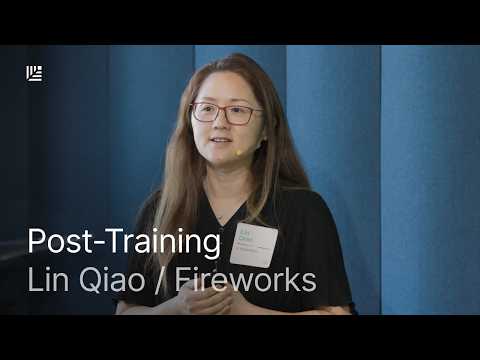
Lin Qiao, co-founder and CEO of Fireworks AI, lays out why AI application companies must own their own intelligence rather than merely consume a commercial API, and offers a concrete approach to post-training. She traces the technical progression from prompt engineering to RAG, supervised fine-tuning (SFT), preference tuning, and reinforcement learning (RL), and shares the key practical traps to watch for: data quality management, preventing reward hacking, and aligning the serving environment. In particular, she describes a practical roadmap for post-training models on high-quality production data accumulated after product-market fit (PMF), cutting serving costs by 5–10x and building a powerful business moat that cannot be copied.
1. The limits of commercial APIs and the need for a distinct moat
In the past, turning a good idea into a shipped product required a team of dozens of excellent engineers and PMs working across multiple quarters. Today the barrier of resources and expertise has fallen so dramatically that an application can be finished in a few weeks even if not a single person on the team can write code themselves. This shift has radically accelerated product development, but it has also made competition at the application layer extremely fierce — anyone can clone a similar app from a single screenshot.
As a result, it is hard to build a sustainable business simply by layering a product on top of an off-the-shelf black-box API (a commercial model). Every company exists to solve a specific problem in its own original way, and the founder's judgment, distinctive taste, and conviction are embedded in that product.
"Every company exists for its own reason, because it focuses on solving a unique problem in a special way. That means the company's judgment, taste, decisiveness, and conviction are embedded in the product."
Only by moving beyond a structure of renting a commercial API — and instead encoding the company's understanding of its customers and its own judgment directly into the model weights — can you build a strong moat that cannot be imitated.
2. What owning intelligence means, and the step-by-step technical roadmap
To own intelligence rather than rent it means directly controlling the whole path: from data, through model weights, to serving infrastructure. Foundation model labs build general-purpose models from public data and labeled data for common tasks, while real businesses have to solve their own specialized domain problems. Curating high-quality production data, augmenting it with synthetic data, and injecting it into the model is therefore essential.
Advancing intelligence should be approached in stages, and the progression closely resembles how humans acquire knowledge.
- Prompting: Use the pre-trained model as it is; the stage for testing ideas quickly.
- Retrieval-augmented generation (RAG): Connect dynamically changing current facts or internal documents to the model in real time.
- Supervised fine-tuning (SFT): Teach the model the correct output structure and behavior directly through high-quality datasets — the equivalent of acquiring basic knowledge by reading books and literature.
- Preference tuning (DPO): Reflect interaction data such as user likes and dislikes to teach the model the product's particular taste and judgment criteria — analogous to how a person develops their own personality and style while growing up.
- Reinforcement learning (RL): Raise reasoning ability through reward signals to maximize expertise in a specific domain such as legal, finance, healthcare, or customer support — like becoming a specialist in a particular field (an accountant, a dentist, and so on).
- Distillation: Transfer the knowledge of a high-performing but heavy and expensive teacher model into a small, fast student model, maximizing cost efficiency and response speed in the real serving environment.
3. Common traps in post-training practice, and how to solve them
Many teams that attempt post-training spend enormous amounts of money and time and still fail to get the results they want. The main causes of failure and points to watch are as follows.
Focus on data quality over data quantity
In post-training, quality matters far more than quantity. Blindly pushing in massive amounts of data can actually degrade performance. The people best positioned to judge whether data is suitable are not the machine learning research team but the product team, which knows the product requirements best. Product managers and engineers must therefore be deeply involved in selecting and curating the data.
Turn vibe evals into systematic evaluation
Founders and developers eyeballing outputs and gauging model performance by "vibe" does not scale. Just as traditional software engineering goes through unit tests and integration tests, subjective human judgment criteria must be quantified and built into a repeatable, systematic evaluation pipeline (systemic evals).
Weak simulation environments and preventing reward hacking
If you design a reinforcement learning environment that is disconnected from reality, the model will maximize the reward in the wrong way — reward hacking.
"We asked the model to generate code that minimizes compilation errors. What did the model do? It wrote no code at all. Zero compilation errors — but not remotely the outcome we wanted."
Models will step outside human intent and game the target metric, so multi-dimensional reward rubrics must be designed in fine detail.
Numerical alignment between the training and serving environments
Successfully finishing model training is not the end. If the compute libraries, matrix multiplication methods, and precision of optimization techniques differ between the training stack and the deployed serving stack, the excellent performance you had at training time can quietly disappear in production as quality degrades. Rigorous alignment between training and inference infrastructure is essential.
4. Domain-specific post-training success stories
Many leading companies are matching or surpassing frontier closed models through post-training.
- Cursor: To gain full control over its own model supply chain, it ran deep post-training on rich user interaction data. Through this it has continuously advanced its Composer model series, demonstrating coding performance at frontier-lab level.
- Doximity: In clinical medical AI, it post-trained a specialized model on Fireworks that matches symptoms with drugs and side effects, taking first place on the Stanford–Harvard clinical safety benchmark.
- Factory: Focused on code security, where the tolerance for error is extremely narrow, it tuned a specialized model and reached the top tier of security benchmarks.
- JenSpark: As a deep research and slide generation tool, it achieved frontier-model-level quality while cutting operating costs by 5–10x.
5. Q&A: effective reward signals and when to adopt post-training
The Q&A after the talk covered how to design rewards for reinforcement learning and the best moment to begin post-training.
What makes a good reward signal
A reward function is a kind of scoring rubric written as code. If you were building a recruiting agent, for example, you would quantify a company's own definition of an ideal candidate — "grit and drive," "speed of execution" — as multi-dimensional metrics and combine them with appropriate weights. The particular combination of those metrics and how they are weighted is itself the company's proprietary know-how and core competitive advantage.
The best timing to start post-training
In the SaaS era, once you found product-market fit you moved straight into scaling. In the AI era, achieving PMF and scaling the business should be treated as separate stages.
- Early stage (before PMF): Use commercial frontier models and concentrate every resource on validating PMF.
- Growth stage (after PMF): Meaningful high-quality data and user preferences begin accumulating in volume in the production environment. This is exactly the right moment to introduce post-training.
"After product-market fit, post-training becomes the core means by which many companies build specialized intelligence."
Adopting post-training after PMF not only strengthens your business moat with a model that cannot be copied, it also lowers serving costs by 5–10x, preventing the risk of "scaling into bankruptcy" as traffic grows and delivering healthy unit economics.
Closing
Post-training your own model, rather than simply calling an off-the-shelf AI API, is the most powerful way to permanently imprint a company's own business sense and taste into its software. Early on, validate market fit nimbly with commercial models — but once the product is proven, actively adopt post-training with accumulated production data as fuel. Doing so lets you achieve outstanding domain expertise and overwhelming cost savings at once, securing a competitive position no one else can match.