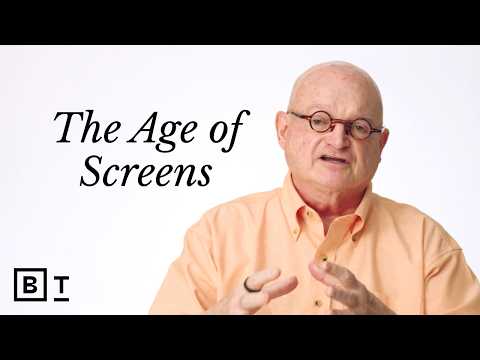
In this video, George Washington University neurology professor Richard Cytowic explains how digital devices in the modern screen age affect our brains and how we can reclaim our attention. He emphasizes that our brains are essentially the same as those of our Stone Age ancestors, with evolutionarily limited attention spans and energy capacity. He argues that digital devices easily push past these limits and overwhelm us, and he offers concrete strategies for restoring attention. He covers the importance of sleep, the effects of blue light, and the need for social interaction, providing practical advice for the overloaded modern brain.
1. The Stone Age Brain vs. the Screen Age 🤯
Professor Cytowic says that in modern society our attention spans have become dramatically shorter, and he calls this the "tyranny of attention." He explains that too much information and stimulation pours in, exceeding the brain's processing capacity.
"Everyone agrees that our attention spans have become terrible. I call this the tyranny of attention — so many things demanding our attention from so many directions that we are simply overwhelmed and don't have the mental bandwidth to deal with it."
He emphasizes that unlike washing machines or appliances that are replaced every five to ten years, our brains are no different from those of our Stone Age ancestors tens of thousands of years ago. Because evolution is gradual, once the brain finds a "good enough" solution it maintains it and adds new functions on top — much like a New England farmhouse with rooms added one by one, an odd shape but perfectly functional.
2. The Brain's Energy Limits and Overload 🔋
Our working memory acts as a "mental scratch pad" that processes information we focus on in the moment, but its capacity is extremely limited. The brain operates within a fixed energy budget, and every cognitive activity consumes energy. ATP (adenosine triphosphate) is the fuel for every cell in the body, and even thinking burns enormous amounts of it. This is why you feel utterly exhausted after an exam even though you've done no physical activity whatsoever.
"Everything costs us in terms of energy expenditure… You go in to take a test and you're just thinking, not doing anything, and after three or four hours you're really wiped out. Because you've used a lot of mental energy."
Our attention is like a bank account that can easily go into the red — it must not be squandered or overdrawn. The brain's fixed energy bandwidth cannot be expanded through diet, exercise, or sudoku puzzles. That means we have to learn to live within our limited bandwidth. Just listening to one person speak takes half that bandwidth; trying to follow two people at once exceeds it entirely and becomes impossible.
It's easy to assume that scrolling or swiping takes little effort, but it too consumes that narrow bandwidth. Most of the brain's energy goes toward pumping sodium and potassium ions across cell membranes to maintain physical structure, leaving very little for actual thinking.
Professor Cytowic uses the 2017 Oscars mix-up — where the wrong Best Picture winner was announced — as an example of working memory overload causing a mistake. The brain works like a change detector, responding to novel stimuli. On the ancient savanna there was little change, but modern life is saturated with change engineered to capture our attention.
3. Screen Addiction and the Dopamine Reward 📱
The professor compares screens to secondhand smoke because they affect everyone in their line of sight. Large monitors in waiting rooms and airport lounges blasting moving images force our gaze, and even actively trying to ignore them costs energy.
"Screens are like secondhand smoke — they affect everyone in their field of view. The giant monitors in waiting rooms and airport lounges force eye contact with moving images, and even trying not to look burns energy. Either way, we lose."
Regarding the commonly used term dopamine reward, the professor notes it is somewhat misapplied. Eating delicious food also releases dopamine, but the brain actually has two distinct pleasure circuits.
- Wanting and reward system: Activated very easily but impossible to fully satisfy — the basis of the hedonic treadmill. The moment we get something, we want something else.
- Pleasure and liking system: Narrower in range and harder to activate, but it can actually be satisfied.
Research shows that behavioral addictions — such as TikTok addiction or compulsive scrolling — activate the same brain regions as physical addictions to alcohol or cocaine. Take someone's phone away and you can watch their anxiety rise by the minute.
Big tech companies compete fiercely for our "eyeballs" across all 1,440 minutes of the day, trying to keep us on their platforms as long as possible. Netflix's Reed Hastings famously said "sleep is our biggest competitor." They use intermittent reinforcement — the same principle as a casino slot machine — to keep us scrolling. The irregular, unpredictable rewards create physical and behavioral addiction.
4. Practical Strategies for Restoring Attention 💡
So how do we reclaim our attention? The most effective method is turning off your phone, but for many people that is the hardest thing to do. There's even a name for the anxiety we feel without our phones — nomophobia. We've been conditioned like Pavlov's dogs to that vibration when a text arrives.
The professor suggests the following concrete practices.
4.1. Adjusting Screen Settings ⚙️
- Use blue light filters: On an iPhone, enable the blue-yellow tritanopia filter.
- Reduce brightness: Lower the brightness on your phone and TV to the maximum comfortable level. On OLED TVs, you can reduce brightness, contrast, and picture mode by up to 40% and still enjoy excellent image quality.
- Limits of blue light glasses: Yellow-tinted glasses help with glare, but blocking enough blue light requires lenses so deeply orange they're impractical for everyday use.
4.2. Sufficient, Healthy Sleep 😴
- Regular sleep habits: Keeping consistent sleep and wake times is the single best way to restore concentration and focus.
- What sleep actually does: During sleep the brain is not simply resting — it is consolidating memories, clearing metabolic waste accumulated during the day, and processing emotions.
- The cost of sleep deprivation: Getting too little sleep is equivalent to having a blood alcohol level of 0.08% and causes significant impairment the next day.
- You cannot "catch up" on sleep: Staying up all night and sleeping in on the weekend doesn't work. The brain's circadian rhythm cycles through four stages of deep sleep (slow-wave sleep) before reaching REM; disrupting this cycle cannot be undone by a marathon weekend sleep.
- Sleep hygiene:
- Keep electronics out of the bedroom: Don't put a TV in the bedroom.
- Maintain regular sleep and wake times.
- Control bedroom temperature: The ideal bedroom temperature is 20°C (68°F). Don't sleep in a room that is too warm.
- Avoid stimulating activity before bed: After dinner — especially in the hours before sleep — avoid emotionally arousing activities like TikTok, politics, or religion. They raise adrenaline, disrupt sleep, and ultimately harm concentration, attention, and memory.
"The bedroom should be quite cool. Twenty degrees Celsius is ideal… In the hours before bed, it's not a good idea to do things that can excite us — TikTok, politics, religion — because that raises adrenaline, disrupts sleep, and then everything suffers: our focus, our attention, our memory."
4.3. Human Connection and Self-Control 👫
- Engage with people in the real world: Meet others in person for coffee or a walk. This releases bonding hormones like oxytocin, producing a genuine sense of wellbeing that you simply cannot get while staring at a screen or sitting through a Zoom call.
- Zoom fatigue: Video calls are exhausting for multiple reasons — the camera angle feels unnatural, you burn energy worrying about how you look, and the separation of video and audio disrupts the natural flow of conversation.
- Emotional regulation and self-control: Avoid heated arguments in the evening; have the wisdom to wait until morning. This is a matter of emotional intelligence and self-control. Getting angry and resentful ultimately only hurts yourself.
4.4. Intentional Rest: Niksen 🧘♀️
- The Dutch art of doing nothing — Niksen: The Netherlands has a wonderful concept called niksen — the art of doing nothing. Step away from the computer, gaze out a window, look at a tree, listen to birdsong, watch branches swaying in the wind. Even three minutes is enough.
- Tripping the circuit breaker: Niksen is like tripping a circuit breaker in the middle of a hectic day. It is not meditation and it is not forced emptiness — it is simply choosing to look up, take in your surroundings, and breathe.
"The Netherlands has a wonderful concept called niksen — the art of doing nothing. You get up from the computer and gaze out the window, look at a tree, listen to birds, watch branches moving in the wind. Three minutes is enough."
5. The Importance of Silence 🤫
Professor Cytowic calls silence an essential nutrient. When our ancestors evolved 3 billion years ago, the world was extremely quiet — perhaps only the wind. A snapping branch was an immediate danger signal that triggered instant alertness. The brain was never designed to be active 24 hours a day. It needs periods of rest to restore itself.
Conclusion 🌟
Professor Richard Cytowic warns that today's digital environment is depleting the brain's limited resources, and he argues that understanding the biological constraints of our Stone Age brains is essential. To recover from attention overload, he says we must improve our screen habits, get sufficient quality sleep, nurture healthy human relationships, and carve out moments of silence through intentional rest — particularly the practice of doing nothing, niksen. In the end, our brains need time to heal themselves, and through that healing we can live more balanced lives in the complex world of the digital age.