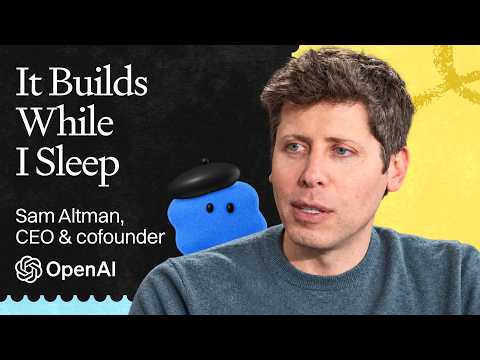
In this interview, Sam Altman says AI will enable more products and creativity rather than simply replace developers. OpenAI's always-on agent Dot restored his focused mornings and creativity, changing how he develops ideas into features. His central message is that AI should create a new Renaissance, expanding individuals' and small teams' capabilities, rather than an industrial future turning people into machine parts.
1. Developers Will Build More, Not Disappear
Every Podcast host Dan Shipper meets Altman at DevDay and asks why developer events and development work keep growing despite dramatic coding-model advances. A few years ago, such powerful AI seemed likely to reduce demand; reality appears opposite.
Altman's explanation is simple: people want enormous quantities of products and services. Better development tools reveal that latent demand.
"People just want more. Their expectations are very high, and I think that's wonderful."
Developers can do more than ever, but the ceiling of what can be built rises too. AI doing work does not automatically eliminate human work; it opens new products and problems previously out of reach.
He has not always been entirely optimistic about jobs. AI will likely take much work requiring little creativity where the performer makes little difference. Yet many other desires and possibilities remain.
"There will certainly be tasks and jobs AI takes over. But people want so many other things. We won't run out of new things to do."
He locates humanity's continued importance in human nature. We care who made the art, founded the company, or proposed the idea, more than what a machine accomplished alone.
"We don't care much about what machines do. We're obsessed with other people: who is behind the art, company, idea, or product?"
Shipper jokes whether an agent solving Navier–Stokes equations unseen in a data center really solved them. Altman mentions an actual difficult problem solved by many collaborating agents. Public attention focused on how the process was explained and the people involved, rather than only the solution. Even AI achievements leave people seeking meaning, context, and human stories.
2. OpenAI's Platform Strategy and the Small-Team Era
Shipper notes 22 new DevDay features, far more than earlier events. Altman says they cut announcements to fit 50 minutes and are trying to apply their own productivity claims.
"If we say these tools make people more productive and able to build more, we'd better build more ourselves."
He highlights ambient intelligence, or proactive AI, as the next phase: agents running in the background around the clock, connected to systems, noticing situations and acting without constant instructions.
"A world where agents run in the background 24 hours a day, connected to your systems and proactively doing things for you."
Apps, portable subscriptions, and app-store features fit this platform strategy. Ideas are plentiful; creative execution is scarce. OpenAI wants people to build within ChatGPT, users to carry subscriptions across apps, and developers to connect with users.
He distinguishes two philosophies:
- AI leaves one giant company dominating everything.
- AI dramatically expands individuals, solo businesses, and small teams.
He places OpenAI in the second camp.
"We believe the number of companies will grow enormously, and barriers for individuals, solo companies, and small teams building wonderful products will fall dramatically."
He does not claim to have found the AI era's finished app store. But he sees a platform foundation already enabling millions to build important products and companies. The aim is infrastructure for outside creators, rather than capturing every opportunity internally.
3. A Renaissance Rather Than an Industrial Revolution
Altman compares AI with the Renaissance more than the Industrial Revolution. The latter centered on machinery and productivity; the former on human possibility, creation, and discovery.
"The Renaissance was fundamentally about humans. The Industrial Revolution was fundamentally about machines."
He recognizes the Industrial Revolution's extraordinary prosperity and progress, yet says individuals did not always experience it positively. Narrow specialization could make people feel like cogs, separated from many things that make life good.
"People often became cogs in a machine, doing highly specialized work somewhat disconnected from many aspects of a good life."
Predictions of AI automating everything while humans live like rewarded house cats make him sad. That is not OpenAI's vision.
"That is definitely not the future we believe in."
He wants broad scientific discovery, art, and entrepreneurship, with people able to begin new things. Beyond economic growth, they should regain control over life and time.
"I want people to regain control over their lives, do what they want, and spend their time as they choose."
AI might reconnect people with the past, as the Renaissance rediscovered ancient knowledge while opening new science and engineering. Reconsidering human values can accompany dramatically expanded technical possibilities.
4. Dot Restored His Creative Mornings
The interview centers on always-on agent Dot. It may seem less impressive than a scientific discovery, but Altman calls it life-changing, especially for restoring his favorite early mornings. 🌅
"Early morning is my favorite working time. It's when I'm most creative."
He used to use mornings for deep, complex projects. Running OpenAI meant overnight problems could worsen seriously if he ignored his phone. Checking it, however, filled his mind with email, messages, and emergencies and destroyed deep work.
"The moment I checked my phone, everything else contaminated my mind and the deep-work time disappeared."
Dot now determines what deserves immediate attention, alerting him only to genuine urgency and organizing or handling other issues. He can use that mental space for creativity or his children.
"I trust Dot to decide what I need to think about. I only have to think about something truly urgent; otherwise Dot handles it."
The seemingly simple change substantially improved his life.
"I got space back for creativity, or for my children. It was simple, but a big improvement to my life."
On DevDay itself, an employee's Dot detected a possible failure just before a live demo and asked whether to try a fix with only minutes left. That version could not yet fully fix production, but Altman expects that level of proactive response.
His own Dot also spotted a brief gap before the interview and told him to check a particular matter. He had missed routine tasks while busy all day; without Dot, he says, the issue would have been overlooked and caused major confusion later.
"Not having to worry feels completely different."
He currently calls his Dot "Dotty," having previously tried "Alfred" after the butler character, and is still considering a better name.
Dot remains early, with bugs and work needed on mobile, cloud computers, and other interfaces. Yet it has already become his default way of using ChatGPT.
"I really love it. It's already become my default way of using chat."
5. An Agent That Reads Life's Context and Turns Ideas Into Products
Shipper recalls trying to change a flight when Dot warned of a conflicting meeting found in Slack rather than the calendar. It combined context a human might miss.
Altman considers this ability to gather context across life and surface the right information one of Dot's most impressive qualities.
"Its ability to collect context across your whole life and do things even an extremely attentive person would struggle to do is remarkable."
He identifies a sufficiently intelligent model, at the intelligence level referred to in the subtitles as Astra, as the crucial research breakthrough. Many engineering components are needed, but adequate reasoning and judgment were decisive.
From an Idea to Five or Six Versions
Dot is also a creative partner developing vague ideas into features. Altman had an interesting feature concept that was difficult to explain to people in detail and had too many possible implementations to choose confidently.
He sent notes while walking or whenever thoughts arose. The assistant made five or six versions; he gave feedback and requested improvements.
"Being able to pour out raw thoughts and keep receiving and giving feedback was wonderful."
He describes leaving a long voice message before sleep and waking to find not only the feature built but seven further steps completed.
"Leaving a long voice note as you fall asleep, then waking up to find it built and the next seven steps done, is amazing."
In another case, he could not find something he distinctly remembered seeing in Slack. After ten to 20 minutes searching with Codex, he wondered whether he had dreamed it.
The next day, Dot said it remembered the abandoned search, kept looking overnight, and found the material. It was a screenshot, not Slack text, located by examining images individually.
"I'd given up. Dot was persistently looking for something that would help me."
Always-on agents can remember and continue work after users stop or fail, rather than only answer questions. Dot also made Altman realize how much social media, phones, and notifications were damaging his attention.
"The technology is amazing, but social media, phones, and notifications were intruding on my attention much more than I realized."
6. Living Documents Written by People and Multiple AIs
A brief sponsor segment advertises Attio CRM, describing automated lead capture, renewal detection, follow-up drafting, and API and MCP connections enabling agents to work alongside salespeople.
The discussion then turns to OpenAI Space. Shipper calls launching three near-office-suite tools at once a major bet. Altman says it was not planned that way, but they realized existing software was not designed for close AI collaboration.
Traditional tools allow a person to work or AI to act for them. Their document, project-management, and collaboration abstractions break down when multiple humans and AIs work together.
"Software as a whole wasn't really designed for collaborating with AI."
Altman still writes initial ideas traditionally because writing clarifies thought. Assistants or people can handle expansion and follow-up afterward.
He is excited about "live documents," a concept still lacking a settled name: documents that update with interactions and outside changes. Multiple people's assistants can create new outcomes together, beyond sharing information.
"Seven assistants can work together and produce something new that was partly in all our heads but didn't exist before."
He has rebuilt his management dashboard this way. Instead of a common company dashboard, he uses a personal business summary that reads his Slack messages and continually reconstructs itself around changing interests.
"I now have a business summary just for me that changes with what I care about and don't."
Recently he has focused more on alignment issues in AI safety and security than revenue or growth. Six months earlier, traditional business metrics might have dominated. He wants to visualize how Dot infers his priorities and how they change over years.
Shipper describes Dot reading messages ahead and advising him to wait an hour before viewing something potentially upsetting. Half-joking, he wants a real-time mood dashboard. Agents may become involved in attention and emotional management, not just productivity.
7. Fast AI and an Ecosystem of Portable Subscriptions
Shipper asks about the feature referred to in subtitles as the Decisions API and OpenAI's model and product strategy. Altman says users always ask for the same improvements as models advance.
"People always want cheaper prices, faster speed, and better quality."
OpenAI aims to offer the best models across cost, speed, and performance tradeoffs. No company can cover every approach and architecture from new labs, but it aims to offer the strongest choices in proven core-model areas.
They discuss carrying ChatGPT subscriptions and tokens into outside apps. Developers previously worried whether they could afford heavy AI usage, often selecting cheaper models and compromising experience.
Portable subscriptions let users access desired models within their existing subscription without developers bearing every AI cost.
"If users bring their subscription, you can say, 'Great, use whichever model you want within it.'"
Asked which apps excite him, Altman answers those nobody has imagined yet. Large DevDays and ecosystem investment reflect a belief that more good ideas exist outside OpenAI than inside.
"We believe there are far more good ideas outside our building than inside."
As a user, he dislikes subscribing separately to every service. Interesting apps should connect immediately to the advanced AI he already uses.
"I hate signing up for 100 separate services."
8. Why "OpenAI Just Killed That Startup" Does Not Match His View
Every DevDay prompts viral claims that a new OpenAI feature has killed a startup. Altman says pessimism attracts attention, but insists this is not what happens in reality.
"Those posts do well because people like pessimism. But it doesn't actually happen."
He says OpenAI strongly believes in supporting builders rather than having one giant company take everything. Providing internal tools externally and expanding model access express that belief.
"We're saying we'll give you all the tools we use."
He compares AI with a foundational tool, perhaps the discovery of fire.
"This changes what's possible. Maybe it's like fire. We may have brought it down from the mountain, but we want to give it to everyone and let people do things."
The possibilities are too broad for OpenAI alone. Developers and founders worldwide must discover problems and build products.
Startup practices will also change. Some principles endure, especially making what people want.
"You have to make things people want. That advice was right 100 years ago and is right now."
But what one or two people can do changes radically. Silicon Valley support systems and conventions have not fully adapted. Assumptions about needing cofounders and investment models based on team size and costs may need reconsideration.
He calls this a founder "golden age," exciting enough to make him want to invest in startups again. Exceptional founders, ambitious projects, and willingness to take large risks alongside them remain his priorities.
9. CEOs Can Become Makers Again
Shipper observes that CEOs of large companies usually lack time to build, yet Dot and Codex seem to have made Altman a maker again. Altman hesitates over calling OpenAI a giant company, but strongly believes reducing friction even slightly unlocks more creation.
"Lower the barriers just a little, and people will make much more."
Dot lets him accomplish substantial work in spare moments and limited interactions. Beyond personal Codex projects, he now wants to release something genuinely new publicly.
"Not just personal projects. I want to put something into the world, something genuinely new and wonderful for people."
Asked whether that means samaltman.com or an official OpenAI product, he says he might build a plugin or even a real OpenAI product. Everything feels possible.
AI is not merely a management tool for delegating work. Leaders can again experiment, build, and test ideas themselves. This does not mean replacing teams; individuals and teams can both create more value.
"Next year teams will do things, I'll do things, and more people will do other things. An extraordinary amount of wonderful work could result."
10. Ultrafast Changes the Pace of Thinking and Creation
Near the end, Altman says he does almost all prompting in Ultrafast. He acknowledges others cannot always access that speed.
"I know not everyone can use Ultrafast for everything all the time. But going back is really hard."
Fast responses change thinking itself, not merely waiting time. Citing an older Bret Victor talk, he emphasizes creators' immediate connection with their work and rapid feedback loops.
He had not realized how profoundly speed affects iterative thought. Building and exploring solutions becomes a different think-try-revise process.
"When building something or thinking through solutions, the difference is enormous."
OpenAI has long pursued lower intelligence costs, offering stronger models more cheaply over months and years. He now sees broad access to speed as another essential investment.
Large investments and custom chips could make ultrafast inference widely available. Faster models improve both user experience and OpenAI's research and inference systems.
"We now realize we must invest in making speed available to everyone, just as we tried to make intelligence available to everyone."
Asked when ultrafast can handle every problem, he jokes that it already can for more money. Soon, roughly eightfold speedups may be available at good prices, although by then a new benchmark 100 times faster may exist.
"There will always be real limits at the high end of intelligence and speed. But we'll keep increasing value per dollar."
He says OpenAI will seek price-performance improvements rapid enough to embarrass Moore's Law. Premium AI may remain expensive for a while, but the long-term aim is broader access to strong intelligence and speed.
Closing
Altman's central idea is restoring human time, attention, and creativity, not automation alone. Always-on agents such as Dot can filter urgent issues, recover forgotten context, and develop vague ideas into outcomes.
His desired future is not one where OpenAI builds everything, but a Renaissance-like ecosystem where fewer people can build more and more individuals bring ideas into the world.