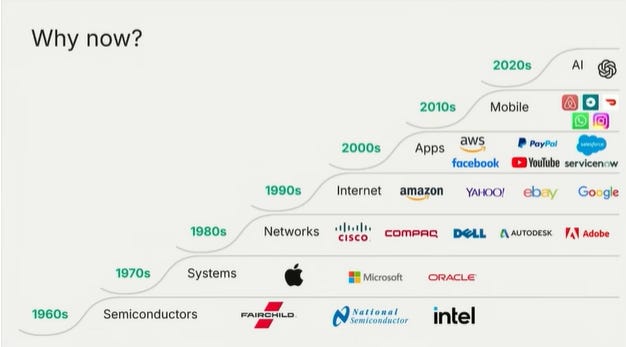
Intro: The AI Era -- Now Is the Time!
Welcome to Product Market Fit! This weekend, I did a deep dive into one of this year's most important AI strategy briefings: Sequoia's AI Ascent. Based on insights shared directly by pioneers from OpenAI, Nvidia, LangChain, Anthropic, Ramp, and more, here are 42 key points you must remember if you're starting an AI startup now.
1. AI: The Biggest Opportunity Since the Internet
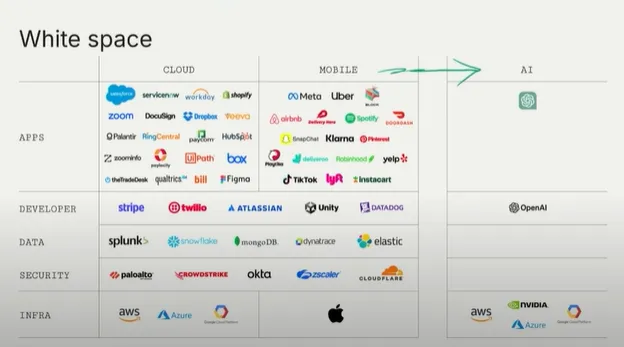
AI is launching at 10x the scale of the cloud boom. Sequoia and industry leaders emphasize that AI isn't just one market -- it's devouring all markets (software, services, infrastructure, labor, and more).
"This is the biggest opportunity since the internet. Bigger than cloud, faster than mobile."
Key Insights
- Biggest opportunity: Largest since the internet, bigger than cloud
- AI eats every market: Software, services, infrastructure, labor, etc.
- Value lives in the application layer: The tools people actually use win
- Foundation models are moving upward: Go narrow and deep, not wide
- Customer-centric products win: Solve the customer's problem completely, not model-first
- The agent era is here: Move beyond chatbots to agents that actually do work
- Speed is everything: First to ship wins
- Distribution is built in: 5.6 billion connected to the internet; success means explosive growth
- Product matters more than model: Startups compete on UX
- The real weapon is the workflow: Own the entire journey that produces results, not just a tool
2. How to Build AI Products

Most users don't know what AI can do. The key advice: "Don't ask users what they want -- build a product that shows them the way."
"The best AI products feel magical, not mechanical."
Step-by-Step Strategy
- Build opinionated products: Don't ask users -- show them the direction
- Deliver magical experiences: Surprising, not mechanical UX
- Tool -> Copilot -> Autopilot: Gradually increase automation
- 95% is running the company: Focus on team, execution, product
- The AI-specific 5% matters at scale: Data flywheel, trust, UX
- Build a data flywheel: User behavior makes the model smarter
- Focus on real revenue: Actual adoption, retention, behavior change -- not vanity metrics
- Don't fear low initial margins: Token costs keep dropping; scale is the answer
3. The Arrival of the Agent Economy

The next AI platform isn't chat -- it's agents. Agents collaborate, reason, and take real action.
"The next platform shift isn't chat -- it's agents. Agents will collaborate like humans."
3 Remaining Technical Challenges
- Memory: Personalization and long-term memory
- Protocols: Communication between agents
- Security: Trust, identity, auditability
"Whoever solves these first will build the 'AI operating system.'"
4. Building Agents in Practice: The Ramp Case Study

Most agents fail because they can't complete the workflow. Ramp had agents directly manipulate the UI, giving them immediate access to all features.
"Don't rebuild your product for agents. Just let them operate the UI."
Ramp's Approach
- Agents directly use the UI: Real clicks via headless browser
- No need to rebuild existing products: Instant full feature access
- Complete coverage from day one: No separate tools or infrastructure needed
5. The Future of Agents: Background, Trust, Self-Improvement

Agents react to signals in the background and receive human oversight through interfaces like Agent Inbox.
"Human intervention isn't optional -- it's required. Agents need approval, intervention, and feedback."
Trust and Control
- Every action logged and editable: Users can audit and correct at any time
- Self-improvement: Agents evolve through workflows
6. Where Should AI Startups Compete?
- Avoid foundation layer competition: OpenAI is already trying to become the API standard
- Compete on vertical depth: Focus on one persona, one task -- go deeper than OpenAI
- Small teams, big ownership: Fast execution is key
"The future isn't just text -- it's voice and code. We're heading into an era of agents that can speak and build."
7. Robotics and the Future of AI
- Robotics is the next frontier: Physical AI trained 100% in simulation
- Future AI products won't look like software: They'll be like invisible teams working in the background
8. FAQ & Practical Advice
Q. What's the secret to a successful AI startup in 2025?
- Focus on vertical applications
- Design for human intervention (trust)
- Build defense with a data flywheel
Q. What does Sequoia look for when investing?
- Actual user behavior and retention
- Margin improvement as token costs decrease
- Data flywheel contributing to business metrics
- Deep focus on a specific workflow/industry
Q. Where does AI startup value accumulate?
- Application layer: Full-stack solutions solving specific problems
Q. Why do agents/copilots fail?
- Incomplete features and weak integrations
- Must open the entire UI to agents, like Ramp
Q. What is the "agent economy"?
- Autonomous agents don't just respond to prompts -- they proactively collaborate, transact, and complete work
- Small teams can operate like large companies
Q. Chatbot vs. agent?
- Agents run in the background, event-driven, handling complex workflows
- Trust secured through Agent Inbox and similar interfaces
Q. How to compete with OpenAI/Anthropic?
- Avoid foundation model competition -- build vertical products on top
- Focus on high-friction, niche problems
Q. What is a data flywheel?
- Usage creates data, data improves AI, which attracts more users
- Must contribute to real business outcomes (retention, reduced churn) to be a true weapon
Q. The mistake of just bolting AI on?
- AI should be designed as the product's core, not an add-on
- Anthropic: "Treat AI as a first-class user, not a sidebar"
Q. Viral/rapid scaling strategy?
- The internet is ready: Good products spread naturally on TikTok, Reddit, X
- Shareable outputs, free trials, easy onboarding
Q. Team structure for fast execution?
- Small teams with strong ownership
- Fast prototyping, minimal slow meetings
Q. What comes after chat-based interfaces?
- Background agents, voice interfaces, autonomous coding assistants
Q. How to build user trust?
- Visibility, control, accountability
- Agent Inbox, action logs, approval/rollback features
Q. Infrastructure costs and margins?
- Token/compute costs keep falling
- Focus on building products people love; margins follow at scale
Q. Remaining technical challenges for agent-based AI?
- Persistent memory: Context and personalization
- Common protocols: Inter-agent communication
- Trust and security models: Safety of autonomous actions
"The startups that solve these three will lead the next decade."
Conclusion: Now Is the Time to Jump Into AI -- Precisely
You no longer need to be early to AI, but you can be precise.
- Go deep vertically
- Move fast
- Design for trust
- Remember: you're no longer managing code -- you're managing thinking systems!
"You're no longer managing code. You're managing thinking systems."
-- Guillermo
Reference Links
Key Concepts:
AI Ascent, Sequoia Capital, agent economy, data flywheel, vertical applications, trust design, fast execution, workflow ownership, AI operating system, future AI products