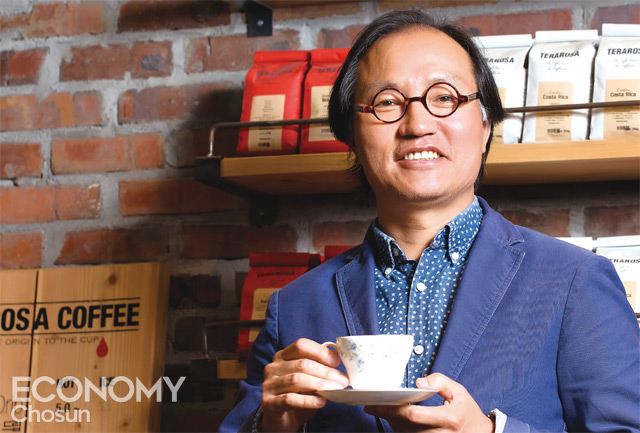
1. The Origins of Terarosa and CEO Kim Yong-deok ☕️
- Terarosa is Portuguese for "red earth," and in Brazil it also carries the meaning of "a land of hope."
- CEO Kim Yong-deok (born 1959, officially recorded as 1960) spent 21 years as a banker before taking early retirement in the wake of the foreign exchange crisis and diving into the coffee business.
- He did not attend a four-year university, and taught himself almost everything about architectural design and interior work. He is currently personally designing and building a coffee museum in Gangneung.
"As I learned about coffee, I naturally found myself studying the history of civilization in Europe and around the world."
2. From Banker to Coffee Entrepreneur 🔄
- After opening the first location in Gangneung in 2002, Terarosa expanded to its tenth location (Busan) by 2016.
- Despite having few locations, it is regarded as the finest in Korea for its spatial aesthetics and quality of coffee.
- All roughly 200 employees are full-time staff, with the industry's best benefits including the four major social insurances.
- The Seojong branch (Yangpyeong) has become a local landmark, popular enough to cause traffic congestion every weekend.
"The Seojong location was originally an old-style hanok restaurant. I redesigned it and opened a café there. The customer response was better than I expected, so I acquired more land in front and built a new building."
- 2016 revenue: 24.3 billion won. Roughly 60% from in-store sales, 40% from roasted beans and specialty merchandise.
3. The Journey to Discovering Coffee 🚶♂️
- After early retirement, he traveled for a year, with a vague plan to open a restaurant.
- He opened a pork cutlet restaurant in Gangneung, but was struck by exposure to the upscale restaurant culture of Cheongdam-dong in Seoul.
- This led him to study restaurants, wine, and ultimately coffee.
- Comparing the coffee industries of Japan and Korea ignited his anger at the backwardness of Korea's coffee industry.
"The coffee our restaurant was serving wasn't really coffee. I came to understand how far behind Korea's coffee industry had fallen. It was an enormous shock."
4. History, Coffee, and Righteous Anger 📚
- Studying coffee led him to compare European civilization history with Korean modern history.
- Reflecting on Japan's Meiji Restoration, Itō Hirobumi's overseas study, and the era of Korea's King Gojong, he felt deep regret and anger about the relationship between a leader's vision and national development.
"The year Gojong ascended to the throne was 1863 — the very year the first subway ran in London. … It took Japan exactly 30 years to modernize. … If Gojong had embraced foreign knowledge and sent young people abroad to study, our country would have turned out very differently. That anger gave me a mission: how can the coffee industry become a source of national competitiveness? That became my homework."
5. The Value and Vision of the Coffee Industry 💡
- The food and beverage industry, once established, endures.
- He drew comparisons to the market capitalizations of global F&B giants: Starbucks (100 trillion won), Nestlé (250 trillion won).
- He argued that while manufacturers like Samsung Electronics face an uncertain future, the food and beverage industry offers long-term stability.
"In the food and beverage business, once you stand tall, it's very hard for others to catch up. So I'm constantly asking myself, 'How do we become a luxury brand?'"
6. The Pride of 'Made in Gangneung' 🏞
- He opened the first location in Gangneung because of his deep attachment to the region.
- The regional brand identity of 'Made in Gangneung' lends an air of prestige and has become one of Terarosa's greatest strengths.
"Don't people trust 'Made in Florence' more than 'Made in Italy' even for foreign products? … Identifying with a specific place has given us a premium image, and that has become our strength."
7. The Philosophy of Coffee Farms and Green Beans 🌱
- Terarosa imports 600 tons of specialty coffee annually from 15 countries.
- He described a poignant experience with the coffee trees of the Harrar region of Ethiopia.
"The Harrar region gets very little rainfall, so many of the coffee trees there are barely clinging to life. … How old are these trees? They must be 200 or 300 years old, though no one knows exactly. … From those frail, barely-standing trees, you get only about 300 to 500 grams of fruit."
8. Terarosa's Spatial Aesthetics 🏛
- Inspired by café culture in 18th- and 19th-century Paris and Vienna.
- 'Élégance' is the guiding principle of every interior space.
- Every location has a different concept, yet the goal is always to feel unmistakably like Terarosa.
"The spaces you frequent speak to your taste and your place in society. … Our guiding principle for interior design is élégance. Grace."
9. The Secret to Maintaining Specialty Coffee Standards 🏅
- The philosophy: "The quality of our newest employee is our quality."
- Over a year of staff training before anyone debuts behind the bar, including rigorous in-house tests and practice.
- It takes roughly two years to become a lead barista.
"We put employees through enormous amounts of training before they ever step up to the bar. The excuse 'this coffee was made by a junior staff member, so it's not quite up to par' is simply not acceptable."
10. What Sets Terarosa Apart from Starbucks — and the Future 🌟
- He emphasizes that Starbucks sells 'place,' while Terarosa sells 'quality.'
- Terarosa's per-location revenue is twice that of Starbucks.
- The goal is not a revenue target but to be a 'Good Company.'
- Quality of life for employees, and sustainability spanning 100 to 200 years, are what matter most.
"Starbucks sells place, not taste. … We are a specialty company. The green beans we source cost at least twice what Starbucks pays."
"Our first slogan is 'Good Company.' Being a Good Company is our goal — not being a Big Company. We have already surpassed them in quality and design."
11. Terarosa Busan Suyeong: Where Coffee Meets Steel 🏭
- The Busan Suyeong location is a remodeled steel factory built in 1963.
- The interior features tables, chairs, and a coffee bar made of steel, honoring the space's original identity.
- A space where the coolness of steel and the warmth of coffee find harmony.
"We designed the space to honor the 'origin' of a company that quietly worked with iron for over 50 years."
12. CEO Kim Yong-deok: Profile 📝
- Born 1960 (actual birth year: 1959)
- Graduated from Gangneung Commercial High School (1978)
- Worked at Choheung Bank (1977–98)
- Founded Haksan Terarosa Coffee Co. (2002)
- President of the Korea Specialty Coffee Association (2014–2015)
Key Concepts at a Glance
- Terarosa
- CEO Kim Yong-deok
- Specialty coffee
- Spatial aesthetics
- Staff training
- 'Good Company'
- Made in Gangneung
- Differentiation from Starbucks
- Coffee as national competitiveness
- Busan Suyeong location, steel interior
A Closing Thought
Kim Yong-deok is not simply an entrepreneur who sells coffee — he is a man with a vision to build Korea's culture and competitiveness through coffee. His passion, his philosophy, and his unwavering commitment to being a 'Good Company' are what have made Terarosa the premium brand it is today.
"We have never once set a revenue target. Our first slogan is 'Good Company.'"
That single line says everything about Terarosa. A deep philosophy in every cup, and a passion that lives in every space — that is the power of Terarosa. ☕️✨