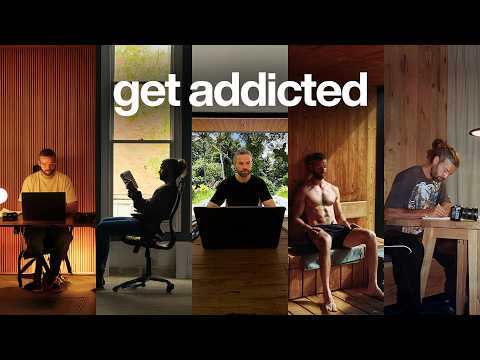
This video lays out a five-level roadmap for discipline that moves beyond the beginner stage of relying on personal willpower and effort, and instead builds a business that runs on its own through systems and delegation of authority. It transparently reveals concrete methods and real metrics for solving the bottleneck where the founder personally makes every decision, in order to achieve true freedom. Ultimately, it emphasizes that to successfully scale a business and gain freedom over your time, you must evolve beyond personal self-control into organizational systems and leverage discipline.
1. Level 1: Self-Control Discipline
When most people hear the word "discipline," they picture waking up at 5 a.m. every morning, finishing every item on their to-do list, and working harder than anyone else. Founder Matt Gray used to think the same way. But as he grew his business to eight figures (tens of millions of dollars) in revenue and met other successful founders, he realized that this conventional thinking was completely wrong. 😉
The most disciplined founders are not the ones who work the hardest, but the ones who build a business that runs without them. And that is real discipline.
The personal consistency that helped him reach six figures in revenue stops working beyond that point. Individual capacity does not scale, but systems do. As the business grows, headcount increases, and every decision carries enormous time and cost, the "self-control discipline" that depends on a founder's individual willpower hits its limit.
Matt, too, once had a perfect routine of waking up at 5:30 a.m. to work out, drink a smoothie, and handle deep-focus work at a time when no one else was awake. But even at the peak of his personal discipline, the business was leaking energy. Customers slipped through the cracks of his management, team members waited on his decisions, and his work hours exceeded 60 a week, yet the work still piled up like a mountain.
This was not a motivation problem—it was a capacity problem. Because every decision had to pass through the founder, he was plagued by the anxiety that the business would collapse without him.
Once every decision starts consuming time you don't have, self-control discipline becomes fragile.
To break out of this stage and scale the business, you must focus not on individual willpower but on constraints. 🛠️
2. Level 2: Constraint Discipline
When a business grows, the real enemy is not a lack of effort, but decision fatigue. A situation where you must make choices at every moment—from trivial questions to major decisions—depletes a founder's cognitive resources.
Therefore, Level 2 discipline is the stage of reducing the decision-making burden concentrated on the founder and distributing it across the organization. A common trait of the outlier CEOs featured in the bestselling book The Outsiders is precisely decentralization of leadership—pushing ownership and decision-making authority down into the lower levels of the organization. 💡
The core of Level 2 discipline lies in "pre-deciding." It means designing your environment by creating rules in advance so you don't have to deliberate every time. For example, setting a rule that meetings happen only on Tuesdays.
You can also change your decision-making structure by not solving problems for team members directly when they bring them to you, but instead asking a powerful question like the following:
When someone brings me a problem, I don't solve it for them. I ask just one thing: "What's your recommendation?"
At first, team members may resist out of fear of making mistakes. But once the founder encouraged them by saying, "It's okay to be wrong—take ownership and correct course yourself," the company culture changed completely in just 30 days. Team members stopped bringing problems and instead started asking only for "approval" of solutions they had already prepared.
Constraints are not restrictions. Constraints create creativity and set us free. Real discipline is designing your environment so that you don't even need to make a choice.
3. Level 3: Data-Driven Discipline
Many founders believe that if they just work harder, add a new initiative, and launch one more content channel, they'll finally have a breakthrough. But effort without direction is just noise.
Level 3 discipline is the stage of focusing all your energy on the "signal" and boldly discarding the rest. In other words, keeping only the core metrics and feedback loops that actually grow the business. 📊
Matt openly shared the actual metrics dashboard he tracks while running his media company.
- Views and subscriber counts aren't everything. A video about systems that looked like a massive hit—breaking 200,000 views over 30 days—generated only $258 in actual revenue.
- On the other hand, a strategy video that stalled at just 44,000 views and looked like a failure on the surface actually generated $29,000 in revenue.
This shows the need for precise data discipline that isn't fooled by surface-level numbers (views) and instead tracks the actual profit per piece of content. You also need to use the dashboard to manage balance by category (AI, mindset, business, branding, etc.), tracking which content grows subscribers and which content actually drives revenue.
In addition, you must prevent the silo effect, where marketing, sales, and customer success departments operate separately without communicating with each other. You need to create tight sync channels between departments and maintain a rigorous system that reflects market feedback into content and sales strategy in real time.
If you can't answer what the three core metrics that actually grow your business are, you're just guessing. And if you're not tracking them every week, you're not working within a Level 3 feedback loop.
4. Level 4: System Discipline
Level 4 is the stage of prioritizing process over individual personality. The more capable a founder is, the easier it is to fall into the thinking, "No one does this as well as I do." But this kind of pride becomes a prison that traps you.
If the business only runs when you personally take action, then it isn't a business—it's just a "job" that is extremely dependent on you. Level 4 discipline is the stage of moving away from being the engine that personally drives the business, and becoming the architect who designs the machine that is the business. 🧱
Matt's company, Founder OS, has one extremely powerful, non-negotiable rule:
If you solve a problem, you must document it. Documentation means two things: a Google Doc that walks through the system step by step, and a Loom video guide of 15 minutes or less that runs through it on screen. No exceptions. If it isn't documented, it isn't a system.
In the past, there was a tricky client audit task that took Matt six hours to do himself. When he traveled for business or recorded a podcast, it created a fatal bottleneck where customers simply had to wait.
Matt documented this process in detail along with a screen recording and handed it off to a team member. Astonishingly, when the team member who received the guide performed this task for the first time, it took just 60 minutes—and the quality was far better than when Matt did it manually himself. That's because the system contained the accumulated wisdom of everyone over time. 🚀
5. Level 5: Leverage Discipline
Level 5 is the stage that high-performing founders fear most, and the turning point that takes a company from hundreds of millions of won in annual revenue to hundreds of millions of won in monthly revenue. It is complete letting go—in other words, "ownership transfer."
Many people confuse delegation with ownership transfer. Delegation is micromanaging by saying, "Do this task and report back to me," but ownership transfer is different.
To gain true leverage and freedom, you must not simply hand off tasks—you must transfer authority. Real leverage is saying, "The ownership of this outcome is now yours. The decisions and the responsibility are yours. I trust you."
Here's what happened when Matt completely transferred core customer experience and renewal tasks—which directly impact revenue—to a team member.
- Week 1: Just in case, he checked on progress frequently.
- Week 2: Holding himself back, he checked just once.
- Week 3: He didn't intervene at all, yet nothing broke. On the contrary, the system ran perfectly.
The moment a founder sets down the hero role of solving every problem, true freedom arrives—the freedom to devote themselves to more enjoyable and valuable work for the business (envisioning future strategy, creative activities, and so on).
To grow into a company with $20 million or more in annual revenue, you need micro-CEOs inside the organization who can directly lead a $10 million business unit and a $5 million business unit.
Conclusion: Build a System That Replaces You
| Level | Name of Discipline | Core Goal and Characteristics |
|---|---|---|
| Level 1 | Self-Control Discipline | Maintaining personal routine and consistency (with inherent limits that don't scale) |
| Level 2 | Constraint Discipline | Minimizing decision fatigue through pre-deciding and rule-setting |
| Level 3 | Data-Driven Discipline | Focusing only on the core metrics (signal) that create real revenue |
| Level 4 | System Discipline | Building process through documentation of work (Loom & Doc) |
| Level 5 | Leverage Discipline | Achieving true freedom by fully transferring ownership of outcomes to your people |
A business's growth depends not on how much longer the founder works, but on how high a level of discipline they execute. You must start from the personal effort of Level 1, build systems, and finally reach Level 5, where you completely transfer ownership—only then does the business reach the point where it grows on its own without you.
Take a moment to reflect on whether you yourself are becoming the bottleneck of your business, and design the life of a truly free founder by meticulously building, one by one, the systems that will replace you. 🌟