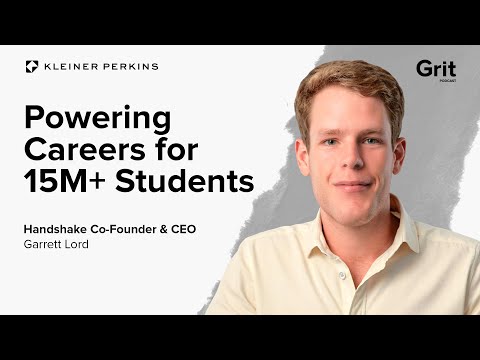
Handshake originally started as a career platform for students and has now evolved into a vast expert network for AI training. In this episode, founder Garrett Lord and investor Mamoon Hamid candidly share their challenges, growth, and new strategies for the AI era. The story reveals how verified trust and talent become the keys to innovation, transcending traditional organizational boundaries and opportunities.
1. The Origin and Growth Story of Handshake
Handshake was born from Garrett Lord's dream during college to achieve "equal opportunity." He wanted to extend the career opportunities that had been available only to Silicon Valley and elite university students to a much broader audience.
"My friends and I grew up in middle-class families in Michigan. We went to good universities, but truly great jobs were always out of reach. So the dream started with solving this inequality in employment."
With his father's full support -- his father actually invested his retirement savings -- the elder Lord became a steadfast backer of early-stage Handshake.
"My father invested his life savings in my business. My friends gave up offers from world-class companies and lived together in a rural house. Failure was not an option."
The early days of struggle followed. They pulled all-nighters at a noodle shop in Michigan, slept in their car to meet customers in person, and built trust one person at a time while making the rounds of college campuses.
Through these efforts, Handshake grew into a massive career network used by 18 million people, partnering with 92% of American universities -- roughly 1,600 campuses.
2. Personal Balance and the Power of "Grit"
The conversation naturally shifts to work-life balance and a leader's authenticity. Garrett confesses that his recent marriage and the birth of his child clarified his life priorities, which actually had a positive impact on his work.
"After having a kid, only the truly necessary things remain -- the most important things. Time management naturally changes. It was a turning point in my life."
The co-host also emphasizes that most panelists cite "the strength drawn from home" as surprisingly helpful for their work.
"Almost everyone sitting here talks about the strength they get from home, the presence of their partner. I actually had the bias that successful people sacrificed their families. But the reality was the exact opposite."
Garrett shares that even in his 20s, he used to say "I really look forward to starting a family and raising kids someday," and expresses gratitude for now living that dream.
3. Handshake's New Challenge: Pivoting for the AI Era
After hitting growth plateaus post-COVID, Handshake found a new opportunity to leap forward through a serendipitous connection. A deep conversation with an AI researcher at a Kleiner Perkins year-end party in 2024 proved decisive.
"At that party, I grabbed one researcher and talked for nearly four hours. They asked, 'Why don't you enter this market directly?'"
Previously, Handshake had provided graduate-level talent data to AI companies through intermediary brokers. Now they transitioned to partnering directly with research labs, providing AI model training data based on their core expert network.
"Our competitive edge is 10 years of built-up trust, a directly verified expert network, and an enormous pool of young talent. This is an asset others can't easily replicate."
In the AI model training business, it's not just ordinary people -- real experts in fields like mathematics, physics, chemistry, accounting, and medicine play critical roles in problem-solving, evaluation, and explanation generation.
"Today's large AI models have already absorbed all the knowledge on the internet. Now they've reached a stage where they can't advance further unless 'experts provide the correct answers.'"
The point is emphasized that Handshake's network of graduate students, PhDs, and alumni is one of the few groups that can provide genuine 'correct answers' for AI training.
4. AI Data Training Structure and Real-World Examples
In Handshake's AI training projects, the process of "real experts participating to evaluate, analyze, and correct domain-specific problems" is treated as critically important. For example, with math problems, PhD specialists in the field directly identify errors and critical reasoning steps in solutions, then provide the correct answers.
"When a model does step-by-step problem solving and incorrect reasoning appears, experts correct it immediately and provide the final correct answer."
They concretely explain how high-quality, ethically sourced data actually improves AI model performance.
Additionally, the experts participating in the network earn real income by applying their domain knowledge to AI training data, providing strong motivation.
"You can earn up to 100,000-150,000 won per hour evaluating AI training data in your research field. And this hands-on experience becomes a tremendous career asset."
As Handshake's data projects expand, they vividly convey how an ecosystem encompassing experts from increasingly diverse fields -- including voice, coding, and instructional design capabilities -- is being built.
5. Hiring, Organizational Culture, and Post-Pandemic Changes
The tenacious, real-world stories of recruiting key talent within a rapidly growing new business are also alive and well. When Garrett learned that his top AI leader candidate had received an offer from another company, he met them immediately -- even on a holiday -- and flew out to spend several days together to persuade them.
"Even when rejected, I don't give up. One person -- I showed up at their 30th birthday party, spent the entire day and night with them, and they got on the plane with me and came straight to our headquarters."
The new business team, Handshake AI, operates like a completely small startup within the organization. They emphasize that prioritizing "each team member's opinions and passion over titles and conventions" is what leads to results.
"In the new business, everyone reports directly to me. Taking off the rank insignia, moving flat and equal with team members, each contributing their best ideas -- that's when speed really picks up."
Meanwhile, the real-world impact of AI on organizational efficiency is conveyed vividly.
"These days, a team of 20 finishes in three months what used to take a year. Two or three years ago, it would have required 80 people. The key is one person doing the work of seven or eight. Hiring practices are changing too."
The actual service is expanding beyond U.S. college students to include graduates, professionals, PhDs, and even Europe (France, Germany, UK).
6. Future Outlook and the "Act Two"
Handshake is broadening its business from being commonly known as "a company that sells software to universities" to an expert network and AI training market. They view this as an "expansion of the core mission" and repeatedly emphasize that it would have been impossible without the trust and assets built up previously.
"Like Roblox, Amazon, or Google, only platforms built on over a decade of trust can create a 'second innovation.' The AI business is about planting new value on that foundation."
Throughout the story, the thread is that a company's network, trust, and the "grit" demonstrated on the ground are what steadily guide the entire organization.
7. Hiring, AI Tools, and the Future of Jobs
The final section wraps up with "AI-era hiring trends" and practical advice experienced in the field.
- Handshake is actively hiring across various roles in New York, San Francisco, and other locations.
- Thanks to AI, each employee can do the work of seven or eight people, and revenue per employee productivity is rising dramatically.
- They emphasize that pessimism about students and new employees soon disappearing coexists with the simultaneous creation of new roles demanding higher digital productivity.
"Companies now want '10x productivity talent who are proficient with AI.' It's not simply that headcount is shrinking -- the content and capabilities of work itself are changing."
The core belief is that in the future, "companies that invest in people and platforms that connect truly capable individuals" will maintain the market advantage.
Conclusion: Opening the Way with Grit and Trust at the Center of Change
Handshake's growth goes beyond the evolution of a simple platform -- it demonstrates that "verified trust and an expert network" are the true weapons of innovation. The founder's authenticity, trust in family and team, and the "grit" of never giving up despite difficulties were the foundation that made all this change possible.
"When I think of 'grit,' I think of my father. The power to hold on and not give up. That's ultimately what brought us this far."
In a new era, the real competitive edge beyond technology is "people" and the trust they've built -- this was an impressive conversation that drove that point home.