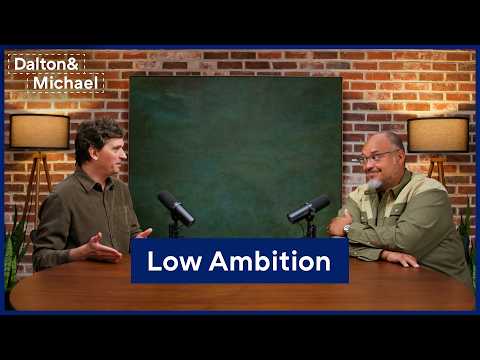
This video identifies low ambition as a hidden reason venture-backed startups fail. Small goals may look safer, the two hosts say, but they are more dangerous because they lack the power to move customers, investors, employees, and partners. The crucial qualification is that high ambition must be paired not with fantasy or slogans, but with concise, credible logic.
1. Low Ambition Is Not the Safe Choice
Dalton and Michael open by calling low ambition the "surprising secret killer" of startups. Founders know that startups are extremely difficult and rarely succeed, so they often reason, "Wouldn't aiming lower make success easier?"
"You say startups are so hard and hardly anyone succeeds. Then I should set a much lower target to improve my odds."
It sounds rational. Building a small, simple business appears easier than creating the next Google. But after observing startups for many years, the two say this logic fails—especially for venture-backed companies.
The problem is not only that the outcome may be small. Thinking small is neither a new nor creative strategy. If it reliably improved startup success, countless venture-backed small companies would already have generated major investor returns. Reality offers no such evidence.
"The absence of evidence is itself very powerful counterevidence."
This does not mean small businesses are bad. Small owner-operated or bootstrapped businesses can be excellent and sustainably profitable without venture capital. But a company funded by venture capital and premised on major growth is structurally incompatible with a small goal and low ambition.
"If your ambition is low, should you avoid venture capital? Yes."
The two explicitly note that most of the video may not apply to businesses operated without venture funding. But for any company seeking outside investment at some stage, low ambition can be poisonous.
2. Nobody Tells You Directly That Your Ambition Is Too Low
Low ambition is dangerous partly because founders receive almost no direct feedback about it. Investors generally do not say, "You are not brave enough," or "Your dream is too small," because that can sound insulting.
Instead, founders hear indirect feedback:
- You do not have enough users yet.
- The market, or TAM, is too small.
- The growth potential is not sufficiently proven.
- It is too early to invest.
The hosts believe the deeper problem is that even if the company succeeds, the world will not change enough.
"If the world does not change enough when you win, it is hard for people to find the outcome interesting."
Because startups are difficult, founders cannot endure through their own effort alone. Customers, employees, cofounders, investors, and early supporters all need to push the company from their respective positions. The hosts call them "invisible hands."
"To do something hard, you need invisible hands that lift you up and push you forward."
Those hands rarely gather around an ordinary, uninteresting goal. Around a large and exciting goal, people may want to help to an almost irrational degree. When a dream makes someone think, "The world would be better if this worked," they may offer introductions, advice, product trials, or recruiting help even when the direct reward is small.
"The world wants big new things."
"When the dream is large and clearly makes the world better, people want to help you, even in small ways."
3. Give People a Reason to Care
Michael says that if someone declared, "I want to eliminate cancer completely," he would ask immediate questions about feasibility, but still feel strongly attracted to the mission itself.
"My goal is to eliminate cancer. I do not want anyone ever to get cancer again."
The natural next question is, "How?" Yet people also understand the scale and meaning of the goal. Improving mobile-ad click-through rates by 0.05% with AI might become a business, but it is much less likely to capture memory and emotion.
"We will use a new AI to improve mobile-ad click-through rates by 0.05%."
The hosts say examples extend beyond medicine into technology: self-driving cars, or AI products that dramatically expand people's abilities and let them do what was previously impossible.
They cite Gmail in particular. Yahoo Mail offered very little free storage at the time and charged for more. Gmail provided vastly more. It was a deliberate attempt not at a marginal improvement but at an experience 100 times better than the alternative.
"Gmail was 100 times better than the alternatives."
YC often advised founders to pursue that standard: not a 2% improvement over a competitor, but, whenever possible, a 100-times-better product.
"Aim to be 100 times better. If you are making something 2% better than the alternative, why bother?"
Such a difference is not just performance. It makes customers' lives dramatically easier, enables previously impossible work, and gives more people a reason to care about the company's success.
"To win, many people have to care—customers, investors, employees, and cofounders."
One important variable founders control when choosing an idea is this care. The greater the ambition and the more the company improves customers' lives and the world, the more reasons people have to care.
4. Ambition Is the Engine Power That Moves the World
Dalton compares a startup or organization to a battery, flywheel, or engine. To pull stakeholders such as customers, employees, investors, and partners forward, a company needs sufficient power and speed—enough torque.
"You have to pull the world in a different direction."
A weak core engine without torque cannot persuade and move outsiders. An ambitious idea, by contrast, may possess the horsepower and momentum to pull the world somewhere new.
"An ambitious idea can have the horsepower and torque to pull something forward."
This power matters even when the founder is not pitching. An internal champion at an enterprise customer must persuade bosses and colleagues without the founder in the room. An investment partner must explain the company to other partners and LPs. Employees must tell family, spouses, and friends why they joined.
A good startup therefore needs not a story only its founder can tell, but a story other people want to carry forward.
"How well can people pitch your company in a room where you are absent?"
"Are we changing the world, or optimizing click-through rate by 1%?"
Dalton recounts meeting Elon Musk once in 2008. Within 30 minutes, Elon said:
"My goal is to die on Mars—just not on impact, I hope."
The line is simple and provocative, and it remains memorable. Elon repeatedly told people such audacious stories, then showed actions that supported them. People consequently invested in his vision, worked for him, and wanted him to succeed.
The hosts warn against history and media depicting great founders as people who made everything alone. Building rockets and robots or scaling companies is inherently a team game. A great person's essential ability is not doing everything alone, but creating a story large enough that people will stake their lives and time on joining it.
"Their real ability was building the biggest team."
Politics offers a similar example. Michael recalls Obama's campaign. Surpassing entrenched conventions and prejudice to achieve a huge goal required not one person, but a powerful team and movement. Great companies often feel less like mere companies and more like movements.
"It is very hard to build a movement around improving click-through rates by 1% with AI."
5. An Idea Is Not Good Merely Because It Raises Money
The two believe today's AI market can distort founders' judgment. In an AI boom, many ideas are easily funded, encouraging the false equation "fundable idea = good idea."
Something similar happened in 2021, when a new unicorn appeared almost every day. Even services such as Cameo, which sold short personalized celebrity videos, became unicorns. The hosts do not dislike Cameo, but it is difficult to call it the most ambitious idea for changing humanity's future.
"If your only scoreboard is what gets funded, your sense of what is good can become badly distorted."
The same can happen in AI. Seeing a slightly modified "15th version" of a product several companies already make receive funding can persuade founders that it too is a good idea. The "17th AI SDR" mentioned at the beginning fits this pattern. An AI SDR automates sales work. Building another one in a crowded market may win seed funding, but whether it can inspire long-term passion and support is a different question.
"You might raise a $2 million seed round for the 17th AI SDR. But what happens next?"
The dangerous part is that decent cofounders, resumes, and early revenue may carry a company through a seed round or even Series A. After that, people's interest can disappear.
"Nobody will tell you that after that point, nobody may care."
Founders should therefore not choose ideas solely by asking, "Can this get funded?" More important questions are: "Can this company create a major difference in the world?" and "Is it important enough that people will keep caring for a long time?"
6. A Big Dream Needs Credible Logic
Throwing out an unsupported science-fiction story is not high ambition. Dalton emphasizes that ambition must combine a simple pitch, an intuitive logical leap, and the founder's credibility as the person capable of making that leap.
"Ambition needs a simple pitch. The logical leap should be intuitive, and you need credibility as the person who can make it."
Elon's Mars story was more than one memorable line. He was leading Tesla, understood hardware deeply, and could explain in detail why NASA was slow and inefficient and what blocked space exploration and settlement. His claim was that institutional slowness in a government agency obstructed space development and that the problem could be solved differently.
Behind "I want to die on Mars" therefore stood a real execution path and deep industry understanding.
The same was true of OpenAI. Sam Altman did not merely say, "Give me money and I will build magical AI." He knew the relevant researchers and could explain possible technical progress from published papers and research trends.
"Sam did not simply say, 'I will make magical AI. Give me money.' There was enormous substance behind it."
The two say this depth of inquiry is not as inaccessible as it may appear. Ten years ago, AI was not today's buzzword, but determining who the leading researchers were and which papers mattered was not a state secret. It was a matter of curiosity. Understanding NASA's structural problems was similar.
"Learning who the leading AI researchers were was a matter of curiosity."
"Understanding how broken NASA was also a matter of curiosity."
In fact, a highly ambitious idea may initially look foolish to experts and authorities. When SpaceX began, established experts such as NASA officials sometimes declared it impossible. Founders do not need ideas welcomed by experts from day one; they need logic strong enough to withstand opposition and doubt.
"Ultimately, you must be willing to look foolish to experts."
"You need credible logic that lets you sit down for 30 minutes and explain every piece."
7. The Ambitious Founder Versus the Scenester
The hosts distinguish highly ambitious founders from people who mainly consume the atmosphere and status of the startup world. They call the latter scenesters. A scenester is more interested in recognition and fame within the startup game than in actually changing the world.
"The scenester's ideal is not changing the world. It is sitting on a panel with you or Musk."
Scenesters generally fear being dismissed by experts. They seek validation from industry authorities from the beginning and avoid unfashionable fields or ideas that do not look impressive. They want to join the immediate zeitgeist.
"Scenesters are deeply afraid that experts will dismiss them."
"They want to be part of the zeitgeist from day one."
Real ambition, by contrast, may emerge in a field that is not currently sexy. The opportunity may lie in discovering a problem outside the market's current attention that people mock today but that could transform the world if solved. When joining or investing in an ambitious company, distinguish between a company with only an appealing slogan and one with actual logic and execution ability.
Finally, the two offer unexpected advice to someone asking, "What if I do not yet have ambition that large?" Rather than forcing themselves to operate a low-ambition startup for years, they may find it more enjoyable and fulfilling to work inside an ambitious organization.
"If you have no idea how to make your startup ambitious, you may be happier and more fulfilled working somewhere that does not have that organizational problem."
Working at a company such as Starlink, which launches satellites at scale to connect the world to the internet, lets a person experience how much a single organization can accomplish. That experience can awaken ambition. They may come away thinking, "If that company can do something like this, perhaps I can build a big company too."
"If that company can do this, maybe I can build a company."
What investors truly seek is not merely a B2B SaaS idea that is easy to seed-fund, but a company capable of making a major difference in the world.
"Whether it can raise a seed round is not our central metric. Whether it can make a major difference in the world matters more."
8. The Meta-Tarpit of a Low-Ambition Idea
At the end, Michael returns to the concept of a tarpit: a problem that is difficult to escape once you fall into it. His ultimate "meta-tarpit" is becoming trapped in a low-ambition idea that the founder privately knows can never become large and does not genuinely find exciting.
"The ultimate meta-tarpit is being trapped in a low-ambition idea that you know in your heart can never become big."
When explaining such an idea, the founder can feel that inertia rather than passion is already driving them. They introduce the company without believing in it, speaking only because they are expected to. Spending years that way may be a greater loss than an ordinary business failure.
"If you burn years of your life on something you believe deep down is a waste of time, that is the real tarpit."
"You have to get out."
Conclusion
The hosts' conclusion is clear. Startups are difficult regardless, so rather than remaining with a small, safe-looking goal merely because it seems easier to fund, choose a large problem people genuinely want to help solve. That big dream must not be an empty slogan. It needs knowledge born of deep curiosity and executable logic behind it. 🚀