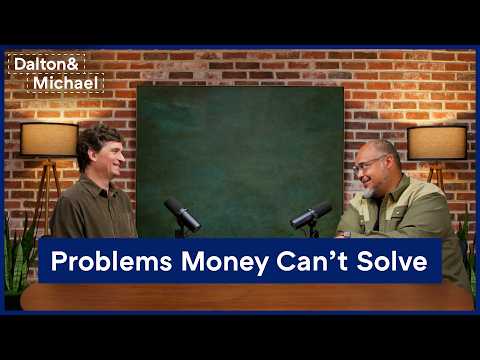
Centered on the message that raising more money does not make a startup successful, this video examines problems funding cannot solve and situations it can make worse. Capital cannot fix a product customers do not want, bad hiring, culture, or lack of focus. Money is most powerful when it expands a business model that already works, faster and more precisely. Founders must treat funding not as success itself but as a tool for solving a specific problem. 💡
1. Having More Money Does Not Mean Winning
Dalton and Michael begin with founders becoming overly anxious when a competitor announces a large funding round. They fear that the competitor can now do anything with money, but the hosts point out that far more intimidating opponents already exist: public incumbents with thousands of employees and vast cash reserves.
"If that competitor frightens you, why aren't you afraid of public companies with thousands of employees and incomparably more money? We were competing with them from the beginning."
If more money guaranteed victory, startups could not exist. Giants such as Apple and Google would already own every market.
"If you believe that more money makes winning inevitable, give up. Apple and Google already won."
Fortunately, funding size and success are not proportional. A resource-poor startup can defeat a large incumbent through a better product, faster execution, and deeper customer understanding.
"It is fortunate that more money does not mean greater success. Otherwise no startup would have a chance."
The hosts admit that as founders they too believed the next funding round would make every problem easier. What matters, however, is not funding itself, but correctly identifying what blocks the business. The video proceeds through bottlenecks money cannot remove.
2. Advertising Cannot Rescue a Product Customers Do Not Want
The most fundamental startup challenge is always making something people truly want. If customers do not want what you are selling, a larger bank balance cannot create demand.
"The most fundamental startup problem is making something people want. Unfortunately, more money in the bank does not make people want your product more."
Advertising, marketing, and billboards can expose the product to more people, widening the top of the funnel. They cannot force people to desire something they fundamentally do not need.
"You cannot make people want something they do not want, no matter how much you spend."
The hosts mention failed wearables and poor hardware products from the past. Even enormous funding could not make them succeed if people did not want to use them.
When the product is bad, heavy advertising is not merely ineffective; it burns cash.
"If the product is bad and you spend on ads, you are wasting money. You probably spend more than the ads earn. Facebook is the only winner."
Founders can deceive themselves by pouring money into ads and watching a user graph rise. But if the growth curve matches the company's burn curve, the company has not discovered demand. It has bought traffic.
"If the growth graph and burn graph are identical, what did we learn? Only that we should invest in Facebook."
This produces false confidence, prevents founders from confronting the absence of demand, and can make the eventual failure later and larger.
3. Customer Understanding and Growth, Not Money, Win Competition
Funded founders often treat capital as a war chest. They expect to buy competitors, recruit expensive executives, and use many tactics to gain an advantage. The basic principle of competition is simpler.
"You beat competitors by growing faster and having a better product."
If spending does not directly produce faster growth or a better product, it is unlikely to be the universal remedy a founder imagines. Raising more than a competitor does not create victory by administrative decree.
Dalton recounts a conversation with a founder who hated Workday and called the product terrible. Closer examination showed that many things the founder disliked were exactly what Workday's real customers valued.
"The founder said Workday was completely awful. It turned out that almost everything he hated was something Workday customers liked."
The founder cared about an attractive user interface, but Workday's customers did not regard that as central. The episode shows how easily founders confuse personal taste with customer need.
"They wanted to spend money improving the product without even knowing what customers wanted to buy."
Spending in that state creates no value; it travels farther in the wrong direction. Once an organization becomes accustomed to mistaken spending, reversing course is extremely difficult.
"It is very hard to stop spending on the wrong thing once you become accustomed to it."
Before spending, founders must verify what creates customer value and the causal connection from the expense to product improvement and growth.
4. Expensive Executives and Mass Hiring Will Not Save the Organization
A common use of funding is executive hiring. A founder may expect a chief revenue officer to change the revenue trajectory. The right person at the right moment can help, but hiring an executive simply because the money is available can destroy value.
"If you are tempted to hire an executive before you are ready, it may destroy value."
An executive mismatched with the company's stage can merely complicate structure and work. Without product-market fit or clarity about what to sell, even an excellent sales executive cannot solve the fundamental problem.
Money can reassure candidates: a company with $10 million appears safer than one with $1 million. Funding obviously helps if imminent bankruptcy makes hiring impossible. But visible wealth can also attract mercenaries interested only in compensation.
"If you look rich, you may hire people who do not care about the mission and look only at cash compensation."
The organization then fills with people drawn by salary rather than conviction in the vision. The hosts say they have seen this work poorly many times.
Another issue is spreadsheet hiring. A manager declares a need for N people, leadership adds N rows to a plan, and checks only whether the budget balances. Too little attention goes to who is hired, whether they are excellent, and whether the company needs them.
"Putting money into a machine does not produce high-quality talent."
A manager can hire eight poor performers and still make the plan look complete because the budget was spent and the headcount target met. Money cannot replace a founder or leader's attention, judgment, interviewing, and control of hiring quality.
"Money cannot buy your attention."
Spending $2 million to build three sales pods under the assumption that enterprise sales will then work is dangerous. First establish whether the motion works, who the right customers are, and whether the process is repeatable.
"You think spending money on three sales teams will make enterprise sales work? No. Sorry, it will not."
5. Offices and Benefits Do Not Create Culture
Money can help hiring when it contributes to a good culture where people want to work. A good office and basic benefits can improve working conditions.
"If money in the bank translates into 'This is a great place to work,' that can be a good use."
But an expensive office, abundant snacks, and flashy perks do not automatically create a culture where employees care whether the company wins.
"You can spend heavily on offices and benefits and still build a culture where the average employee does not care whether the company succeeds."
Conversely, a company can operate from a shabby basement while building a culture where everyone wants to show up and produce results. Livable wages, medical insurance, and basic treatment matter, but beyond that the hosts see few cases where more spending produces overwhelming motivation.
Employees sometimes see product reality more objectively than founders. They may join excited about the vision and growth, then understand after months of meeting customers and examining the product whether the company is truly performing.
"Employees know. Once they meet customers and understand the product deeply, they know whether it is actually good."
A high salary does not make an employee lie to themselves that the product is excellent. Healthy culture therefore comes less from capital than from confidence in the product, a shared mission, and transparent confrontation with reality.
6. More Funding Makes It Easier to Lose Focus
With little money and few people, early startups are forced to concentrate on one or two things. YC repeatedly emphasized this principle.
"Focus, focus, focus. At the early stage, focus is forced on you."
A large round enables many simultaneous initiatives: multiple products, different customer segments, and several bets justified as diversification. The hosts believe such parallel hedging usually backfires.
"Once money arrives, you do many things at once, diversify risk, and hire people for everything. Paradoxically, it does not work."
Dalton says conversations with founders pursuing many things usually reveal which one genuinely excites them. Yet they often invest less than 20% of company resources in that central opportunity.
"They were putting less than 20% of their effort into the thing that objectively excited them most."
Founders say they cannot stop other projects or need three simultaneous bets to feel safe. But talent, leadership attention, and time are all limited. Dividing them does not create safety; it can weaken the most important opportunity.
"Good people, attention, and time are limited. Why dilute them? Feeling safe is not the same as being safe."
The hosts do not oppose experiments. They favor sequential experiments—learn from one, revise, then move to the next—rather than three parallel initiatives.
The issue afflicts even billion-dollar companies. Larger companies tend to launch many businesses and spend time on coordination, a condition called big company-itis.
"Once big company-itis enters a startup, it is very hard to remove. Keep it out as long as possible."
A small startup should not imitate in advance the very mistakes that damage large corporations.
"You are importing into your company the exact problem that breaks big companies."
7. Money Is Powerful When Scaling What Already Works
Why raise money at all? The hosts do not oppose funding. When a company creates real customer value and the model works repeatably, capital can help enormously.
First, if the product genuinely helps customers, additional hiring may remove a growth bottleneck. Second, if exposure reliably leads customers to try, enjoy, and keep using a good product, marketing investment can be highly effective.
"If you can predict that telling people about a good product makes them try it, like it, and stay, you are in an excellent situation."
Michael explains this through payback period. If sufficient data shows that customer-acquisition cost is recovered within ten months, the company should aggressively raise money to scale it.
"If you have enough data to know customer-acquisition cost is paid back in ten months, raise as much money as possible for that."
Do not claim a ten-month payback simply because a customer signed an annual subscription. Establish that customers love the product, find life difficult without it, and are likely to keep paying for a long time.
"If after ten months customers feel they cannot live without you and keep paying, that is a wonderful business."
Funding rounds may be economically necessary to build a company large enough to go public. But fundraising should not be the goal. It should be a consequence of the company performing well.
"Do not make fundraising the objective. Treat it as a lagging indicator: 'We are doing well, and this followed.'"
The hosts use Uber and Lyft and DoorDash to illustrate good use of funds. After Uber opened the black-car market, it was rational to raise capital to pivot and scale once it understood that Lyft's model using ordinary drivers might be better. That is a calculated investment based on understanding of customers, markets, and the business model.
Likewise, after DoorDash proved profitability in its first 12 markets and learned which regions to enter, how to operate stores, and how to run promotions, funding expansion into the next 50 markets was sensible.
"Aggressive investment is excellent when customers clearly love the product and you know what to do."
By contrast, "We have $10 million, so let's hire people and buy billboards" is hand-waving.
"Hiring and buying billboards because you have money is a hand-waving plan. The earlier examples were precise and specific."
The key is whether the use of funds is specific, testable, and repeatable.
8. Funding Also Creates New Problems: Boards and Employee Expectations
Dalton warns about two side effects founders often fail to appreciate.
The first is the board member who arrives with an investment. The investor may have invested while believing the company was doing better than it really was. The founder must then meet that investor every quarter, which can become an enormous source of stress for a pre-product-market-fit CEO.
"One of the biggest stresses I often see for a pre-PMF CEO is an investor-director who no longer likes the company."
The investor may not be able to destroy the company or force immediate action, but it is psychologically burdensome when an important shareholder and hoped-for adviser broadcasts, "Investing in your company may have been a mistake."
"Having an important shareholder become a negative cheerleader is not fun."
The second side effect is changed expectations inside the company. A founder may know the company is struggling, while employees assume it has already succeeded because a famous VC invested $20 million.
"The founder knows the company is not doing well, but employees think it is because Sequoia gave it $20 million."
Employees can begin treating the startup like Google rather than a company still fighting to survive. When people believe success is already secured, they may calculate their personal share and benefits before considering sacrifice for survival and growth.
"Once people think the company has succeeded, they start asking, 'How do I get my piece?'"
In a team that shares the reality of a long road while believing in mission and colleagues, people instead ask what they can contribute and sacrifice. A struggling company in which everyone is also extracting their own share is in serious danger.
"If the company does not work and everyone is taking their cut, good luck. That is not a problem money fails to solve; it is a problem money creates."
9. Money Is a Tool, Not a Master Key
Michael concludes that founders should treat money as one tool in a toolbox. Startups need product development, customer interviews, hiring, sales, operations, focus, and culture. Capital is only one tool among them.
"Treat money as a tool. It can solve certain problems, but money itself is not the answer."
Fundraising ability is useful. But believing money is a cure-all and applying it to every problem guarantees failure.
"When you have a hammer, everything looks like a nail. If money is all you have and you try to fix everything with it, it will not work."
Dalton describes the startup environment as ambition, intensity, intelligence, and scarcity of resources. Large corporations try to manufacture that environment but struggle. Startups can find more original solutions precisely under constraints.
"Ambition, intensity, intelligence, and scarce resources create a better environment for invention."
Early scarcity is therefore not only misfortune. Without money, founders must focus on essential problems, reduce waste, and rapidly discover what customers truly want. The pressure can produce invention and creativity.
"I wish we could bottle into a pill what the best companies do when cash is scarce."
"The desperation of scarce cash produces far more invention than the six months after funding, when people think, 'Now we can spend.'"
Conclusion
The conclusion is clear: money cannot substitute for customer demand, product quality, leadership judgment, strong culture, or organizational focus. Overfunding an unproven business can conceal problems and magnify bad hiring, scattered strategy, and distorted expectations.
The best funding follows a product customers already love and a repeatable growth engine, then accelerates that engine. Scarce resources are uncomfortable for an early startup, but can become one of its strongest sources of focus and innovation. 🚀