
Palantir's FDE (Forward Deployed Engineer) goes beyond being a mere dispatched engineer or consultant--they identify the essence of problems in the field and directly implement impactful solutions. The core of their work stems from a unique abstraction called ontology and direct field experience. In an era where the internet and AI continue to advance, the article emphasizes that the truly important things can only be discovered through someone's footsteps, observation, and communication.
1. What Is a Palantir FDE?
As Palantir's stock price has risen, attention to the unique role of FDE (Forward Deployed Engineer) has grown. An FDE is an engineer who is embedded at the client site, uncovers problems, directly implements solutions, and takes responsibility through to resolution. This is fundamentally different from conventional practices. Unlike dispatched engineers in the systems integration (SI) industry or consultants in the consulting industry, FDEs work in the following ways:
- They embed deeply at the client's site and discover real problems alongside the local team.
- They do not stop at defining problems--they implement solutions and continuously improve them until impact is achieved.
This attitude and approach clearly differentiates them from traditional dispatch work. Rather than merely fulfilling requirements handed down from above, they take on the role of "the agent who digs into the truly important problems and solves them together."
2. Palantir's Ontology: A New Lens for Looking at Problems
Palantir views the world through an abstract structure called ontology. Ontology is the work of breaking down the world's entities into Entities, Links, Actions, and other components to create a digital twin. Through this approach, data can be structured to match the actual circumstances and context of an organization, enabling realistic simulation.
The key point here is that simply bringing a solution and installing it does not create innovation. Without identifying the real problem, you end up in the practical dilemma of "just tacking on another lump and walking away."
That is why Palantir leverages the FDE position to collaborate with clients to the very end and create real change.
3. The FDE's Role: From Problem Discovery to Impact
While a typical SI dispatched engineer occupies a subordinate position, performing only the work defined by the client, the FDE differs in that they think through the client's problems together, define them, and create impact directly in the field. For FDEs to properly fulfill this role, the Palantir-style ontology-building process is essential.
As the saying goes, "a monk cannot shave his own head"--the real data and relationships within an organization, which are difficult for internal employees alone to surface, are what FDEs construct from an outsider's perspective.
FDEs lead semantic data modeling while communicating with the client organization, and collaborate closely with engineers at headquarters to reflect impact in the system. While advances in AI/ML/LLMs have made coding and development easier, the emphasis remains that "truly important problems" in the field must be found by people.
"The important things in the world aren't on the internet. You have to go out and find them, and only people can do that."
In other words, the essence of the FDE is the role of directly discovering and implementing the truly important things in the world that cannot be found on the internet.
4. 'Impro' for FDEs and Growth in the Field
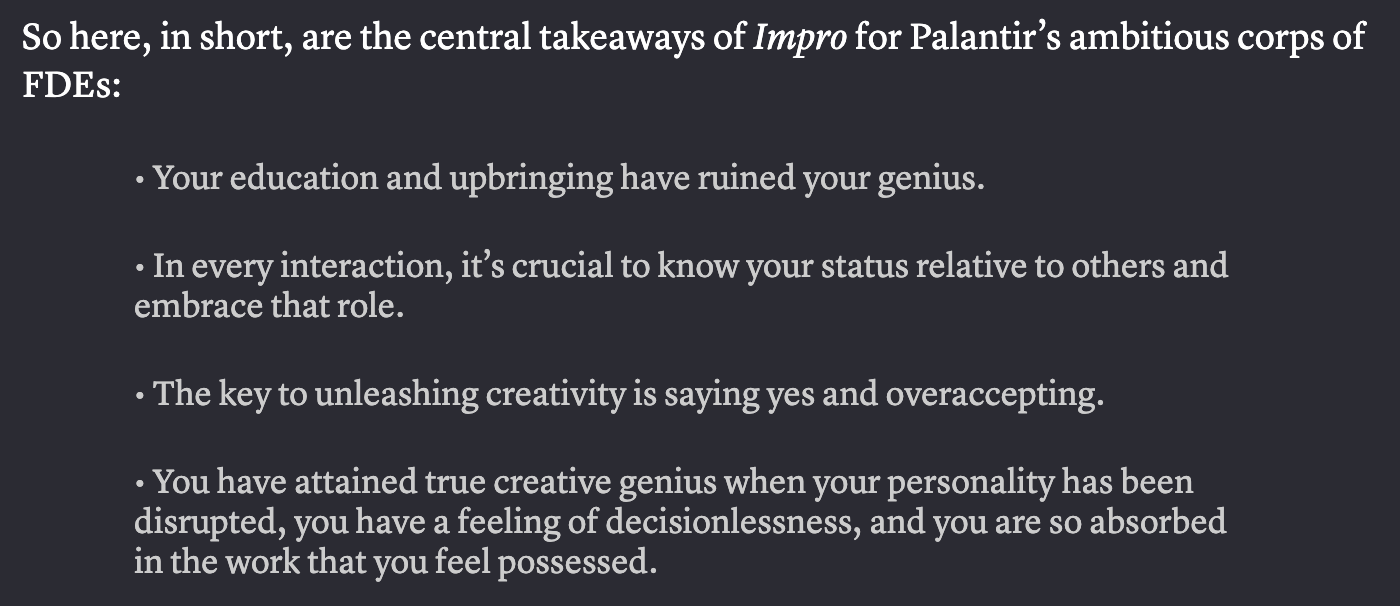
When someone becomes an FDE, they are encouraged to read a book called "Impro" (Improvisation and the Theatre). This book teaches improvisational communication skills, status adjustment in relationships, and positive conversation techniques--how to respond flexibly to the various situations encountered in the field.
"How to subtly yet intentionally perform one's status as higher or lower than the client's"
"Why starting with 'Yes, and...' rather than 'No' allows positive improvisation to exert its power"

This is also a methodology for growing in high-stress environments, where FDEs sometimes lead, sometimes defer, and sometimes plant seeds within teams to create impact at client sites. As this training and experience accumulates, it naturally leads to paths of growth and entrepreneurship after the FDE role.
5. Growth and the Next Step
After serving as an FDE at Palantir, many go on to start their own companies. This is because they are filled with "real-world growth" experience gained in the field.
"I am sincerely grateful that you all helped me grow."
Directly confronting uncertainty, finding problems, and creating impact--this experience is something they have internalized through their bodies as "the important role that only people can play" in an era of advancing AI.
6. Living Like an FDE in the AI Era
In 2025, as AI grows ever smarter, the role of people becomes finding problems and richly infusing them with context. And that work cannot be solved through digital information alone.
"The person who goes out to find the important things in the world that aren't on the internet, the person who mines opportunities from there."
This serves as a renewed commitment that this is the practical approach to leading more meaningful growth and change in the AI era.
Closing
Palantir's FDE is more than a mere technician or consultant--they are a creative practitioner who finds real problems in the field and creates strong impact. As AI and automation spread, what matters is "the real problems" found by people's own feet, beyond the internet. The important things in the world--their value still begins with human hands, eyes, and hearts.