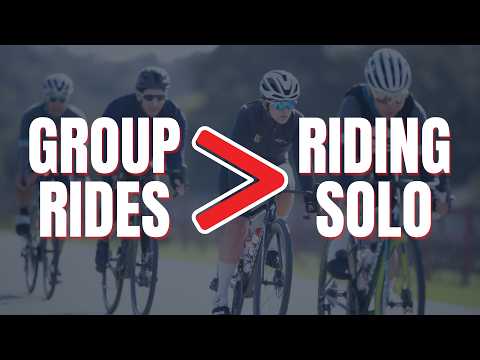
This video uses the psychological concept of social facilitation to explain why having a training partner or riding in a group boosts speed, motivation, skill, and efficiency. At the same time, it warns that blindly riding with others every single session can backfire through overtraining, over-arousal, and skill breakdown — so balance with solo riding is the real key. It wraps up with a sample weekly schedule, tips on finding the right partner, and practical ways to locate a group ride that fits you.
1. "Get Faster for Free" — Meet Social Facilitation
The video opens with a pretty provocative question: would you do something that could raise your performance, speed, motivation, handling skills, and efficiency — without adding more training volume? It anticipates the usual pushback — "sounds expensive," "there's no such silver bullet" — and responds: this method costs nothing but time and effort, can even deliver results with less effort, and above all makes riding more fun.
"Performance, speed, motivation, handling, efficiency… all in one shot. Would you do it? … It doesn't cost money — just time and effort."
That "one thing" is simply social facilitation — in plain terms, having a training partner or a group to ride with. The presenter frames this not as a vague feeling but as a well-documented phenomenon in social psychology.
"What is it? 'Social facilitation.' In other words, having a partner or a training group."
But he's quick to add: don't skim past this thinking you already do it. Plenty of people ride in groups yet don't understand why it works, how to use it intentionally, or when it turns against you.
"You already do this, let's move on — don't do that. Because there are downsides too."
Drawing on his coaching experience and sports psychology, he argues that always riding with others is a problem, but so is riding alone like a lone wolf every day. To maximize both performance and enjoyment, you need balance — and that's the message that closes out Part 1. 😊
2. How Social Facilitation Works: Arousal, Challenge, and Flow
He defines social facilitation as the concept that explains how performance changes when other people are present. In sport, the effect typically raises physiological arousal — sharpening attention, curiosity, and motivation. When that arousal meets a challenge at the right difficulty level, the result is what we call the Flow state.
He cites psychologist Mihaly Csikszentmihalyi, describing Flow as one of the most enjoyable experiences a human being can have. In Flow, everything clicks, movement feels smooth, time seems to slow down, enjoyment intensifies, and you're fully absorbed in the present moment.
"When you enter Flow, everything just 'fits.' Movement is fluid, time slows, enjoyment grows, and you're completely in the moment."
He then links this directly to riding alongside someone, competing, or performing in front of others as one of the key triggers of Flow. The tension and stimulation a group provides can act as an on-switch for your best performance.
3. What History Tells Us: Co-action and Audience Effects
The video makes clear that social facilitation isn't just a compelling story — it has a long history of experiments and research behind it.
- In 1898, psychologist Norman Triplett observed cyclists and documented that performance could be higher when riding together than when making a similar effort alone, establishing one of the earliest classic experiments on social facilitation.
- In 1920, Floyd Allport coined the term "social facilitation," and researchers since then have organized the phenomenon into two main types:
- Co-action effect: facilitation that occurs when performing alongside teammates or training partners who share the same goal
- Audience effect: facilitation that occurs when others are watching and cheering
He notes that being around people who positively energize each other naturally draws out our best — but the real insight is that training this intentionally turns it into a powerful performance tool in the brain.
"This is the core of what social facilitation is saying. You need to understand why it works to know what tool you're actually using."
4. But Groups Aren't Always Medicine: When Social Facilitation Backfires
Here the video's tone shifts sharply. There are two sides to this coin. Social facilitation is powerful, but used carelessly it can work against you.
The main backfire scenarios he outlines:
4-1. Excessive Intensity and the Pressure to Always Perform
When group pace keeps climbing, or you're always trying not to get dropped, intensity can creep too high without you noticing — and a persistent feeling that you always have to be on builds up.
"Intensity gets too high, pressure gets too high, and there's always this feeling that you have to perform."
4-2. Over-Arousal: When Anxiety Gets Out of Hand
If the ride is too long, too fast, the course feels intimidating, or the riders around you are taking sketchy risks, anxiety spikes beyond a productive level and the effect flips negative.
"If the ride's too long and too fast, the course is scary, or people are riding dangerously… anxiety shoots up."
4-3. Skill Breakdown: When Pace Undermines Technique
Even skilled riders can start making more mistakes when the pace exceeds what their fitness can sustain. And for riders still developing their skills, jumping into the deep end is genuinely dangerous.
"If the pace is too high for your fitness level, mistakes happen. If your skills aren't there yet and you go in the deep end… that's when bad things can happen."
4-4. Mismatched Partners: When the Relationship Breaks, Training Breaks Too
If your partner is far stronger and won't slow down, doesn't communicate, or doesn't train the way you agreed, the partnership simply doesn't work. He compares training partners to a romantic relationship — a partnership only succeeds when it goes both ways.
"A training partner is like a relationship. To succeed, it needs to be a 'partnership' — bidirectional."
4-5. Social Inhibition: When "Together" Actually Shrinks You
When skill or motivation is lacking, the social element can flip into social inhibition — actually lowering performance. So jumping blindly into the fastest local group because a YouTuber told you to is a recipe for trouble. Finding a safe environment appropriate to your level and the right group is what matters.
"Don't just jump into any local group ride because some YouTuber said to."
He adds that he's seen many riders who assumed group riding "wasn't for them" — only to get hooked once they found a safe, well-matched environment.
5. Practical Application: 3 Days with a Partner + 2–3 Solo Days
So how do you mix them? His advice isn't "ride with others every day" — it's to find a ratio that extracts the best of both worlds.
His simplest framework:
- 3 days per week: with a training partner or group
- 2–3 days per week: easy riding or solo riding
Those 3 partnered days might be structured like this:
- 1 endurance day: mutually agreed upon staying in Zone 2
- 1 interval day: each doing intervals up the same climb, pushing each other
- 1 weekend group ride: wheel-sucking, attacks, sprints — race-specific skill work
- He also calls this "playing bikes." 😄
"On the weekend, the group ride — drafting, attacking, sprinting… basically 'playing bikes.'"
6. Near a Race: 2 Group Sessions + 1 Individual High-Intensity Session
As race season approaches — especially in the 6–8 weeks peaking toward a target event — he explains that using intensity as the guiding criterion usually gives you the answer, even though individual needs vary. Referencing several training theorists, he notes that 2–3 high-intensity sessions per week is effective while still allowing recovery.
Using a rider doing 5–6 sessions per week as an example, he recommends for this block:
- 2 group rides per week (high race-specificity)
- 1 individual custom high-intensity session per week
- Remaining sessions filled with recovery and endurance work
His concrete weekly example:
- Tuesday: hard group ride
- Thursday: intervals (individual high intensity)
- Saturday: hard group ride
- Sunday/Wednesday: endurance riding
- Monday: rest
- Friday: optional easy spin or additional rest
If you do strength work, attach it to a hard day when possible so it doesn't eat into your recovery days — but if that's logistically difficult or the interference is too great, slot it in on Wednesday or Friday. The point isn't perfect scheduling but consistent execution.
7. How to Choose a Good Training Partner: "A Relationship That Makes Both of You Better"
On partner selection, he says to look for someone who is stronger than you in some dimension, but not all of them. For example, if your sprint is strong but your climbing is weak, ride with someone who climbs well — they push you on the hills, you help them on the sprint. The key word is reciprocity.
"Find someone who can help you — but you also have to be able to help them."
He also emphasizes practical compatibility:
- Similar schedule (especially on hard/long ride days)
- Someone you like or can at least tolerate (you'll perform better)
- If there's a big skill gap, it only works if the stronger rider is genuinely willing to slow down
If both riders have coaches, he recommends connecting the coaches to align key training days. He's candid about one pet peeve: using "my coach said no" as an excuse. Most of the time, he says, a quick conversation resolves it.
"I really dislike hearing 'my coach said I can't.' Usually it's just an excuse."
And above all, fun must be a shared value.
"If it's not fun, there's no motivation. Fun comes first."
8. Practical Ways to Find a Group Ride That Fits You
Finding a group ride is simpler than most people think. His first recommendation is just ask people — local bike shops, cafés, after a race, at a training camp. Most connections happen organically.
He also endorses a modern search approach:
"A nerd today would ask ChatGPT. An old-school nerd would Google it."
He also points to sites like USA Cycling for finding locally based clubs, teams, and rides — and suggests asking your coach if you have one. He mentions brand ambassadors who connect riders in their local communities — distinct from influencers, he stresses — people who genuinely work to help good riders meet other good riders and get healthier, have more fun, and go faster together.
"The ambassadors I'm talking about… they connect good people with other good people. So everyone gets healthier, has more fun, and gets faster."
9. Ultimately It's About Community: A Force That Changes More Than Your Training
The final section reads almost like an essay. He steps back and says, "I'm not a social or sports psychologist — I'm just a coach," but there's one thing he's confident in from experience: between riding alone and riding regularly with others, there's a tangible benefit that goes well beyond training effect.
He calls it the power of community — and the ability to build a culture around the kind of life you want. He revisits this conviction after a recent team camp where riding with friends and teammates reminded him of it firsthand. The conversations were rich and inspiring. Some riders were in peak shape heading into their season; others were rebuilding after a string of hard setbacks.
One moment stands out in his telling: riding together, three hours passed but felt like only one or ninety minutes — time slowed in that characteristic Flow-state way, and the joy was real.
"Three hours had passed, but it felt like only an hour or ninety minutes. Time slowed, and there was joy."
That weekend wasn't just a "hard group ride Saturday at 9 a.m. and done." It was three days of showing up, overcoming excuses, and reconnecting — someone's family opened their home for lunch, people shared stories of pulling each other through the dark stretch after COVID, and a new goal took shape: get back on the mountain bike and build up trail miles together. All of this, he argues, pushes you further than any interval prescription or fueling strategy ever could.
"Better than which intervals to do when, better than how to optimize long-ride fueling… The effect carries you further than all of that advice combined."
He closes with a challenge to the viewer: if you've never ridden with a group or a partner, go try it. And if you're already riding with a group seven days a week — "you're wild," he says — he hopes you've also learned that solo riding has something to offer, and that balance is worth finding. He ends with a note about camps, skills clinics, and coaching.
"If you're doing group rides seven days a week… you're genuinely wild. But I hope you now know that solo riding might help you too."