
This article explains how people with many interests can build a solo knowledge business through social media, newsletters, small products, and coaching without confining themselves to one narrow niche. Define a brand mission moving readers from their current problem, Point A, to a desired transformation, Point B, then connect content and offers to that mission. Rather than large organizations and headline revenue, the author recommends a "soft rich" business with low costs, high profit, and freedom.
1. Multiple Interests Are Business Material, Not a Weakness
The author begins with the confusion of people interested in many fields who cannot choose a path. School seemed to suppress curiosity. He changed college majors five times, never graduated, and was left with lost time and student debt.
Such people struggle to choose careers because they want to do so much. Yet common social-media business advice says to pick a target customer, narrow the niche, and repeat one topic.
"Choose a target customer."
"Niche down and talk about one thing."
Following that blindly, he argues, can create another job where you work longer doing things you dislike for people you dislike. He had some success freelancing in web design but tired of others' projects and began using social media to pursue his own.
He discovered that people follow creators for more than one topic. Someone interested in self-improvement may also explore psychology, philosophy, and exercise. A creator showing the connections can bring readers along naturally.
"Once you remember you're talking to human beings, the idea that you must niche down is fairly absurd. Humans can become interested in anything presented properly."
Many interests are rich material for a shared transformation, not necessarily distraction. What matters is how those topics help change readers' lives, rather than which single topic to choose.
2. Soft Rich: A Solo Business Built for Freedom
Although the original title promises wealth through interests, he does not mean hundreds of millions of dollars. He felt richer working alone or with one editor than after running two organizations, a software company, and an ecommerce company.
Selling knowledge products without a substantial team leaves most revenue as profit. Earning $1 million annually alone may therefore feel more abundant than running a traditional $10 million-revenue company with staff and fixed costs. He calls this "soft rich." 💡
The model is simple:
- Use social media to gain attention and traffic.
- Quickly monetize through a small product or service based on your knowledge.
A huge company, complex team, large ad budget, and elaborate brand are unnecessary initially. Create a way to help people through experience and knowledge and get paid for it.
3. Unify Interests Through a Brand Mission and Content Map
Success requires knowing not just what to post, but why anyone should care. He recommends a content map.
Use pen and paper rather than a notes app or word processor. Handwriting slows thought and encourages deeper consideration instead of indiscriminate typing. The paper becomes a business map to revisit repeatedly.
Many people quit after a few unresponsive posts because they cannot imagine their brand six months or two years ahead. They throw out random topics, then conclude they have nothing to say.
"Do not treat posts as individual darts at a target. Each is a puzzle piece in a larger picture."
Build a map people want to keep exploring, rather than depending on isolated viral posts. Its north star is the brand mission.
Define Points A and B
Mark two points at opposite ends of the paper:
- Point A: The life readers want to escape: their frustrations, trapped situation, or the life the brand opposes, its "enemy."
- Point B: The future readers want: the successful transformation and destination the brand guides them toward.
The mission is moving as many people as possible from A to B, such as helping distracted people develop intentional self-management and agency.
Philosophy, fitness, business, and psychology can coexist if they support that change. A niche is a promise of transformation, not a prison limiting topics.
Expand Broad Topics Into Specific Ideas
Under A and B, write two or three broad topics: the map's major territories.
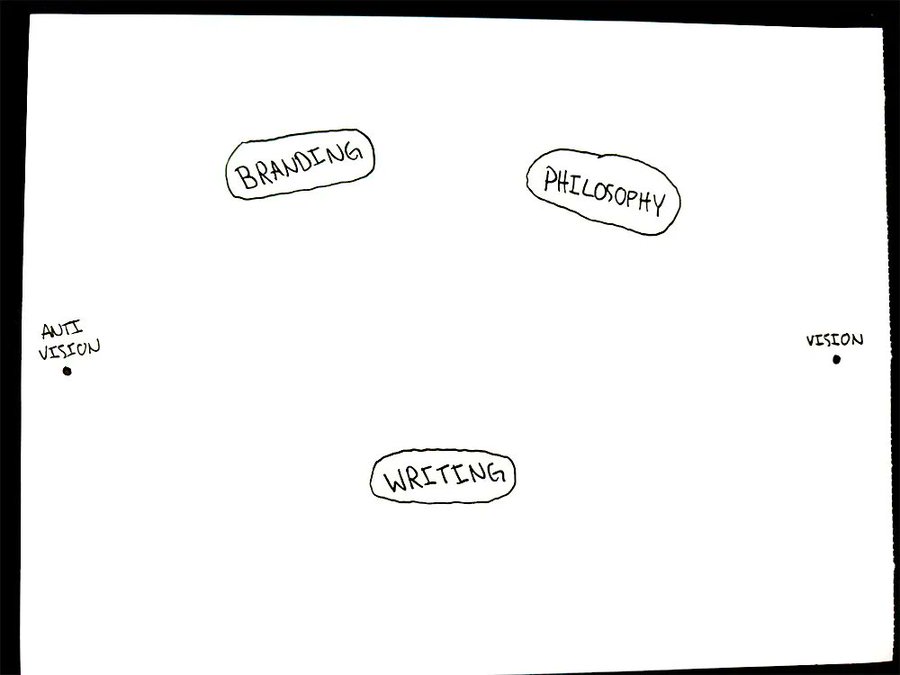
Social-media users scroll for interesting material rather than search for precise information. Starting too narrowly can prevent reaching most people you could help.
Broaden interests, for example:
- Service-business lead generation becomes online business.
- AI automation workflows become artificial intelligence.
- A carnivore diet becomes health or nutrition.
Branch each broad topic into three to five subtopics, like cities within a territory.
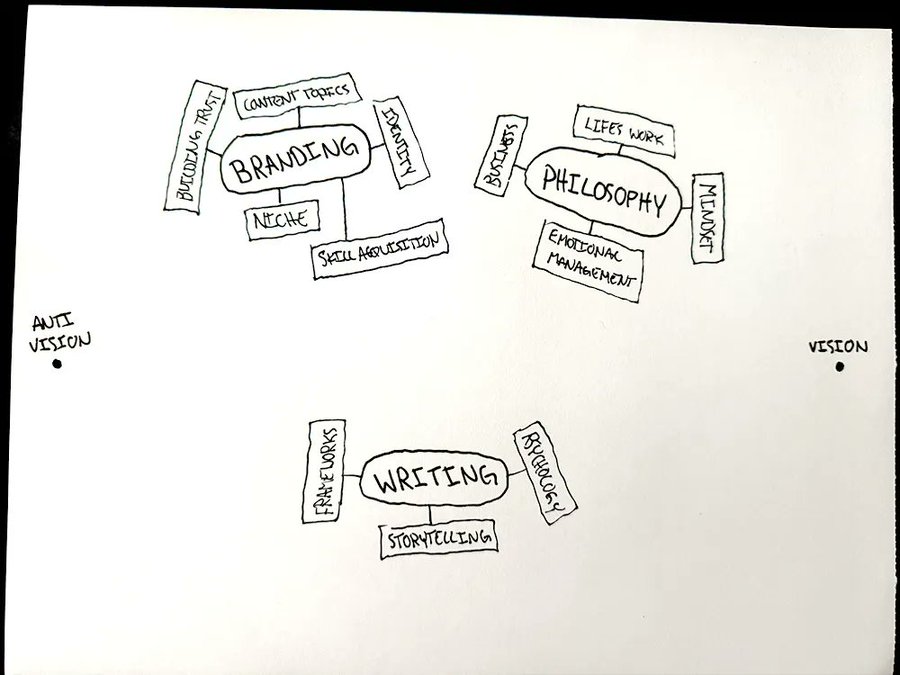
Fitness might include nutrition, training, habits, lifestyle, and recovery. Self-improvement might include mindset, focus, journaling, emotional regulation, and goals. Business might include writing, digital products, audience building, skill acquisition, and AI tools.
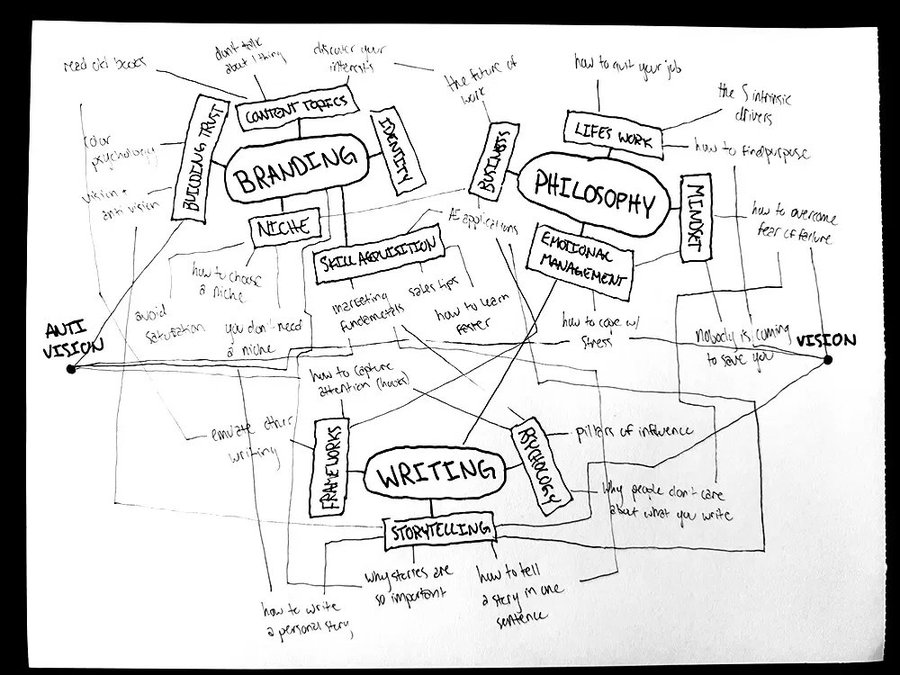
Finally, write three to five specific content ideas per subtopic, considering:
- People's pain and frustration
- Immediately usable methods and steps
- Your lessons and failures
- Why it matters and the cost of neglect
- Industry uncomfortable truths
- Your disagreements with or reinterpretations of common advice
Do not be excessively anxious about expertise. Being one or two steps ahead, or offering another perspective, can be valuable. Someone still learning and experimenting may be more candid and relatable than a master.
"You don't need to be an authority. Genuine interest and being a step or two ahead of the reader are enough."
4. Four Foundations for Running the Business
Avoid adopting many complex tools. Start with four functions:
- A traffic source gathering potential customers
- An email-capture space connecting directly with interested people
- Payments and delivery for products and services
- An idea and writing workspace managing content, marketing, and offers
Gather Attention Through Social Media
Text-centered social media is cheap and easy. It is free, permits daily promotion, and quickly tests which ideas produce growth and sales. You need not first learn video, audio editing, or graphic design.
Choose one suitable platform among X, Threads, Substack, and LinkedIn:
- X offers deeper ideas and growth potential.
- Threads is beginner-friendly but may bring lighter engagement and more hostile comments.
- LinkedIn has purchasing power but is professional and somewhat stiff.
- Substack attracts long-form readers, with followers becoming newsletter subscribers, simplifying email capture.
Build Trust Through a Newsletter
Social media attracts attention; newsletters deepen trust and lead to purchases. He says claims that email is dead come from people who have not run real businesses.
"Social media captures attention. Those wanting more are nurtured on the email list."
He favors one short-form platform and one long-form newsletter. Podcasts or YouTube can substitute, but require equipment and editing, and still need a separate email list.
Payment, Delivery, and Working Spaces
Selling requires landing pages, payments, delivery of files, courses or coaching, and possibly scheduling. The article mentions Stan, Teachable, Kajabi, ClickFunnels, and Gumroad, while promoting his own Eden as an integrated tool. The core principle is a simple path from social media and newsletters to product or service pages, not one particular tool.
Most online-business work is ideas and writing. Invest around one or two hours daily in writing and planning content, newsletters, products, marketing, and service improvements. Notion, Google Docs, and Obsidian work, provided notes are organized rather than merely accumulated.
5. Start With Small Products and Services
What should you sell?
Before building a huge course or polished program, study five to ten creators with a similar style. Examine their popular content, growth, and products, then devise a plan grounded in your experience. This is understanding market structure through references, not copying.
Create two things.
A Micro Product
A micro product is a simple digital item: a template, prompt, or short guide based on proven newsletter or content ideas, sold for roughly $19.
The initial aim is learning what people pay for, not large revenue. A career adviser might sell their own resume with an explanation for $10. Helping buyers create their own resume with AI might support a higher price.
Look for pain, passion, and process:
- Which problem have you solved?
- Which interest or hobby improved your life?
- Which habits, routines, or systems produce a particular result?
Start with rough stone and refine it, rather than expecting a perfect marble sculpture immediately.
"You don't start with a finished statue. You start with an ugly rock and refine it over time."
Find the Product Angle Through Market Response
Positioning, the product's "angle," matters alongside content. A title should evoke a desired outcome more clearly than "writing course."
Study well-performing posts and videos. If "How to focus for 12 hours a day" succeeds, a study product might target that desire as "How to study for 12 hours."
AI can research popular posts and brainstorm names. Do not expect perfect answers: use it for inspiration, then develop ideas through your own experience and authenticity.
A Micro Service
The second offer is one-on-one coaching, around four weekly sessions across a month, with assignments and help overcoming obstacles. He suggests $500–1,000.
One call may only motivate; four can create real change. Selling a four-call package takes roughly the same effort as selling one call, while improving revenue and customer understanding.
Two types are:
- Tutorial services: Teach skills freelancers otherwise perform, such as web design, graphic design, coding, writing, editing, or lead generation.
- Coaching services: Help improve life outcomes in fitness, nutrition, sleep, productivity, relationships, money, mental health, or life direction.
He believes the market for learning is larger than the market for done-for-you work. Solo founders, learners, and career changers may need skills more than they can afford outsourced execution.
6. Design the Four-Session Coaching Offer
Many aspiring coaches do not know what to do on calls. Reuse the content-map paper to design the service.
Start With Your Transformation Story
Write where you began, why you wanted change, what was hard, what you realized, and what you would do differently now. This supports the coaching offer and becomes an initial story-based social post.
Define the Customer's Present and One-Month Goal
Describe the ordinary day of someone you can best help: frustrations, previous attempts, and consequences of no change.
Set a realistic one-month goal. Avoid vague promises such as mastering web design or getting in great shape. Use credible outcomes such as "Build your first website in 30 days" or "Lose the first ten pounds and establish a sustainable exercise routine."
List Every Step, Then Group Them Into Calls
Brainstorm everything needed to move from A to B before organizing it. Web design might include hosting, domain connection, design basics, templates, colors, fonts, copy, page structure, and launch.
Divide the steps into four calls. Add sessions and price if necessary, or reduce to two if enough. For unclear areas, read relevant bestsellers and buy three to five existing products to check for omissions.
Name the service and assign homework after each call. Names such as "Web Design Starter Pack," "30-Day Reset," or "Creator Magnet" make the steps feel like a system.
Send preliminary questions before the first call to understand the starting point. Subsequent calls follow a common structure:
- Check homework completion and obstacles.
- Teach what is needed while solving the customer's difficulties.
- Set actions for the following week.
Expect 30–60 minutes per call. Good results across four calls can lead naturally to another four and a higher-value service.
7. A Sales Flow for a Small Audience
With few or no followers, start by talking directly with people. This is useful: selling teaches customer needs, and content can later take over that role.
The flow is:
- Publish a social post targeting the pain your service solves.
- Explore it more deeply in a newsletter to build expertise and trust.
- Offer a short questionnaire for interested people.
- Have DM conversations with respondents, commenters, and newsletter repliers.
- Send a payment link to suitable prospects.
A long sales page is not essential here. It can help strangers arriving through ads or search, but readers who already trust the content need a way to express interest and talk.
Three Jobs of the Questionnaire
The questionnaire is a sales tool:
- Filter out those without buying intent.
- Help respondents recognize their problem more clearly.
- Offer a lower-pressure action than booking a consultation.
Begin with about three pains you can help with, saying you will ask further questions if you think you can help. Five to eight questions are enough:
- Social account
- Current work
- Current level in the topic
- Desired goal and timeline
- Biggest difficulty
- How long they have pursued the goal
- Commitment to achieving it
- Whether they can make the purchase decision independently
Make "What is hardest?" a multiple-choice question listing pains the service addresses. Reading them should make people recognize their own situation.
Place the form repeatedly in profile links, newsletters' middle and end, relevant posts, and low-cost products. Promote daily. Mentioning an offer once monthly and wondering why it does not sell ignores the need for consistent exposure.
DMs Need Genuine Conversation, Not Elaborate Scripts
Ask about goals first. For form respondents, explore the goal further; for people engaging with posts, ask whether they are currently working on the topic.
Offer one genuinely useful, expert-level tip matching the goal and obstacle. Without client experience, share how you achieved the result yourself.
Then mention the service without pressure:
"If you're interested, I help with this one-on-one. It's four calls, and I can guide you through writing your next four newsletters together."
If there is no reply, send a helpful article or video two or three days later. Try once more the following week, then let it go. In his experience, many return when ready.
Answer interested people's questions and naturally offer the payment link.
"When you're ready, you can sign up here. No rush."
8. Iterate and Grow Through Real Feedback
The two main levers are consistently writing proven social content and promoting offers daily. Lack of growth or sales is feedback that something is wrong or missing. Learn, experiment, and revise rather than quit.
His illustrative month looks like:
- Around 1,000–5,000 impressions per post
- 30–40 questionnaire responses
- Conversations initiated with another 20–30 people who liked, commented, or shared
- Five buyers for a $1,000 four-call package
That produces $5,000 monthly revenue. He presents it as possible without a website, team, or ad budget, using one or two hours daily to write, promote the form, review applications, and start three to five conversations.
Not everyone gets five customers immediately. Even one paying customer within two or three months demonstrates demand. Then raise prices, turn coaching into a course, or build a bigger product from actual customer needs.
9. Closing: Connect Interests Into a Path of Change
The message is to escape the belief that success requires choosing only one thing. Many interests can form one coherent brand if they all move readers from Point A's problems toward Point B's desired life.
You do not need a perfect product, large team, or elegant homepage. Make a content map, offer a small digital product or four-session coaching, and keep revising through responses. Turning knowledge and interests into income with low costs and high autonomy is the author's soft rich life. ✨