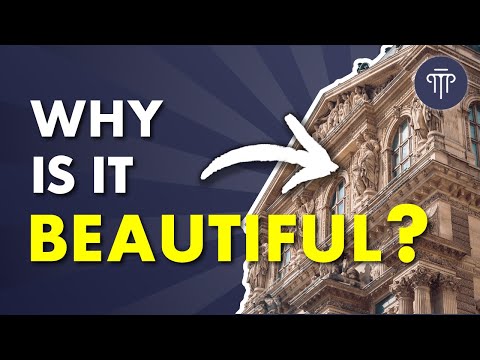
1. Why Are Some Buildings Loved While Others Are Ignored?
The video begins with questions like:
- "Why do some buildings receive more love, and why do people flock to certain places while ignoring others?"
- "Is it simply because they're famous? Or is there something special about them?"
The conclusion is clear. That something special is 'beauty.' People climb mountains, cross jungles, and travel the world to see beauty. This video explores why beauty in buildings and urban environments matters and explains the impact beauty has on our lives.
2. The Problem with Modern Cities: The Absence of Beauty
Much of modern cities is becoming increasingly ugly.
- "Massive concrete overpasses, rundown business parks, depressing concrete housing blocks... Who thought this was a good design idea?"
- "Did anyone even consider the beauty of these buildings or places?"
People still yearn for beauty. For example, millions of tourists visit beautiful cities like Amsterdam or Barcelona every year. They don't walk beneath rundown business parks or concrete overpasses on the city outskirts. "They seek historic city centers, beautiful architecture, parks, and boulevards."
The solution seems simple:
"Why not just build more beautiful places?" But reality is not that straightforward.
3. The Debate: 'Beauty Is Subjective'
Architects often don't make beauty a primary design goal because "beauty is subjective." But it wasn't always this way.
- "In past architecture and urban planning, beauty was considered an essential element."
- But in today's architecture schools, creative personal expression, innovation, and 'concepts' are considered more important.
Modern architecture often overlooks beauty under the guise of being "forward-looking." "Beauty is hard to measure with numbers and is contentious, so why bother?" Ultimately, the mindset that "it's easier to build glass boxes" took hold.
4. Is Beauty Really Subjective?
Research shows that people have remarkably similar responses to certain visual elements.
- "People generally tend to like the same kinds of things."
- For example, one American survey found that "physical beauty" was the factor with the greatest impact on people's satisfaction.
- Another study rated "the aesthetic appeal of a city" as more important than education, safety, or basic services.
Beauty goes beyond simply feeling good:
- "Beautiful places form emotional attachments in people."
- "It's connected to health." Studies have found that people living in areas with beautiful natural scenery are healthier.
5. The 'Design Disconnect' Between Architects and the Public
According to psychologist David Halpern's research, the buildings preferred by architects and the general public are strikingly different.
- Buildings favored by architecture students were the most disliked by non-architecture students, and vice versa.
- "The longer one studied architecture, the greater this gap became."
Interestingly, "architects personally prefer traditional architecture."
- For example, modern architecture master Rem Koolhaas lives in a Victorian townhouse.
- "Why did he choose a home in a completely different style from the modern buildings he designs?"
6. The Connection Between Beauty and Human Nature
Humans originally evolved to survive in nature.
- "Our brains are designed to prefer the forms and patterns of nature."
- Philosopher Denis Dutton explained that "beauty is nature's way of acting at a distance."
- Everything we find beautiful shares three commonalities:
- Has forms or characteristics we instinctively like
- Is fit for purpose
- Is made with skilled craftsmanship
7. Architectural Elements We Prefer
1) Fractals
- Repetitive, self-similar structures commonly found in nature.
- Fractal elements can also be applied to building facades.
2) Symmetry
- "Symmetry gives buildings a sense of balance and symbolizes strength and wealth."
- Humans instinctively prefer symmetry.
3) Ornament
- Ornament helps humans connect with buildings.
- "Appropriate ornamentation stimulates our brains and reminds us of nature's patterns."
4) Organized Complexity
- "Too simple is boring; too complex is chaotic."
- Humans prefer a balance of order and variety.
5) Curves
- Psychology research shows people find curves more beautiful than straight lines.
- "Arches, domes, and spiral structures beautifully demonstrate the appeal of curves."
6) Nature
- Nature gives people a sense of calm, happiness, and healing effects.
- "Parks and trees always make a place more beautiful."
8. A Beauty Experiment: The Louvre Museum
The Louvre Museum has all the elements we prefer:
- Symmetry, curves, ornament, organized complexity
- "The building looks fit for purpose and was made with skilled craftsmanship." As a result, the Louvre remains a beloved building that stands the test of time.
In contrast, many modern buildings lack these elements.
- "They may look cool or stylish, but will they still have value in 50 years?"
- "Many modern buildings are already being demolished, which incurs significant social and environmental costs."
9. The Need for Evidence-Based Design
We can design buildings that people will like through evidence-based design.
- "We can avoid obvious mistakes like massive blank walls, dark spaces, and monotonous gray slabs."
- "Beauty may be essential to the well-being of millions of people in cities."
10. In Closing
This video provided an opportunity to think deeply about why beauty matters. "What do you think? How important is beauty as an element in architecture and urban design?"
"Beauty is not mere decoration; it is an element deeply connected to our lives and happiness."