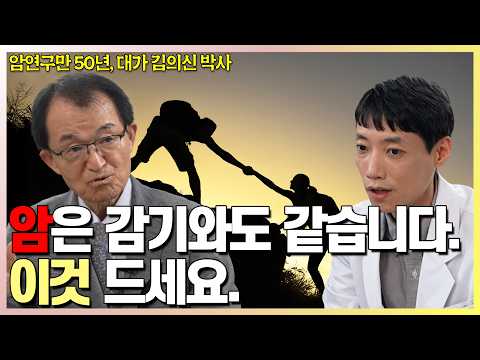
In this interview, internationally recognized cancer specialist Dr. Eui-shin Kim discusses the attitudes he has observed among patients who overcome cancer, differences between Korean and American views of the disease, and practical ideas about prevention and nutrition during treatment. He emphasizes the harmful effect of stress and the importance of a positive outlook, while inviting viewers to reconsider how they think about both cancer and death. He also shares the habits that have supported his own health and explains the idea of "well-dying," offering material for reflection not only to cancer patients but to anyone thinking seriously about life and health.
1. Dr. Eui-shin Kim's Career in Cancer Research
The video begins by introducing Dr. Eui-shin Kim, a leading authority on nuclear medicine and cancer diagnosis who spent more than 30 years researching cancer at MD Anderson Cancer Center. He was among the pioneering clinical users of PET, or positron emission tomography, beginning in the 1980s.
After studying preventive medicine at Seoul National University, Dr. Kim continued his education in the United States. His curiosity about new fields led him into nuclear medicine, where he first encountered PET technology. Cancer research eventually convinced him that cancer is, at its root, an immune disease, and he recognized the potential importance of immunotherapy before the field was widely understood. Working with renowned immunologist David Goldenberg, he combined medical imaging and immunology to develop radioimmunodiagnostic and therapeutic techniques. That work led to an invitation from MD Anderson, where he spent 31 and a half years.
Dr. Kim was also invited to serve as the only Korean professor at Seoul National University's Graduate School of Convergence Science and Technology. For 15 years, he has returned to Korea in the spring and fall to teach graduate students. 🧑🏫
2. The Attitudes He Observed in Patients Who Recovered
After treating many patients at MD Anderson, Dr. Kim developed strong views about how a patient's mindset can affect the course of treatment. He says Korean patients often fare worse than American patients and points to several possible reasons.
What we need to understand is that the way we think can affect what we are able to do and whether things turn out as we hope. People have said this for 2,000 years. After treating patients for more than 50 years, I can tell you that it is exactly right.
Patients with a positive outlook and an active approach, he says, tend to respond much better to treatment. Those who are pessimistic from the outset or distrust the treatment often do less well. To illustrate the point, he says that mood can affect how the body absorbs food and medicine: even excellent food may be poorly absorbed when eaten in anger, whereas eating with gratitude may support the body's detoxification processes.
He also notes that despite the enormous cost of cancer care, only 20% of patients benefit from a given treatment, while a small number recover spontaneously without medication—a phenomenon that remains difficult to explain scientifically. Within the body, factors that promote cancer and factors that restrain it exist in a state of balance, or homeostasis. Disease appears when that balance is disturbed, and Dr. Kim identifies stress as one of the most powerful forces that can disturb it.
People whose minds are full of anxiety and worry can never respond well to treatment, because that balance has been broken.
He regrets what he sees as unusually high levels of anxiety among Koreans. He also says Korean patients are more likely to distrust physicians, move from hospital to hospital, ignore specialist advice, and make treatment decisions on their own. Modern cancer care often uses chemotherapy or immunotherapy to suppress cancer cells before surgery. Yet when some Korean patients learn that a tumor is present, they insist on removing it immediately and place too much faith in surgery. Disregarding the treating physician's judgment can reduce the effectiveness of care. 😔
Dr. Kim makes a striking observation about patients who recover in seemingly miraculous circumstances: they have rarely been people with a great deal to lose. He says that unexpected recoveries sometimes occur after a person stops feeling that death would be unfair and lets go of attachment to the self. To him, this illustrates how powerfully thought can affect the body. He says positive thoughts produce energizing substances such as didorphin, and stresses that even in the most difficult circumstances, the determination to overcome the disease matters greatly. 💪
3. How Korea and the United States View Cancer Differently
Dr. Kim describes substantial cultural differences in the way Koreans and Americans understand cancer.
Americans think of cancer almost like a cold. They see it as one chronic disease among others.
Americans, he says, are more likely to regard cancer as a chronic illness and less likely to assume that a physician can cure every disease. They may decide not to visit an expensive major hospital when it cannot guarantee that they will live longer. Dr. Kim recalls helping about 1,000 Korean patients who traveled to MD Anderson, many of whom deteriorated or died sooner after arriving. Going to a famous hospital does not by itself ensure a good outcome.
He attributes Korea's strong cancer-treatment statistics largely to early diagnosis. The national screening system detects many cancers early, when surgery is easier and medication is more effective. Even then, he adds, a complete cure remains difficult and long-term management is often necessary.
The two cultures also differ in their attitudes toward death.
Most Americans aren't afraid of dying. They say, "Everyone has to die. There is no reason to fear death. The only difference is whether you go a little earlier or a little later—what else is different?"
Americans often accept death as a natural event, while Koreans with cancer may feel as if they have committed a terrible wrong and begin avoiding other people. Americans tend to tell friends and family, ask for prayer, and face the illness with their community. Some Korean patients, by contrast, even ask their pastors to conceal the diagnosis. Dr. Kim worries that this closed response can work against treatment.
4. Cancer Prevention and Nutrition During Treatment
Dr. Kim offers detailed advice on diet for cancer patients. Cancer and aggressive chemotherapy both break down protein, he says, making adequate protein intake especially important.
- Protein:
- He recommends avoiding large amounts of ordinary beef and pork because he believes their connective tissue and cholesterol can promote inflammation and acidity in the body.
- He recommends duck and black goat instead.
- His first choice is plant protein. His own breakfast often includes eggs or potatoes, seaweed, and gamtae seaweed.
- He says gamtae is traditionally associated with the long, disease-free life of sea turtles and contains polyphenols and flavonoids with anti-cancer and anti-inflammatory properties.
- Fish, particularly omega-3-rich salmon, can also help address cholesterol concerns.
- Limiting oxidative stress: To counter reactive oxygen species, which he describes as a fundamental cause of aging and disease, he recommends antioxidant-rich foods such as nuts, multigrain rice, blueberries, and other berries.
- Eating habits: Because eating itself can become a struggle during cancer treatment, he recommends small, frequent meals—up to six a day. Above all, he says it may be better not to eat at all while extremely upset. 😅
Dr. Kim also stresses the value of concentrated protein drinks, such as Ensure in the United States or New Care in Korea. American patients may drink them like water, while Korean patients often struggle because they did not develop the habit of drinking milk as children. He views this as another example of the influence of the mind on bodily function, comparing it to cases in which a person with hysteria is unable to drink water.
The patient's first job is to find a way to eat and drink well, preserve strength, and prevent weight loss.
His central dietary message is therefore simple: cancer patients must eat and drink enough to maintain strength and avoid losing weight, and a positive mental state is an essential part of doing so.
5. Dr. Kim's Own Approach to Healthy Aging
Although he has spent his career studying cancer, Dr. Kim has remained remarkably healthy. He attributes his own slow aging to several factors. 👴🏻✨
- Genetics: Genetics accounts for 15–20% of disease, he says. His parents lived to 90 and 99 without ever being hospitalized, so favorable genes may be part of the explanation.
- Childhood environment: Dr. Kim and his school friends grew up in the countryside, eating simple foods such as barley rice and hairtail fish. They walked roughly four kilometers to school and stayed active through farm work. He believes that environment helped them build strong bodies. By contrast, he says friends raised in Seoul exercised less and ate more sweet, rich food, and few of them remained healthy. For him, this demonstrates the lasting importance of childhood habits.
- Continued challenge and activity: Even after 80, Dr. Kim believes people must keep working on both mental and physical health. The body naturally deteriorates with age, so he recommends spending time with others, studying, working hard, and continuing to provide the mind and body with regular stimulation.
A healthy mind supports a healthy body, and a healthy body supports a healthy mind.
He illustrates the point with golf, which he began relatively late. When he was younger, friends did not want to play with him because he was a beginner. Now those same friends find the game too physically demanding, leaving him without partners. The story reflects the value of remaining active over time.
6. Well-Dying
Dr. Kim closes with an important message about well-dying—preparing to die well.
We cannot cure every disease we know. Once treatment begins, many people must keep taking medicine and managing the illness for the rest of their lives.
Many diseases cannot be cured completely and must instead be managed throughout life. That reality makes it important to prepare for death in advance. Dr. Kim points to the American practice of writing a will while still young.
He is particularly emphatic that a funeral held after death does nothing for the person who died. When someone learns that little time remains, he recommends holding a funeral party while still alive. Friends and relatives can gather, say everything they want to say, listen to favorite music, and share a final celebration. Dr. Kim has attended several such events and says everyone involved found them deeply satisfying. 🥳
We live short lives. Everyone should ask, "How should I live this brief life?" Whatever you do, if you can ultimately do it for other people, you can become both the happiest and the most valuable kind of person.
Illness, he adds, is a natural part of the process that eventually brings life to an end, so it can come to anyone. Statistically, people have at least one disease by age 60 and more than five by age 80. Having a disease does not mean death is immediate.
When a condition runs in the family, everyone in the family should study it together, consult specialists, and trust and follow the specialist's instructions. A patient's own responsibility is to maintain enough strength to undergo treatment; the rest, he says, must be accepted as something beyond the patient's control.
Dr. Kim says one of the greatest rewards of writing his book has been hearing from patients who had resolved to die but chose to keep living after reading it. 📚✨
Closing
The interview asks viewers to see cancer not only as a disease but as something deeply connected to life, death, and the way we think. Dr. Kim explains why a constructive attitude and trust in qualified specialists can matter during treatment, and why accepting death as a natural part of life can help people prepare for a meaningful end. His words also suggest that a physician's true calling may extend beyond treating disease to caring for the patient's state of mind. 💖