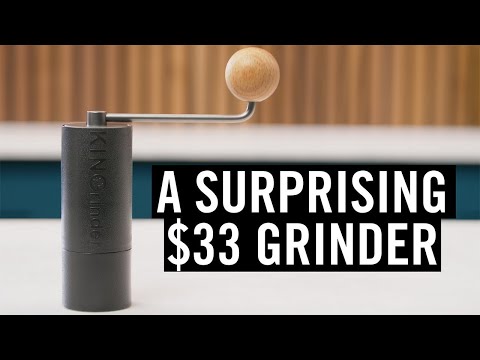
1. Introduction: Why the KINGrinder P1 Is Exciting
- The video opens by introducing the KINGrinder P1 hand grinder.
- "Today I want to talk about this. It's a hand grinder from a company called KINGrinder. This one is called the P1. It's got me a little excited — in a slightly silly way."
- To explain why this grinder is interesting, he first references the Hario Slim (Mini Mill), the classic budget hand grinder.
- "This is the Hario Slim, Mini Mill, whatever you want to call it. For a long time, it was the cheapest hand grinder you could buy. It was around £30, and if you wanted to grind coffee at home, this was the most affordable way to do it."
2. The Limits of Budget Hand Grinders and How the Market Has Changed
- He points out the structural shortcomings of the Hario Slim — ceramic burrs, poor alignment, inability to grind fine, and so on.
- "It has ceramic burrs. There's some wobble in the shaft from the handle down to the burr, so it doesn't align well, and the grind quality isn't great."
- More recently, premium hand grinders have flooded the market, with prices climbing into the hundreds of pounds.
- "These days there are some really lovely hand grinders. You can spend over £200. That's a completely different world from £30."
3. The KINGrinder P1: First Impressions
- The KINGrinder P1 retails for £33 — almost exactly the same price as the Hario Slim.
- "This grinder is sold on Jeff Bezos's website for £33."
- There is a product line — P0 (cheaper), P1, and P2 (more expensive) — differentiated by burr geometry (hexa, hepta, penta, etc.).
- "This one has hexagonal burrs. The more expensive ones have seven- or five-sided burrs."
- Build: metal burrs, polycarbonate body, metal handle, wooden knob.
- "When it arrived, my first thought was: 'Oh, this is actually pretty nice.' For £33, it exceeded my expectations."
4. Good Quality at a Low Price? The Changing Market
- Coffee gear has broadly gotten more expensive, which makes finding something affordable and decent genuinely exciting.
- "If this is good, it would be a fantastic entry point for someone getting into coffee. At £33 you can recommend it without hesitation — especially if it turns out not to be bad."
5. Grind Quality Analysis: Particle Size Distribution
- He uses a particle size analyzer to compare three grinders: the Hario Slim, the KINGrinder P1, and the Comandante (a premium grinder).
- "We have a particle size analyzer. It measures hundreds of thousands of coffee particles and shows you the size and shape distribution."
- "The KINGrinder produces a lot more fines than the Comandante. The Comandante has fewer fines and fewer large particles too."
- "At first I was disappointed. 'Is this not that good? Is it barely better than the Hario?'"
6. Blind Tasting: When Data and Taste Diverge
- He runs a blind tasting to compare the actual cup quality.
- "When I tasted them, the differences weren't as clear-cut as I expected. I was confused. So I wanted to do it again — this time on camera."
- Each grinder produces one cup of V60, dialed in to the same extraction yield (21.3%).
- "At that extraction level, things usually taste good. If you're a coffee nerd, that's a solid target."
- After brewing, he observes the coffee bed (spent grounds):
- Hario: large clumps, lots of coarse particles.
- KINGrinder: finer, more mud-like bed, far fewer large clumps.
- Comandante: less than the Hario, but slightly more coarse particles than the KINGrinder.
7. Tasting Notes and Results
- Blind tasting results:
- "The first cup is the thinnest, most acidic, and has some astringency. My guess is this is the Hario Slim."
- "The second cup is well-balanced and delicious. I have no real complaints. The acidity and sweetness are both nice."
- "The third cup isn't bad. Not as good as the second, but much better than the first."
- "Worst, best, middle. That's Hario, Comandante, and KING."
- "If you have £250, you could buy a Comandante and spend £50 on coffee. Or you could buy a £33 grinder and spend a lot more on good coffee."
- Core message: "I'm genuinely happy that a grinder this good exists at this price. Being able to recommend something to someone for £33 makes me happy."
8. Rethinking Particle Distribution and Fines
- The KINGrinder produces more fines, yet tastes significantly better than the Hario.
- "We tend to be too obsessed with fines. But in this kind of grinder, at this kind of setting, that might not be the thing that matters most."
- "Almost all of the KINGrinder's particles are under 1,500 microns. With the Hario, 14% of particles are larger than 1,500 microns — what you might call boulders. Those boulders don't extract properly."
- "I think fewer boulders is the real secret to a better hand grinder."
- "Don't judge by particle data alone — look at it alongside taste data. Tasting might change your mind."
9. Espresso Grind and Dial-In Experiments
- The KINGrinder P1 is marketed as capable of espresso grinding, so he tries it.
- "Adjusting grind size works like most hand grinders — you turn the dial at the bottom to go finer or coarser."
- "For espresso, the recommendation is 0 to 30 clicks; for pour-over, around 40–60 clicks."
- "Honestly, I don't love grinding by hand. And dialing in espresso settings is particularly tedious."
- He uses a power drill to grind (a fun moment in the video).
- "About 18g seems to be the maximum capacity. You could probably force 20g in."
- "I ground too fine and choked the machine! Backed off a bit and tried again."
- "Eventually I hit the extraction time I was after (28–30 seconds). But the taste… it's not the best espresso. High acidity, lacking sweetness and texture. Espresso isn't really this grinder's strong suit. Then again, it's £33 — you shouldn't expect too much."
10. Overall Verdict and Recommendation
- "A few years ago, if this grinder had appeared in a video about the best grinders under £100, it would have blown away budget options like the Porlex or Hario."
- "It's genuinely exciting that there's something this recommendable at this price point. It's perfect for anyone getting into coffee or wanting to grind their own beans."
- "If you grind fresh beans and brew them properly, you can make genuinely delicious coffee."
- "I don't know about durability yet. How long it will last, whether it will break — we'll have to wait and see. There's a lot of metal, and a lot of polycarbonate."
- "It's not as good as a premium grinder like the Comandante. But at this price, it's genuinely impressive."
- "I hope to see more innovation at the budget end of the market. This is a great thing. I'm excited!"
11. Questions for Viewers and Closing
- "Have you tried this grinder? How did it taste? Share your experience!"
- "If you've also used the P2, let me know how it compares. Is there a big difference?"
- "I'd love to hear your thoughts in the comments."
- "Thank you so much for watching. Have a great day!"
Key Terms and Summary
- KINGrinder P1: A budget hand grinder that punches well above its price
- Hario Slim: The limitations of the old-school budget hand grinder
- Comandante: The benchmark for premium hand grinders
- Particle size distribution: Boulders (large particles) are more of a problem than fines
- Blind tasting: Real taste can diverge from what the data predicts
- Espresso grinding: Possible, but not the grinder's strength
- Value for money: Highly recommendable at £33
- Innovation: Quality is improving even at the budget end of the market
"Being able to recommend something to someone for £33 makes me happy."
"I'm genuinely happy that a grinder this good exists at this price."
"If you grind fresh beans and brew them properly, you can make genuinely delicious coffee."
"I hope to see more innovation at the budget end of the market. This is a great thing. I'm excited!"
☕️ If you want to enter the world of coffee without breaking the bank, the KINGrinder P1 could be a genuinely great choice.