Brian's continuing story: Taeho's Insight #30
How do you make decisions? A few months ago, watching the progress of AI, I formed the following hypothesis.
- The smartphone is already one of the organs of the human body.
- Humans are delegating thought and decision-making to AI, and will continue delegating more of both.
- To test the usefulness of this, I should live a little bit in that future by partially or fully delegating my own thoughts and decisions to AI.
- Just as AI helps solve company problems, it should also be able to help solve personal concerns.
Life is a sequence of decisions. The large and small choices I make now accumulate and shape tomorrow. If there is a future I want, I need to make today's decisions in a way that points toward it. When I try to improve the quality of my decisions according to a purpose, I can stay focused on today while still moving toward the tomorrow I want.
Easy decisions are easy. Even hard decisions become easier if you set principles in advance. But there are always choices where I am not sure what is best and keep turning them over in my mind. At that point, I began using AI actively.
Should I Take This Sudden Meeting?
For example, a few days ago I woke up feeling unwell. I think my sleep quality had dropped because I ate pizza the night before and went to bed. Then I saw an unexpected meeting request from Canada in my inbox. Because of the time difference, if I took the meeting, it had to be in the morning. I started hesitating. It was sudden, and given my condition it would have been perfectly fine to decline, but I was not sure which decision would be better.
So I handed the question to my decision-making AI agent and asked it to decide.
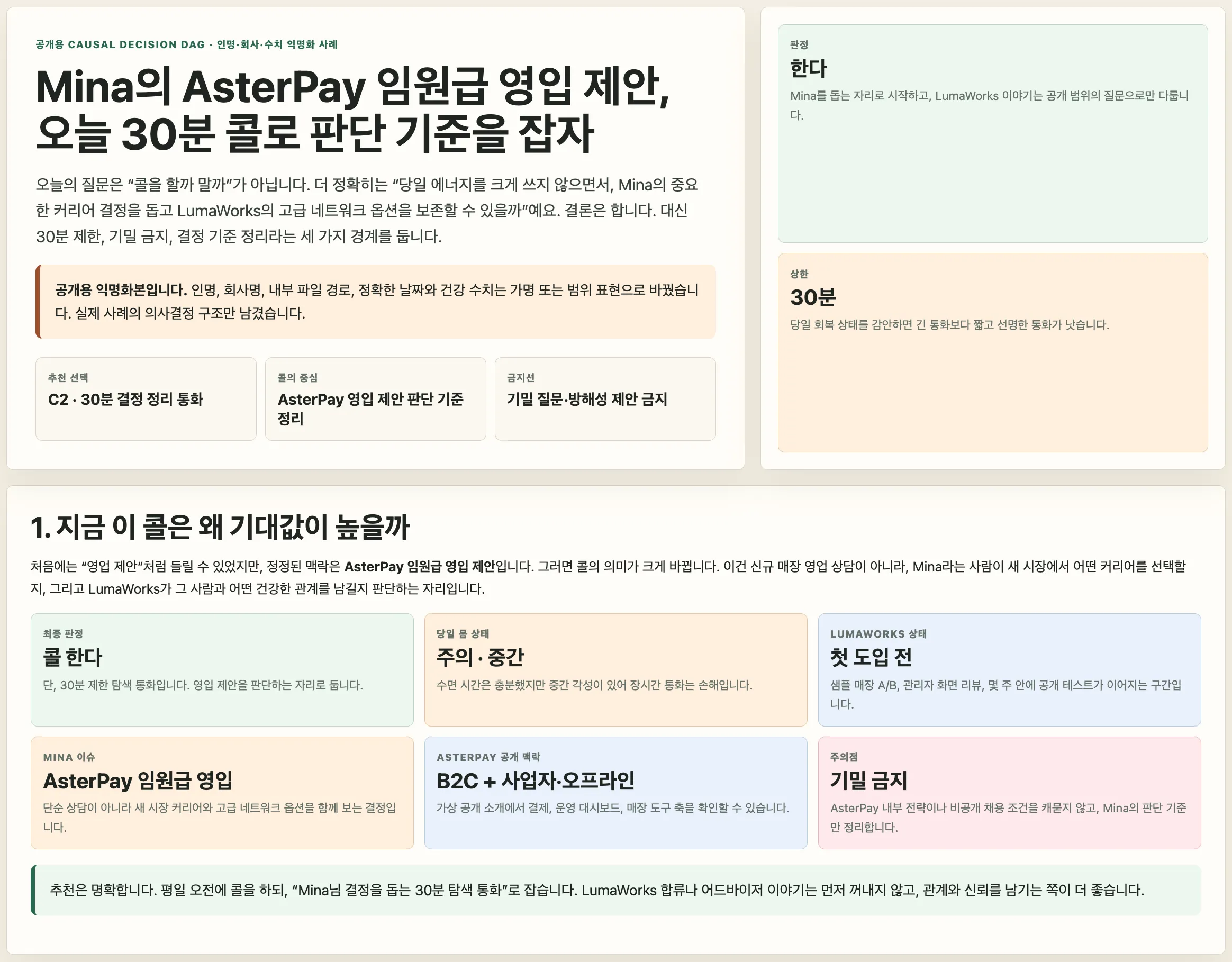
The AI considered my physical condition, the values I care about, and the opportunities and costs involved, and recommended that I take the meeting. But it added a hard limit: 30 minutes.
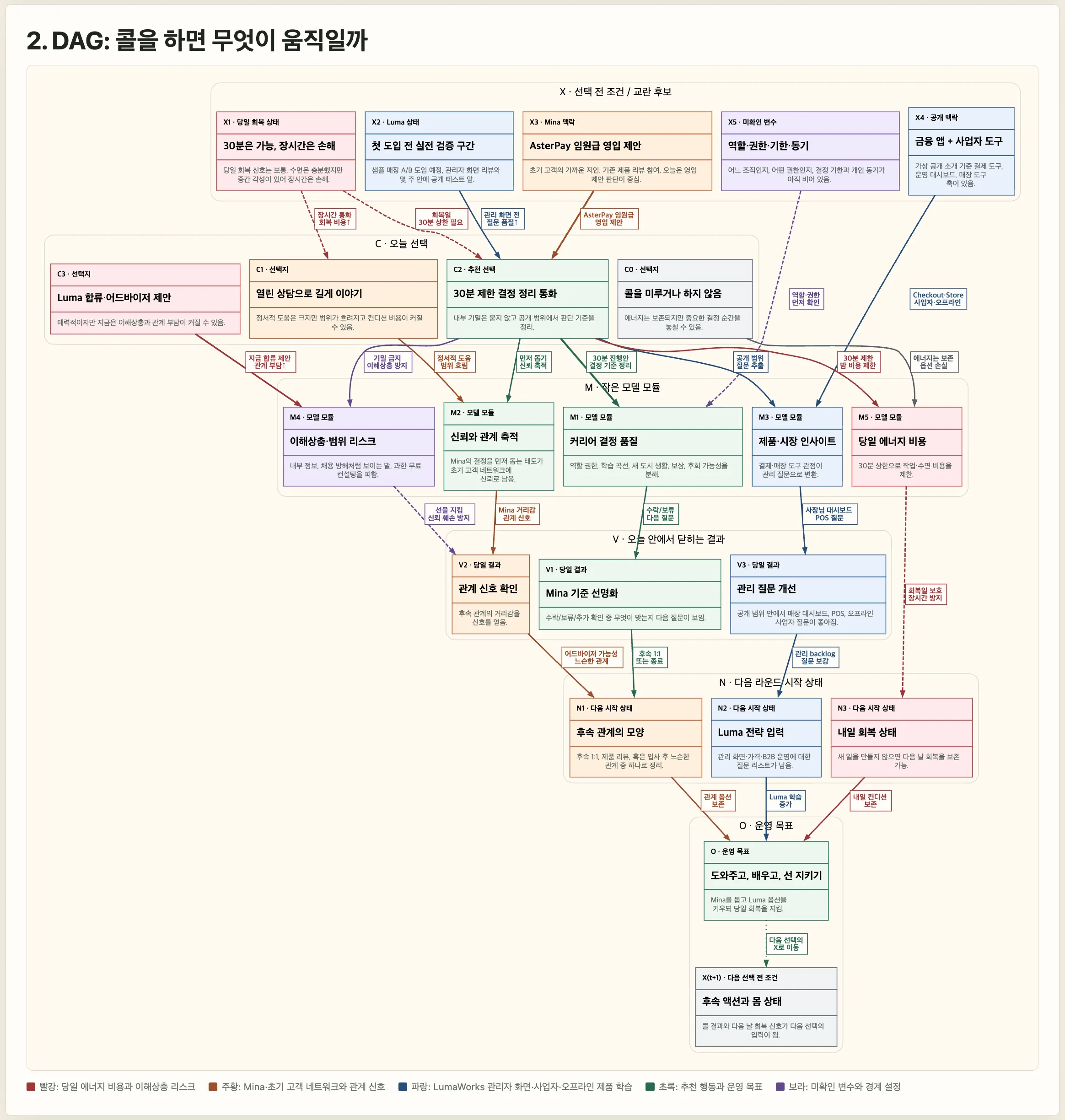
The moment I saw the report, the dilemma of whether to take the meeting disappeared. It felt obvious that I should follow the recommendation. A decision that had been stuck in the realm of worrying turned into something shaped like a solution.
Why could I accept the recommendation so quickly and move into action without wasting energy agonizing over it? Because the nodes and edges in that DAG were statistically meaningful causal modules derived from my health, daily life, work, social context, and N-of-1 experiments.
How Much Sleep Is Best, and When?
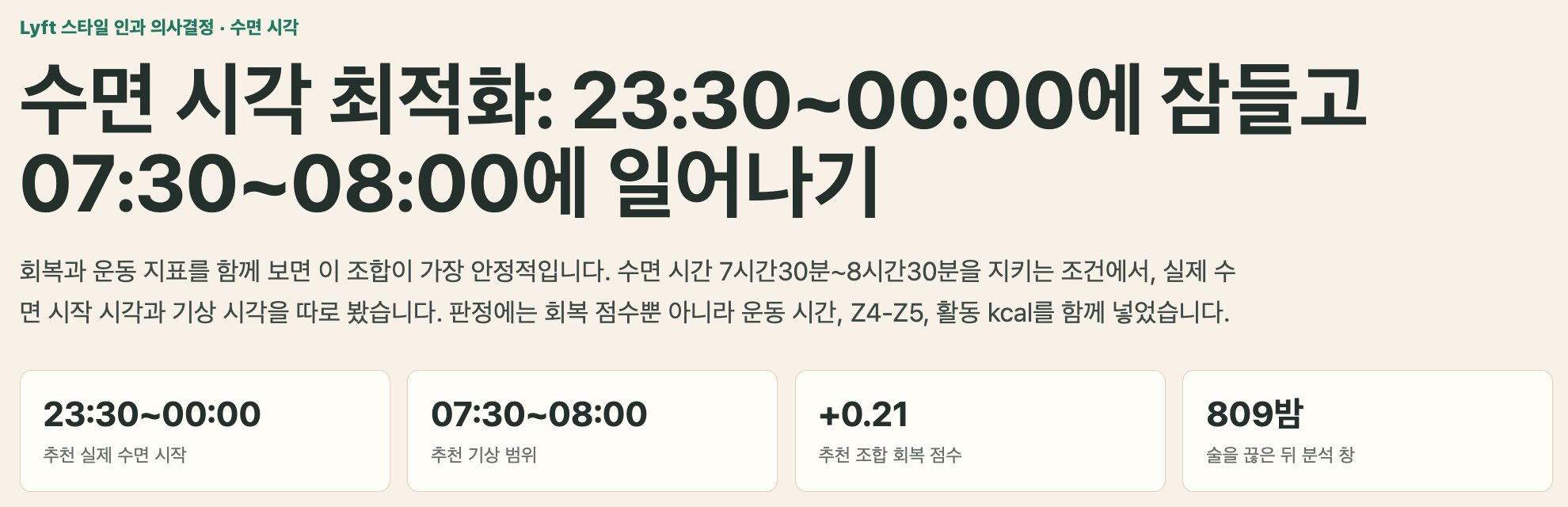
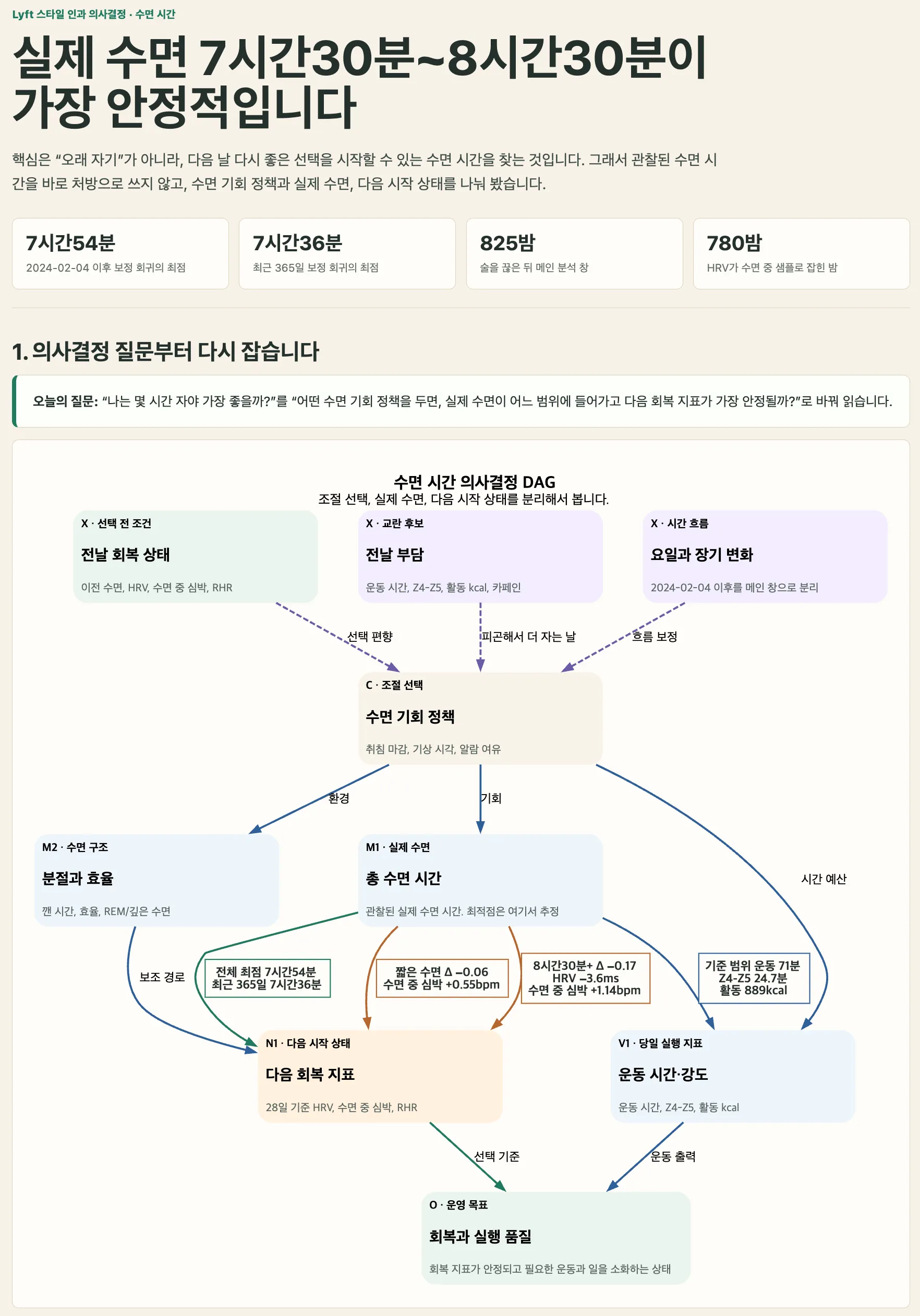
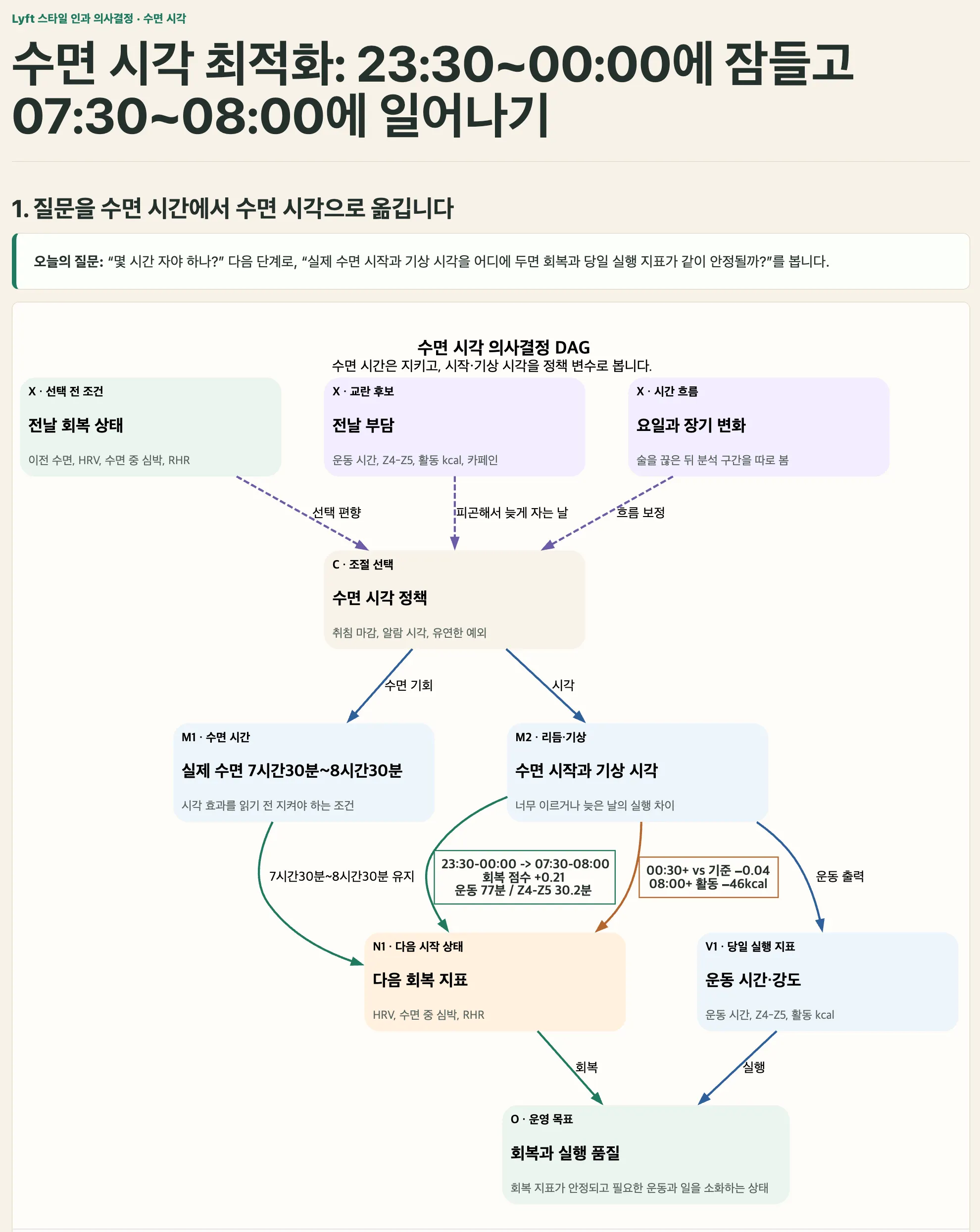
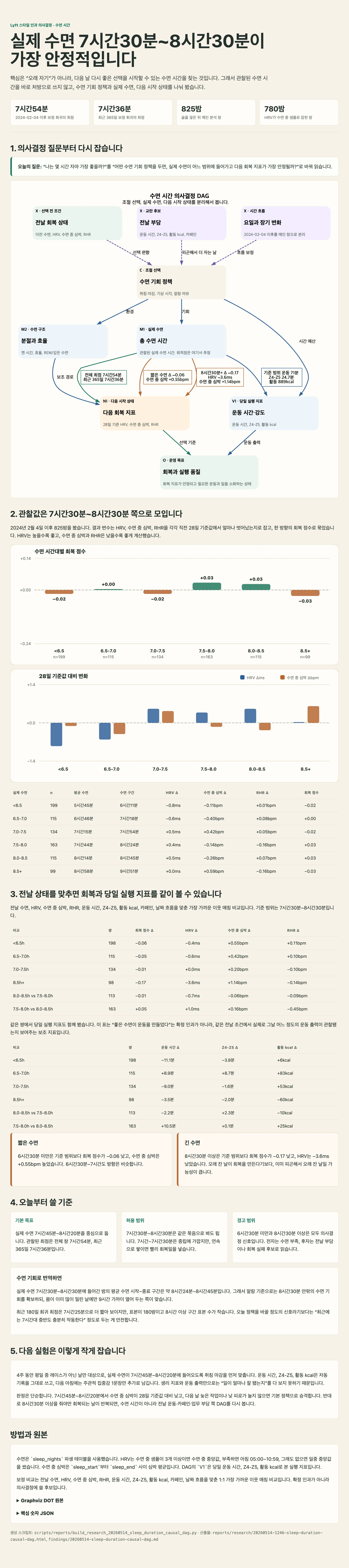
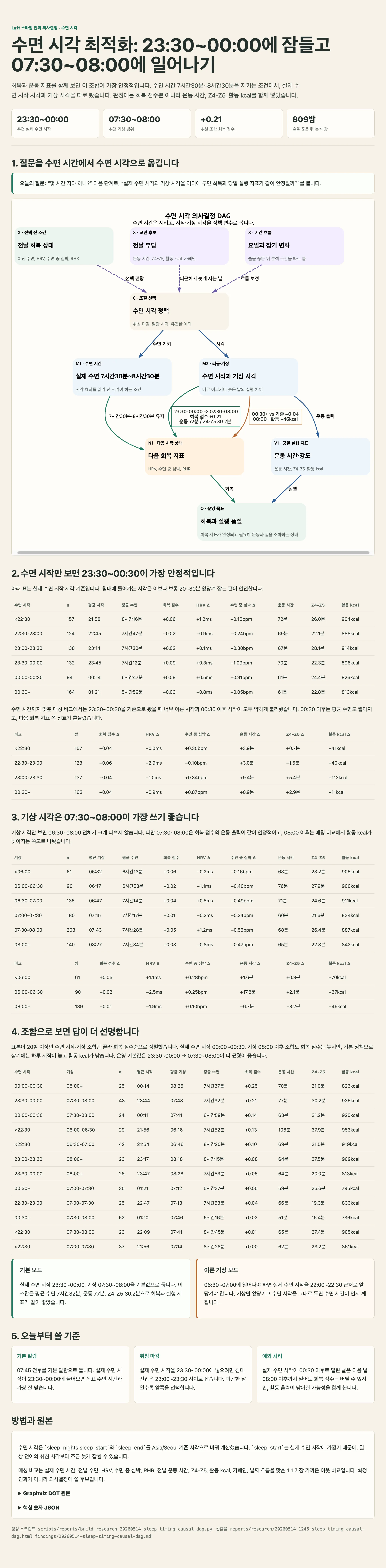
I tried the same approach with sleep. This is where years of data from wearable devices like the Apple Watch began to pay off. Given the intensity of my work and exercise, I am someone who needs 7 hours 30 minutes to 8 hours 30 minutes of sleep to maintain my best condition. In particular, going to sleep before midnight is good for recovery and performance.
What Time of Day Is Best for Decisions?
Mirae Asset Group chairman Hyeon-Joo Park has said that he checks health signals such as heart rate, blood sugar, and blood pressure to find the moments when he can make the most rational decisions. He looked through self-experimentation for the best time to make decisions and said his decision-making was clearest when certain health numbers appeared. During the Daewoo Securities period, when those numbers came up, he reportedly concentrated for three hours and then decided on the acquisition price.
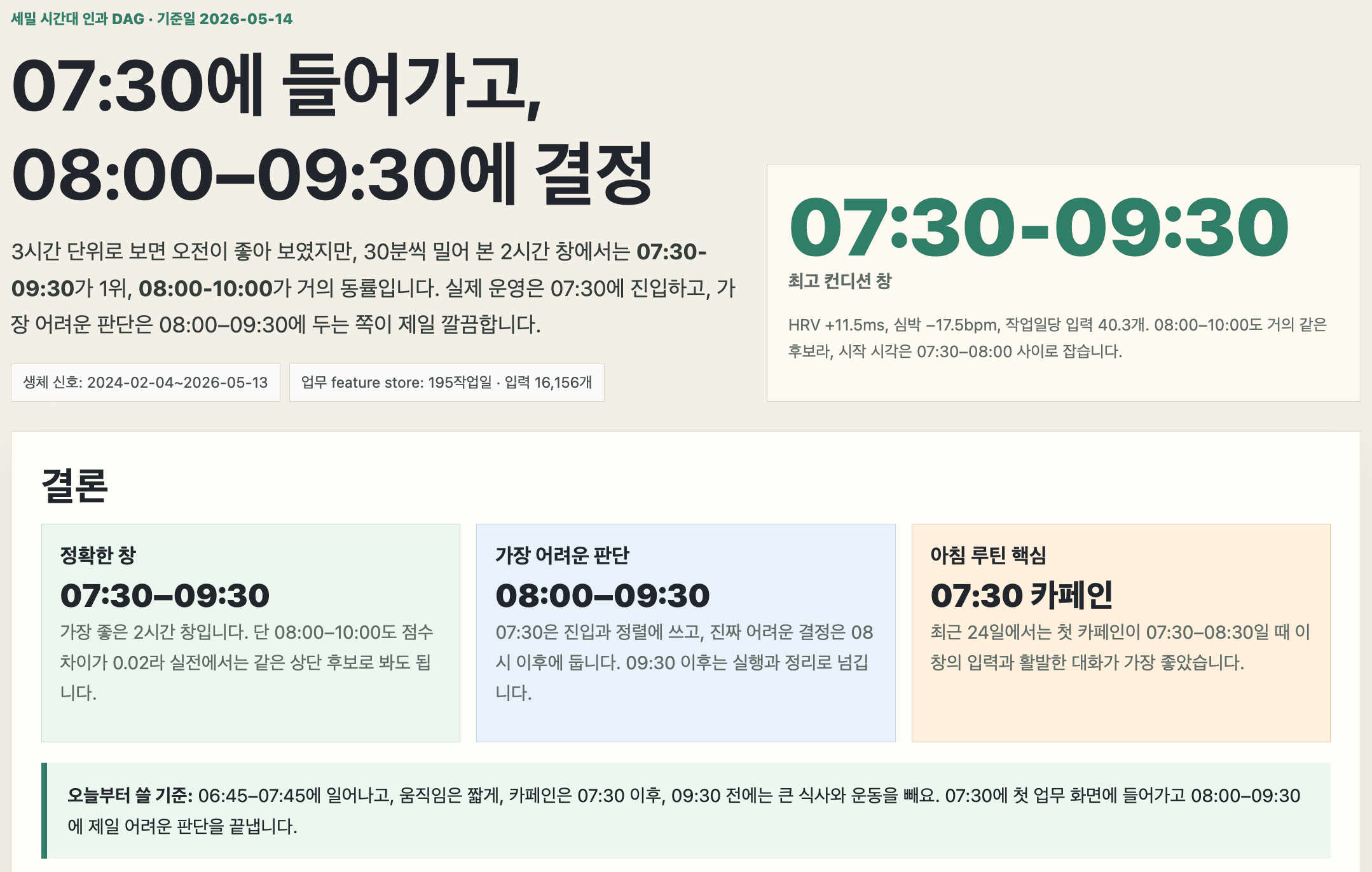
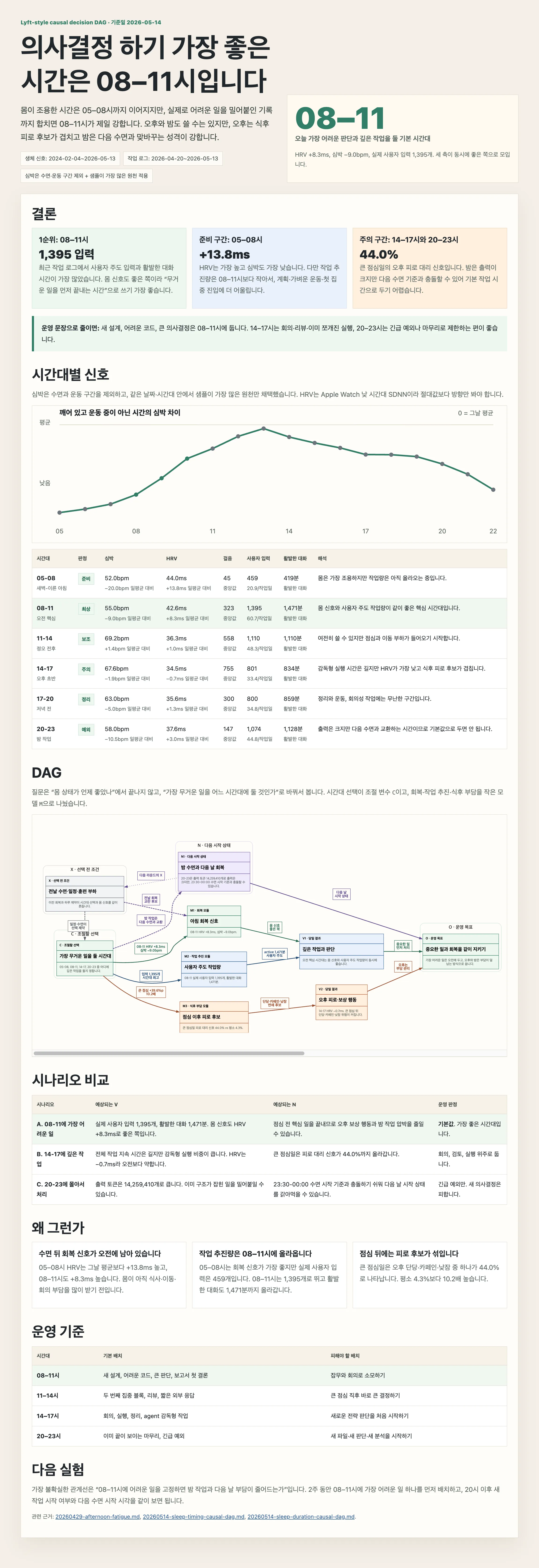
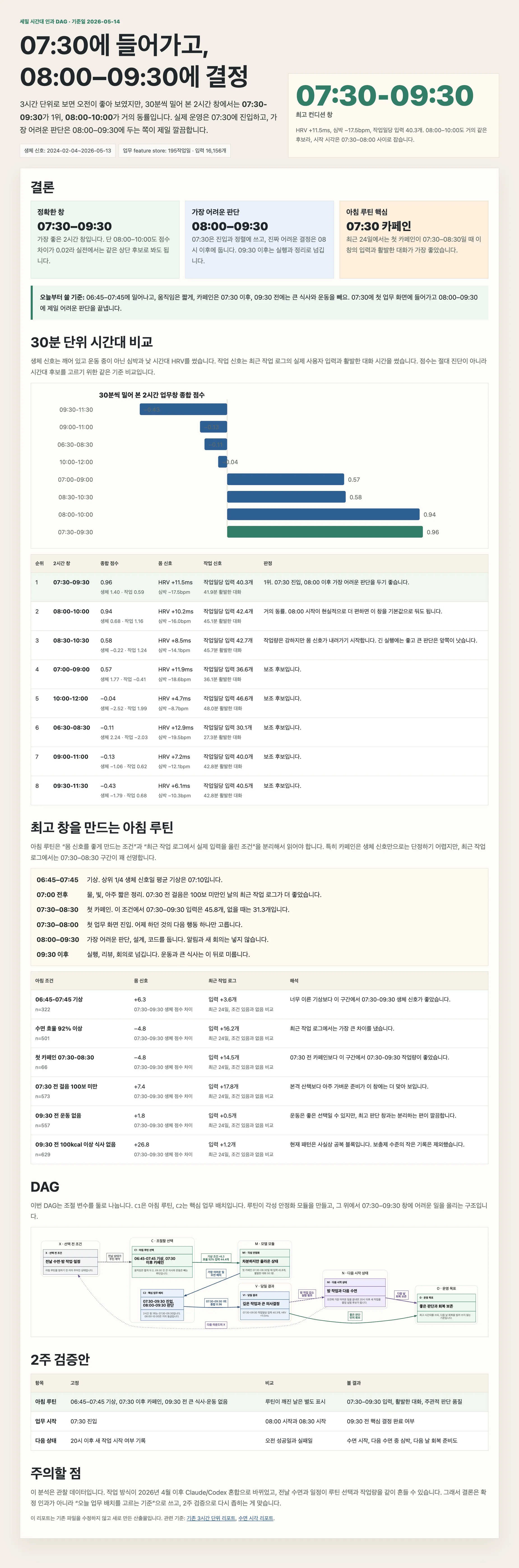
I tried a similar approach. Looking at my physiological signals and life patterns, the best window for making decisions is from 8 a.m. to 11 a.m. More specifically, the best stretch is after drinking coffee at 7:30 a.m., from 8 a.m. to 9:30 a.m.
It also tells me which morning routine maximizes that state.
Losing Weight Without Losing Performance?
I exercise every day, but I still want to get better at cycling. I was born with a body that is strong at short, thick sprints like a track cyclist, but the grass is always greener on the other side, and I also want to climb well. To do that, weight loss is essential, so I asked how I could do it effectively.
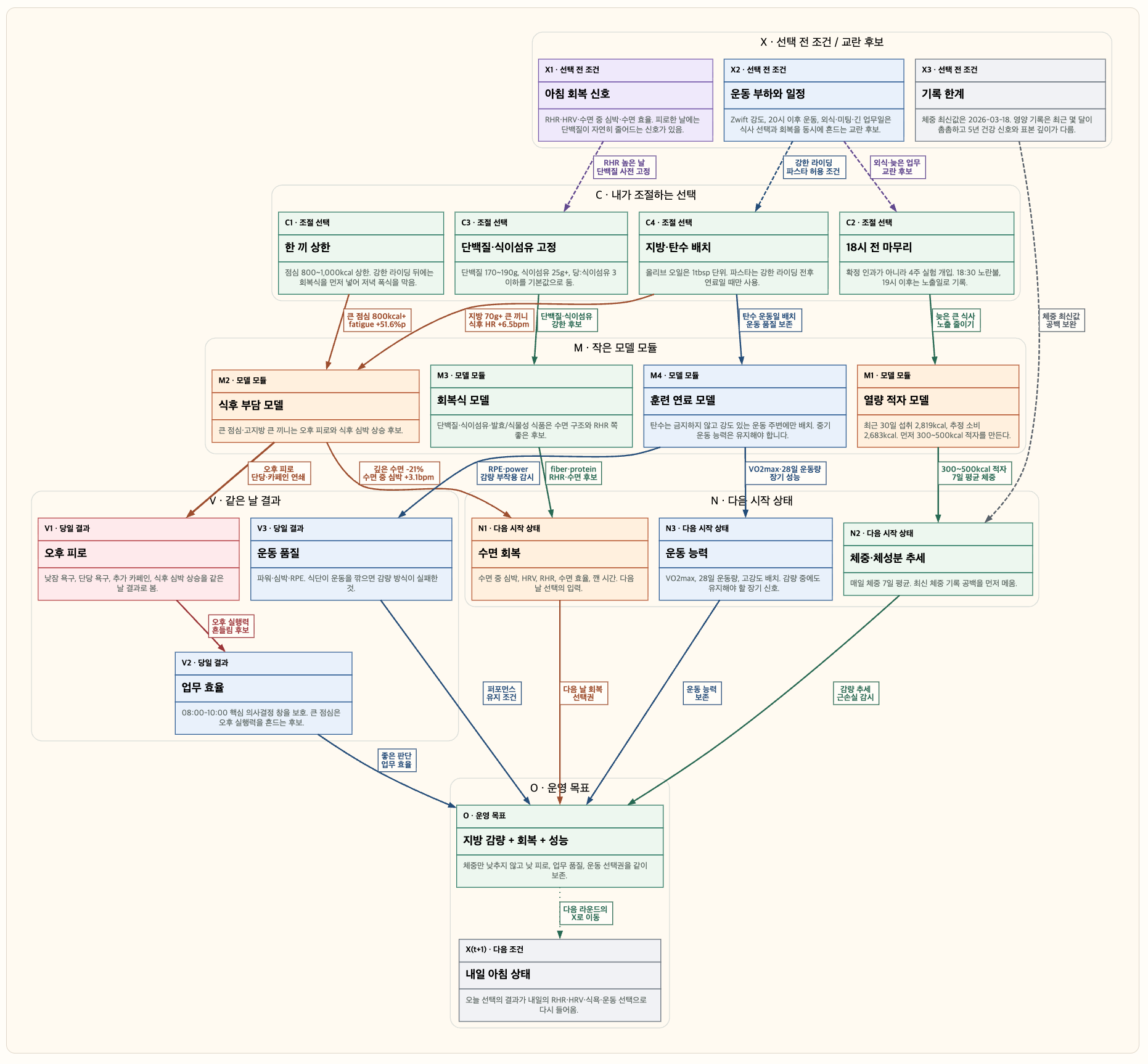
The weight-loss suggestions derived mainly from causal relationships were:
- Do not eat too much in a single meal.
- Get enough protein and dietary fiber. Aim for fiber intake to be at least three times sugar intake.
- Adjust fat and carbohydrate intake. Use pasta as fuel before and after hard rides.
- Finish eating before 6 p.m.
The idea was that these four choices were the strongest levers for my operating goal of "fat loss + recovery + performance." It made immediate sense. Empirically, I had felt most energetic and satisfied when I lived this way, and now the data supported that feeling too. Of course, selection bias may be mixed in here, so I plan to keep running appropriate experiments.
Now Individuals Can Improve the Quality of Every Decision
These days, I am living by asking, analyzing, predicting, and experimenting with all the decisions that fill my daily life. In areas where I already have causal modules, I do not need to rethink them from scratch. I can build larger questions on top of them, and for the choices I need to make now, I can enjoy the effects of minimizing regret and creating opportunity based on counterfactuals. Simply being able to compare what might have happened if I had chosen differently has widened the range of my thinking.
This causal DAG-based decision framework is originally something I used at the companies where I worked. Suppose a company is deciding how much to spend on pricing or promotions for a service or product. Based on many causal relationships confirmed through an experimentation platform, the team draws a DAG, simulates several choices, and makes a decision.
In IT companies this is completely normal, but it starts with collecting data. Building that data pipeline also requires expensive infrastructure and labor, as well as data science literacy. That is why it has had limits in spreading widely to the individual level.
But from what I can see, wearable devices plus AI, LLMs, and agents are now solving all of those difficult points. I have been living with an Apple Watch for five years and logging everything I eat for one year. Most meetings I enter are recorded and summarized, and almost all of my work is done with Claude Code and Codex, so I have information from those work sessions too. My movement, exercise, concerns, family concerns, concerns about people around me, and other life logs are all recorded in my calendar like a database.
That is enough data to begin building an individual's decision-making pipeline. What remains is designing and running experiments to obtain causal relationships for the problems I care about, then modularizing them so they compound. That was not difficult for me because it has been my expertise for more than 10 years. It also helped that, looking back, I had already been living each day through routines as if I were controlling variables.
AI Accelerates What You Are Already Good At
While writing this, I realized something: AI is already good at everything. If I know clearly what I want, it is the best tool for accelerating it. Is this what people call capability overhang? The things I do best with AI are things I was already interested in and wanted to become good at even before AI existed.
I have an interest and a track record in making and accumulating good decisions through data. While working in the startup scene, I learned something: successful startups do not become successful because they made one huge decision well overnight. They succeed because they consistently accumulated decisions that were not bad. Those decisions are small, but they compound over time, and when luck eventually appears, the company rises. To other people, it can look like overnight success.
If you want to become a better version of yourself through Wealth + Health and live a better life, I recommend living like a successful startup. Of course, I have confirmation bias because startups have given me many precious things. I also honestly want the path I have lived to have been the right one.
Now that wearable devices and AI exist, if you have something you want at the personal or company level and want to accumulate good decisions to achieve it, leave a comment or send me a DM. I will come consult. It would also be good to share what each of us is good at.
Thank you.