AI is changing the world of knowledge workers. In a shift often compared to the Industrial Revolution, what is actually changing, and what is not?
The following is from a post I wrote in May 2014 about the role of developers.
A developer should be someone who delegates their work to computers. If you look through history, leaders rose by managing the people under them well. In this new world, just as capitalists hire thousands upon thousands of workers to generate profit, developers should be able to assign their work to thousands upon thousands of computers, manage them, and connect that capability to business.
If we define a rich person as someone who can live on real estate, business income, or interest without working immediately, then a good developer is someone who can set up a situation where computers can keep doing their work even when they are not coding right now. To judge a developer, imagine computers as employees and ask how many they can manage, whether they can share a vision with them, and whether they can handle management crises. Just as a boss who cannot trust subordinates stays busy micromanaging, a developer who cannot delegate automatable labor to computers can never begin thinking one level above that labor. That is where the gap between a developer and a good developer begins.
Today, that sounds obvious. Back then, people told me I was talking nonsense.
So if I compare my younger self from twelve years ago with my current self, has my definition of a developer changed? No. It has not. The essence of the role has not changed. If I keep using the lens of delegating work to computers and managing them, then all that has really changed is that the world has become more efficient and more effective.
Our family motto is: "If you do it, it gets done." It is a sentence sharpened through many years of hard work, mistakes, and lived experience. My wife and I are living proof of it, and we explain it to our children whether they fully understand it yet or not.
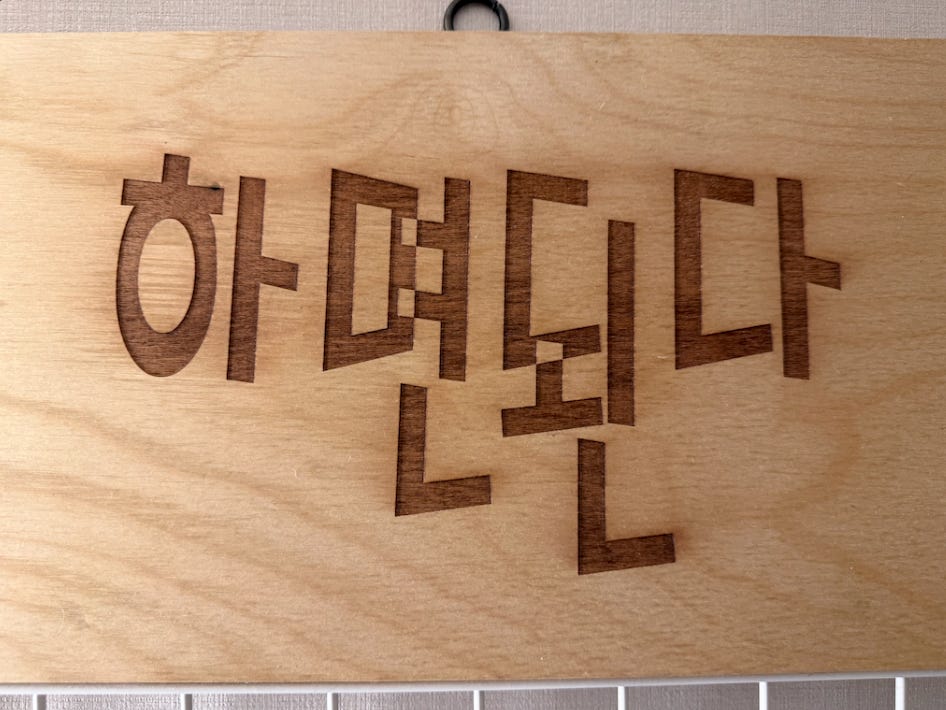
What entrepreneurship taught me is to set big goals or high standards, and then keep repeating, accumulating, and changing until it works. "Until it works" really means until luck arrives, and before luck arrives you have to go through uncertainty fully, like riding a roller coaster up and down through a dark night sky.
But in a sense, that is all there is to it. Endure uncertainty, do not swing with every emotional high and low, and keep building luck, effort, and systems. That is it. Julie Zhuo, whom I deeply respect, once said, "If some action scares you, there is a foolproof way to eliminate the fear: do it 100 times.[1](https://briandwjang.substack.com/p/28d#footnote-1-188780229)" Chef Choi Kang-rok said something similar: "Do anything 100 times and you get good at it. Most people simply do not do it." My experience says the same.
When the ralph-loop skill2 was introduced in early January and people began talking about how effective it was, I thought of our family motto. I started giving AI coding agents detailed descriptions of hard problems they still could not solve well, describing the standard and taste I wanted, and then just watched them work for hours. Like Sisyphus, they kept repeating the task until they got closer to the target.
So does that mean AI will take over the pain of doing something 100 times and we will just become comfortable? Probably not. Whenever a new tool improves, humans push it to its limit and use it to go after even bigger uncertainty. If AI can perform the 100 runs I used to hesitate to do, then we will naturally start chasing goals that require 1,000 or 10,000 attempts. The tools got better, but human nature did not change.
Do not let this change overwhelm you. Once you are overwhelmed, your body freezes. Let go of perfectionism too. Perfectionism prevents people from starting. All you need is a higher standard. The way to achieve a high standard is to endure uncertainty and keep trying until you get the answer you want. Dream bigger, and do it.
"For whatever action scares you (and isn't life-threatening), remember this surefire way to eliminate the fear: do it 100 times." - Julie Zhuo, former VP of Product Design at Facebook