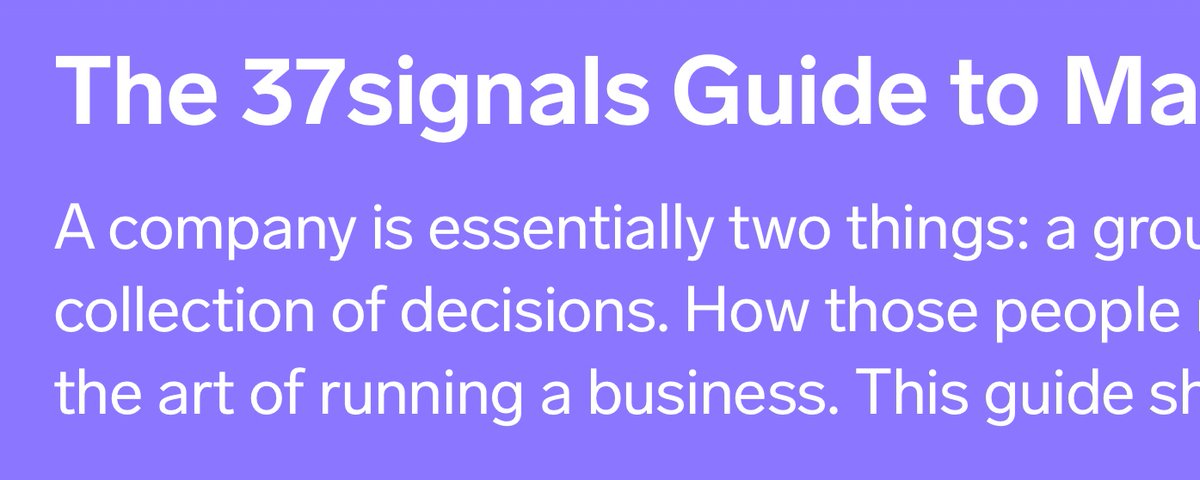
Starting from the premise that a business is a collection of people and decisions, this document presents 38 key questions that 37 Signals considers to make efficient and smart decisions. 🧑💻 These questions are not simply a checklist, but serve as a kind of philosophical guide that helps you make the optimal choice from a long-term perspective by reflecting deeply and exploring various perspectives during the decision-making process. This guide will challenge you to think deeply about the nature and impact of your decisions, with the ultimate goal of running a better business. 💡
1. 37 Signals' decision-making philosophy 🧐
37 Signals defines a company as a 'collection of people' and a 'collection of decisions', and emphasizes that how they make decisions is a key skill in running a business. This guide contains the general principles and philosophy we keep in mind when making decisions at 37 Signals. 🌟 Rather than strict rules, these principles are more like a compass that provides important perspectives to consider in the countless decisions we have to make every day. It's like asking these questions.
"A company is essentially two things: a collection of people and a collection of decisions. How those people make these decisions is the art of running a business."
2. Necessity and responsibility for decision-making 🙋♀️
First and foremost, we must ask ourselves why we have to make this decision and is it really necessary? It's about making sure you're not wasting your energy making unnecessary decisions. Additionally, who is the right person to make this decision is important. Decisions should be made by people with sufficient information, context, and insight, not simply by position. 🧐
- Why do we have to make decisions? Is this decision really necessary?
- Who are the right people? Are decisions being made by people with the right information and insight?
3. Time perspective and minimizing regrets ⏳
Decisions affect not only the present but also the future. It is important to predict not only the immediate results, but also what you will think of this decision a year from now. Additionally, by reflecting on why this decision has been delayed until now and why you are hesitating, you can uncover hidden problems or fears. 😮
- Is this a decision you will be satisfied with even after a year? You need to look at it from a long-term perspective.
- Why the hesitation? You need to figure out the reason for the delay.
- What regrets will we have? If we don't consider X, Y, and Z, will we have any regrets?
4. Accepting diverse perspectives and flexibility ✨
When making a decision, you need to think about why other people might make different decisions and practice looking at the problem from a different perspective. 🔄 Additionally, breaking a big decision into several smaller decisions or considering how easily a decision can be reversed allows for flexible response. It may be necessary to ask penetrating questions to determine whether the first intuition that came to mind was an attempt to rationalize it through data.
- What are the different perspectives? Why do different people decide differently?
- Can decisions be made smaller? Can large decisions be broken down into smaller decisions?
- How easy is it to reverse the decision? Do you have the flexibility to reverse the decision?
- Reconciling intuition and data: Are you justifying your first intuition with data?
5. Analyzing the consequences and impact of decisions 📈
Decisions have new consequences and affect other decisions. Whether this decision will affect any other decisions, and whether it will require a new decision or eliminate the need for another decision? 🏞️ Also, whether this decision will give people more or less work is also an important consideration.
- What will be the impact on other decisions? What other decisions will this decision have?
- Does it trigger a new decision? Or eliminate the need for another decision?
- Increasing or decreasing workload: Should you give people more or less work?
6. The nature and purpose of decision making 🎯
It's also important to understand whether the decisions we make are data-driven or intuitive. Sometimes it's better not to make a decision at all, and sometimes it's better to make a decision at all. 🤷♀️ You also need to think about whether this decision will be given more weight: impact on customers or internal impact on the company.
- Data vs. Intuition: Is this decision based on data or intuition?
- Is it better not to decide? Sometimes it's the best option.
- Impact on customers and the company: Which do you give more weight to?
7. Efficiency and long-term perspective 💡
Making decisions requires predicting what will become easier and what will become more difficult, and whether this ease will last in the long run. ⚖️ You must carefully judge whether short-term convenience is bringing on long-term difficulties. Ultimately, understanding how all of these decisions relate to money is an important part of business. 💰
- What makes it easier and what makes it harder? What changes will this decision bring?
- Long-term perspective: Won't short-term ease lead to long-term difficulties?
- Money connection: Ultimately, what does this decision have to do with money?
Conclusion 🎉
Rather than simply focusing on 'what to decide,' 37 Signals' decision-making guide requires deep reflection on 'how to decide' and 'why to decide.' These 38 questions help us reflect on important aspects we may miss during the decision-making process and help us make strategic and thoughtful choices rather than simply relying on intuition or convenience. 🚀 If we consistently ask these questions and practice decision-making, we will be able to create a smarter and more sustainable future as individuals and as organizations. 💖