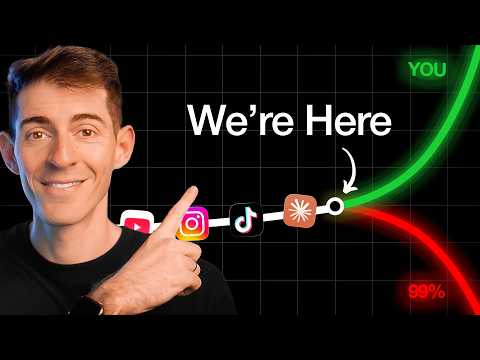
This video presents six key rules and strategies for successfully growing your personal brand and business in the changing social media environment in the AI era. It covers specific ways to survive in the flood of content, effectively secure potential customers, and even generate profits.
1. Momentary memory: Taking advantage of the "flash bang brain" phenomenon 🤯
This is a phenomenon that anyone who has used social media recently can relate to. The "Flashbang Brain" phenomenon, in which people cannot remember much of the content after watching a short video (short form), is widespread. This means that the user's short-term memory has become extremely short. The speaker emphasizes that rather than discussing the good or bad of a social phenomenon, we should focus on how to grow our personal brand and business within this phenomenon.
"People's short-term memory and their ability to remember what they just saw are completely destroyed."
In these situations, content creators should expect only two types of memories.
- Ultra-short-term fine memory: Remembering only for a short period of time, about 30 seconds, while watching a video.
- Ultra-long-term face recognition: Like a face recognition mosaic created through dozens of images over a long period of time, faces are recognized even if the name cannot be remembered.
Since it is difficult to expect other intermediate memories, the following points should be considered when creating content.
- Assume all viewers are first-time viewers: You should tell your story as if your viewers have no prior knowledge of your channel, niche, or business. In other words, you should create every video with the mindset that "This could be the first and last time they see your content."
- Focus on lead conversions (CTAs) in every video: In the past, you might engage viewers with multiple videos over the course of a month, but now every individual video must act like an independent marketing agent. In each video, it's important to capture viewers' emails with a Lead Magnet** to drive them outside of social media platforms and into the slow medium of email.
"My goal is to leverage each individual video to get as many people as possible to give me their email in exchange for a lead magnet, CTA, or product."
This is a strategy that moves viewers away from the clutter of social media feeds and into a calmer email environment, and allows you to measure and optimize the performance of each video independently. The speaker says that through this strategy, he succeeded in increasing his Instagram followers from 3,000 to 33,000 and securing tens of thousands of emails.
2. Reach the highest level: Become the "gold standard" 🏆
The second rule for success in an era overflowing with AI content is to become the "gold standard". This means creating absolutely top-notch content in your field.
The four elements to becoming the gold standard are:
- Interesting and Valuable Content: Covering content that is very interesting and valuable to your core audience.
- New and unusual perspective: Presenting a new perspective that is different from others.
- Clear language: Conveying information in clear language that anyone can understand.
- Sophisticated visuals and format: Packaging your content with as polished visual elements and formatting as possible. ('Sophisticated' here does not mean complex editing, but rather execution of the highest quality in the chosen format.)
The speaker says that when creating content, they approach it with the mindset of "becoming the gold standard in this field," so that they should be so much better than their competitors that when they watch their videos, viewers will forget about their memory issues and focus on the content.
"My only goal is to be the absolute best in every video I make: the best information, the best quality, the best clarity, the best visuals, the best in everything."
This means that, as the saying goes, "If you shoot for the stars, you can hit the moon," there is less chance of failure when you aim for the best. Even if you are a beginner, you can grow quickly if you keep working hard with this mindset. Most people try to achieve "maximum results with minimal effort," but this approach does not work in the flood of content in the AI era. Instead, we need the attitude of "being the best and getting the best results".
Additionally, we emphasize the importance of micro niche.
- Identify the product or service you want to sell.
- Understand the outcomes buyers want most.
- Ask whether the content will help the buyer achieve their goals: If it helps, create it, if not, don't create it.
Ironically, as competition intensifies, advances in algorithmic targeting will open up more of these micro-niche markets.
3. Explosive growth: The double-edged sword of the "explosivity factor" ⚡
The third rule is an insight into the Explosivity Factor era. A recent example of an account called 'Kumar method' went from 0 to 1 million followers with 5 videos in 5 days, showing that a well-designed content strategy can reach hundreds of millions of people in just a week.
"If the right content strategy is designed well, you can literally reach hundreds of millions of people in a week."
However, we warn that this explosive growth is a double-edged sword. It would be a great loss to give up your efforts out of jealousy or frustration after seeing such unusual success stories.
- Lindy Effect: Describes the concept that "the future life expectancy of impermanent things like ideas, books, and businesses is proportional to their current age." The longer it lasts, the more likely it is that it will continue for a long time to come.
- The importance of consistency: Content games ultimately depend on repeated execution and building durability over time. The only defeat is to stop posting.
- Preparing for success: Even if you experience explosive success like Kumar's, it can be useless if you don't have the systems or services in place to handle that traffic. Rather, the disappointment of reverting to the mean may cause you to give up.
Therefore, I advise that this explosive success is an exceptional phenomenon and that it is important to keep moving forward rather than fixing your expectations on it.
4. Content theft: How to survive in the "steal economy" era 🛡️
The fourth phenomenon in the AI era is the "Stealing Economy". The phenomenon of completely copying other people's content on social media is widespread. There are frequent cases of downloading and re-uploading the original idea, thumbnail, title, and even the video itself.
"Suddenly these little annoying people are copying your content word for word."
The speaker says that this phenomenon cannot be reversed and will only get worse in the future. Although this causes great frustration to creators, we advise that we should accept this as an unavoidable Creativity Tax.
However, a warning to those who steal our content:
"A, you're a scammer, and B, what the hell do you think is going to happen? Taking their content and getting millions of views and directing people to a service you don't have the expertise to run just ends up being a Ponzi scheme that amounts to nothing."
Original content creators must respond to this theft by creating content that is "harder to steal."
- More In Real Life Content: Create content based on real experiences that are difficult to replicate.
- Longer format videos: AI creates longer format videos that are expensive and time-consuming to replicate.
- Original ideas based on personal experience: Develop ideas that contain your own unique experiences and perspectives that cannot be easily copied by others.
He emphasizes that it is great to study other people's success stories, extract principles and formats, and recreate them in your own way, but copying other people's content is ultimately just "an imitation of an imitation of an imitation." Ultimately, the best way to succeed in the AI era is originality.
5. Personal Brand Differentiation: "Transpositioning" Strategy 🎨
The fifth way to differentiate your personal brand in the AI era is the "Transpositioning" strategy. How can you make your brand stand out in a world flooded with content? The speaker suggests three ways to differentiate:
- Visual Differentiation
- More Originality
- More Tactically Implementable
And I suggest "Transpositioning" as the wisest way to strengthen these three elements. This means taking inspiration from outside your niche and applying it to your field.
- Borrowing formats from other fields: For example, if you work in the culinary field, you can take the formats that people use in the fitness field and apply them to cooking. In the beauty field, you can apply the way top creators in the productivity field explain concepts or storytelling structures to beauty content.
- Use of Sandcastles: The speaker cites the 'Collection' function of the 'Sandcastles' platform he operates as an example, explaining that it curates and provides the best examples of visual hooks, signature series, and editorial styles in various niche markets. This allows you to access content from other creators and get inspired.
- Global search function: By searching with a specific keyword, you can refer to how other fields are making the most viewed ranked videos or videos on a specific topic over the past 3 months.
"Remixing formats outside of your niche will give you the highest ROI (return on investment). If everyone is looking in, you need to look out and bring it back in."
In other words, if you only look at your own field, you can only create similar content, so bringing fresh ideas from outside and reinterpreting them is the key to differentiation.
6. Platform and Format Selection: Differentiation of "Format and Surface" 🌐
The sixth rule of the AI era is Choice of platform and format. Social media platforms are gradually strengthening and differentiating their own characteristics.
- Instagram: The most powerful platform, with mature algorithms and a 'Comment-to-Click' ecosystem that can effectively drive users from content to leads and sales pages.
- LinkedIn: High average user value, but video product is relatively new and link ecosystem is different from Instagram.
- TikTok: Low value unless you're selling general consumer goods or trying to increase personal brand awareness in a specific niche.
- YouTube: Very powerful for long-form content, but requires a completely different strategy than short-form.
- Facebook: Similar to Instagram, powerful, but effectiveness varies depending on user base.
In terms of content format, the following changes are expected due to the influence of AI. AI will have a ripple effect, starting with the forms that are easiest to replicate.
- Most dangerous: Short-form text, images, short-form entertainment videos.
- Less Risk: Short-form educational videos, long-form texts, medium-length YouTube videos, long-form podcast YouTube videos, live streams.
Currently, it can be successful in any format, but with the advancement of AI technology, the supply of content will explode from the left (short-form text), which will lead to dilution of content and intensify competition.
"You won't lose the race on quality, you'll lose it on dilution, because supply will overwhelm you."
So for long-term success, it pays to move toward a format closer to the right end of the spectrum (long-form YouTube videos, live streams).
- Importance of YouTube: Medium YouTube is the easiest to protect your content, but very difficult to start from scratch.
- Strategy for Beginners: For those who are new to content, we recommend starting with short-form videos and solidifying the basics of content for 3 to 6 months, then switching to or adding long-form YouTube videos. Short form is much easier to get started with, and YouTube is the undisputed king when it comes to lead generation and sales.
Finish
Social media in the AI era is changing rapidly, and the speaker emphasizes that establishing new strategies in line with these changes is the key to success. It is important to understand the "flashbang brain" phenomenon, become the "gold standard" in your field, recognize the double-edged sword of explosive growth, create original content that is "hard to steal" in preparation for content theft, differentiate by "transferring" ideas from other fields, and choose favorable platforms and content formats in the AI era. All of these rules should ultimately help you focus on growing your personal brand and business, converting views into leads and sales.