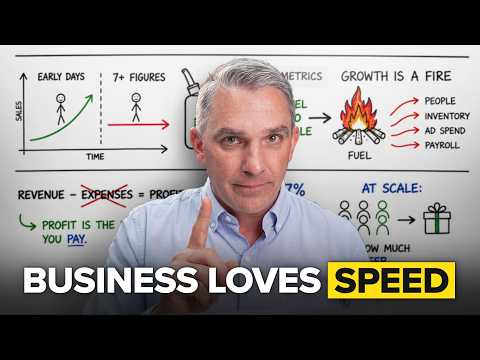
This video uses seven principles to explain the difference between companies that stall at a seven-figure (multi-million-dollar) business in annual revenue and those that scale to eight figures and beyond. The key is not working harder or indiscriminately adding people, but building systems, data, margins, specialists, distributed decision-making, 90-day execution, and a repeatable rhythm. Ultimately, the message is that scaling a business comes less from flashy new strategies than from the ability to consistently execute what matters all the way through.
1. Build Systems Before Hiring More People
Ryan Deiss says that he, too, was once carrying a mortgage and $250,000 in debt while he had a newborn. Today, however, he and his partners run a portfolio of 17 companies worth $200 million, and he has personally met and coached thousands of seven-figure business owners. He says that within 10 minutes of talking with a business owner, he can tell to a fair degree whether that person will grow to a bigger scale or stay where they are.
"Success doesn't depend on working harder. It doesn't even depend solely on hiring 'the right people.'"
The first difference is very clear. Stuck business owners throw more people at problems; scaling business owners build systems.
When you first grow a business to a few million dollars a year, the founder's stamina and tenacity genuinely carry a lot of weight. By working longer than anyone, caring more than anyone, and doing everything necessary yourself, you can reach $1 million in revenue. But that very approach becomes what holds you back at the next stage. Once the founder's time and energy hit their limit, they can no longer increase their own labor, so they try to buy other people's labor. In other words, they throw people at the problem.
The vicious cycle he points out goes like this:
- The founder becomes too busy and overwhelmed.
- In a rush, they decide, "I need to hire someone."
- With no time to hire properly or define the role, they quickly hire someone who seems good enough.
- There's no system for that person to follow and no time to train them.
- The new hire is confused and fails to deliver.
- Out of guilt for not having set them up properly, the founder lets the situation drag on too long.
- Money and time keep leaking away, until finally the founder fires the person and takes the work back.
- Then they get exhausted again and hire again.
"Overwhelm, hire, fail, fire, repeat. I've seen this vicious cycle countless times as the single biggest thing holding seven-figure companies back."
The solution is to answer one single question before making a new hire:
"What system will this person be running from day one?"
If you can't answer that question, it's not yet time to hire. First you need to document how the work itself is done, in whatever form—work manuals, checklists, standard operating procedures (SOPs), screen recordings, and so on. When a new hire joins, they should be able to know "what to do, by what standard, and in what order."
If the founder doesn't know how to structure that work either, they shouldn't hire an inexperienced employee and try to figure out the answer together. In that case, use an outside consultant or agency that knows the field well to build the system first, and then hire the employee who will run it.
"Good people don't fix broken systems. Broken systems break good people."
In short, the order is systems first, people second. 👥
2. Run the Business on a Scorecard, Not a Gut Feeling
To build systems, you first need to be able to see the state of the business. Ryan describes most stuck business owners as "running their business with their eyes closed." The second difference is whether you rely on gut feeling or on a scorecard.
He says you can quickly gauge growth potential by asking a business owner questions like these:
- How many leads did you get last month?
- What's your lead-to-purchase conversion rate?
- How long does it take customers to experience real value after purchasing?
- What's your gross margin?
- What's your revenue per employee?
Scaling business owners have these numbers memorized, or at least know exactly where to look them up immediately. Stuck business owners, on the other hand, go blank when asked.
"Honestly, that silence tells me everything I need to know."
To illustrate this, he tells the story of two pilot friends. One is a professional pilot with an instrument rating; the other is a hobby pilot who flies by looking out the window. On a clear day at low altitude, flying with the hobby pilot may be fine. But if you suddenly run into a storm, trying to navigate without instruments and data is extremely dangerous.
"Running your business on gut feeling is like flying as a hobby pilot."
When the business is small and the environment simple, the founder's instincts may work. But as the business grows, the variables multiply and the market's "weather" gets rougher. At that point, gut feeling is emotional and tired, and easily swayed by whichever person or incident raised the loudest alarm that morning.
"Your gut can get you to seven figures. But what gets you beyond that is tools and data."
The minimum scorecard he proposes has three layers.
Three Top-Level Health Metrics
The first layer is three always-on key metrics that show the overall health of the business. These are mostly lagging indicators that show results; examples include:
- Revenue
- Cash actually collected
- Revenue per employee
Revenue per employee in particular lets you quickly gauge the state of profitability in service businesses where labor costs make up a large share.
North Star Metrics to Focus on for 90 Days
The second layer is three North Star metrics to improve over the next 90 days. If you try to improve every number at once, none of them improve properly. For example, if you're short on leads you might focus on lowering cost per lead, and if sales conversion is the problem you might focus on improving the conversion rate.
"There's no need to look at everything you can't improve. Focus on the three numbers that matter most right now."
Department Operating Metrics
The third layer is 3–5 departmental metrics that each department leader—marketing, sales, operations/delivery, and so on—is accountable for. What matters is not having too many metrics. Around a dozen numbers that clearly accountable owners manage every week beat a 40-metric dashboard that nobody looks at.
Once you start looking at the numbers, uncomfortable realities may surface. Especially if the founder has only been watching revenue, the real problem is likely not revenue but margins, cash, and productivity.
3. Track Margins and Cash, Not Just Revenue
The third difference is that stuck business owners chase revenue, while scaling business owners chase margin.
In the early days, sales matter most. Nothing happens until you sell something. Ryan, too, says that in the early stage of a business you should get out into the market aggressively and "sell, sell, and sell some more." But once you pass seven figures, the question has to change.
Instead of "How much did we make?", you have to ask, "How much of it did we keep?"
He cites a statistic that about 67% of companies that make the Inc. 500, a ranking of fast-growing U.S. companies, eventually fail. Growing fast doesn't guarantee safety in itself; in fact, many companies go under precisely because of rapid growth. The biggest reason is that they run out of cash.
Growth is like fire. Fire doesn't feed itself; you have to keep adding fuel. You need more employees, more inventory, bigger ad budgets, more payroll. So the more you grow, the more money it takes, and growth itself doesn't automatically generate profit.
"Growth is not the same as profit. Growth eats profit."
That's why he recommends the mindset introduced in Mike Michalowicz's book Profit First—the "profit first" approach. The usual formula is:
Revenue - Expenses = Profit
But under this formula, you pay all your expenses and then hope some profit is left over. In reality, there's usually almost nothing left. Instead, you should think like this:
Revenue - Profit = Expenses
Rather than treating profit as a leftover balance that happens to remain, you treat it as a line item that must be secured first. For example, if the company decides it will run at a 20% profit margin, you set aside 20% of revenue as profit first and fit the cost structure within the remaining 80%.
"This company runs at a 20% profit margin. And whatever is left is what we can spend on expenses."
At first it may feel like "I can't run the business that way." But he says the opposite:
"You can't afford not to."
Margin isn't something that naturally appears as a business gets bigger. Because cash needs grow along with growth, a company that can't create margin at a small scale won't be able to create it at a large scale either.
"Margin isn't a result of growth. Margin is a decision."
Profit also isn't just for the founder to take big distributions. Profit is the fuel for scaling the business. Building systems, hiring great specialists, and experimenting with new opportunities all take money. Without margin, there's no fuel to reinvest.
Your scorecard should include not only revenue but also gross margin, revenue per employee, cash balance, and especially distributable cash. What matters is not simply how much cash is in the bank account, but how much money you can actually use or distribute after accounting for debt, working capital, and essential expenses.
"Your P&L can mislead you. But cash doesn't lie."
4. Hire Specialists Who Deliver Results, Not Helpers
The fourth difference is that stuck companies hire helpers, while scaling companies hire specialists.
At first, everyone hires a support rep to handle customer inquiries, an office manager to answer phones and check the mail, a virtual assistant to take on small tasks, and so on. Ryan calls these roles "helpers." That doesn't mean their worth as people is low; it means they are roles that handle individual assigned tasks.
The problem is that if you keep hiring only helpers, the founder's work doesn't go away. Instead of running the company, the founder ends up becoming the person who checks and directs all the helpers' work.
"Congratulations. You've created what might be the worst job in the company."
Helpers just replicate the founder's to-do list in human form. Handing off one task doesn't mean you've handed off responsibility for the outcome. If the founder still has to keep judging "what needs to be done," "how it should be done," and "whether it's going well," then that work is still in the founder's head.
He simplifies it this way: most businesses ultimately do three things.
- Marketing: create interest in the market.
- Sales: convert interest into purchases.
- Execution/delivery: deliver the promised results to customers.
Founders are often excellent at one of these three, above average at another, and weak at the third. Ryan says he himself is strong at marketing but weak at sales. This is where many founders make two mistakes.
First, they hire junior helpers to assist in their weak area. But if you hand work that even the founder doesn't understand well to someone with little experience and then try to manage that person, it's hard to get results.
Second, they hand the area they're good at to a helper, while the founder tries to focus on their weak area. That's like putting your best player in your worst position.
"We're benching our best player—ourselves—and making them play the position we're worst at."
Ryan confesses that, begrudging the cost of marketing, he once hired junior staff and tried to take on sales himself. The result was bad sales and bad marketing, because the structure had someone who wasn't good at sales doing sales, and a non-expert helping with marketing.
The solution is to hire not someone who simply provides help in the weak area, but a specialist who is on the founder's level and even better than the founder in that weak area. For example, if the founder is strong at marketing but weak at sales, they should bring in a sales leader as excellent as the founder is at marketing.
"Helpers handle tasks. Specialists create results."
Specialists are an investment, not a cost. What's truly expensive is spending money on several people who can't do the job properly. After bringing in a specialist in your weak area and generating growth, you should hire specialists in your average areas too, and ultimately bring in someone even better than you in the area you're best at.
"Even in the area you're good at, there are people better than you. That's because they're not trying to run an entire business—they focus only on that one thing."
However, hiring specialists is pointless if the founder still has to approve every decision. At that point the organization isn't a team; it's a waiting room where everyone waits their turn outside the founder's doctor's office.
5. Don't Be the Bottleneck—Build a Decision-Making Engine
The fifth difference is that stuck owners hoard decisions, while scaling owners build a decision-making engine.
"A company grows at the speed and quality of its decisions."
Good decisions alone aren't enough. You have to make good decisions quickly. A good decision made too late can miss the opportunity, and a fast but bad decision is obviously harmful. So for an organization to grow, team members need the ability to understand the context, make sound judgments, and execute on their own.
Many founders think they delegate well because they assign work to employees. But if employees must always come back for approval right before executing, that's only task delegation, not decision delegation.
"If every decision has to go through you, you're not the CEO. You're still the bottleneck."
Ryan offers the 3-3-3 rule to solve this. Before someone brings a decision to the founder, it has to pass through three gates.
Research for 3 Minutes
The first is 3 minutes of research. Check that they've at least tried to find a basic answer through Google, Claude, ChatGPT, and the like.
"There's no end to people bringing me questions whose answers would come up immediately with a Google search or by asking ChatGPT."
This isn't just a rule to save the founder's time. It's a mechanism that helps employees grow into people who look for answers themselves first when they hit a problem, rather than people who immediately "ask the boss."
Get Input from 3 Peers
The second is talking to 3 peers. It doesn't matter whether they're inside or outside the company. Having others test your idea can sharpen your judgment. Employees also learn that the founder isn't the only source of knowledge and advice.
"The answers are out there, the problem is solvable, and you don't need to bring everything to me."
Present a Solution in a 1-3-1 Document
The third is, when the founder's input really is needed, to bring a 1-3-1 document.
- 1: Clearly define the problem in one sentence.
- 3: Present three well-considered options.
- 1: State the one you recommend.
"Don't just toss out three options and ask, 'Which one should I pick?' Tell me what the problem is, what the possible options are, and what you recommend."
Under this approach, the employee becomes not just someone who relays a problem but someone who researches, judges, and recommends. Ryan says that for people who bring these documents well, he agrees with their recommendation as-is about 9 times out of 10.
"Next time, don't ask me. Just do it."
The people who build up this trust are the ones who eventually become leaders and executives. The essence of leadership lies not in taking down tasks, but in making and executing decisions in context.
6. Execute in 90-Day Sprints Instead of Annual Plans
The sixth difference is that stuck business owners make annual plans and forget them, while scaling business owners operate in 90-day cycles.
It's not that many business owners never plan at all. In fact, they often put together impressive plans for the new year at year-end, especially in December. But the year-end mood breeds excessive optimism. He compares it to grocery shopping while hungry: just as you load up on more than you need, everything seems possible in the new year.
"Annual plans are like an entrepreneur's New Year's resolutions. Most are abandoned by the first week of February."
Conversely, making overly big goals or a vision board doesn't tell you what to do on Monday morning either. So he suggests creating a 3-5-1 sprint plan every 90 days.
3: Three North Star Metrics
First, set a long-term three-year revenue and profit goal. Then, to move toward that goal, pick the three key metrics you must improve during this quarter's 90 days. These tie into the North Star metrics created earlier.
What matters is deciding which numbers to improve first, not deciding on projects first. You shouldn't start a project just because a competitor is doing it or because someone thought it was a good idea.
5: Five Key Initiatives
Next, choose five key projects that can move those three metrics. Ryan says five is usually about the maximum number of new projects a team can properly push forward in 90 days.
"You can pick lots of projects. But if you don't finish any of them, it doesn't matter."
More important than whether a project is a good idea is whether it actually moves the chosen key metrics within these 90 days. Even a good idea should be put on hold if the timing isn't right.
1: One Unifying Phrase
Finally, create one unifying phrase that focuses everyone for the quarter. It's closer to a 90-day short-term mission statement. It shouldn't be a long, vague mission statement, but a phrase short and sharp enough that team members can easily remember it and put it on a T-shirt.
When a new idea or tempting opportunity comes in, you ask:
"Does this fit this 90-day mission?"
If it doesn't, you turn it down or postpone it—not because it's a bad idea, but because it's not what we should be doing right now. This is how you protect the organization's focus. 🎯
7. Repeat a Boring Rhythm Instead of Chasing Shiny Strategies
The seventh principle, which Ryan sees as the biggest difference of all, is that stuck business owners chase shiny new things, while scaling business owners follow boring rituals.
He says that if a business owner talks only about new projects, new strategies, and competitors' latest moves every time you meet, that owner is likely to stay stuck. It's not because they're lazy. On the contrary, they do too much. But they finish nothing, so nothing compounds.
"They do too many things, but they don't finish anything. So nothing builds up."
In contrast, companies that actually scale look somewhat boring from the outside. They don't waver by constantly testing new things; they do the next right thing, and then the next one after that.
He compares a friend who works out consistently with a friend who's always looking for a new diet, workout program, or health app. The healthy friend does similar workouts and eats similar food every day. It's not exciting, but it works.
"Compounding doesn't care how exciting the repetition is. It only cares whether you keep showing up."
The "boring but winning" operating rhythm he lays out is as follows:
-
Set a three-year revenue and profit goal.
Three years is long enough to create meaningful change. He explains that just sustaining compound growth of around 24% a year can double the size of a business in three years. -
Break those three years into 12 quarters.
Each quarter, review what worked and what didn't over the previous 90 days, then create a new 3-5-1 sprint. -
Hold a 60-minute leadership meeting every week.
In this meeting, review the scorecard and key initiatives. There are two questions:- Are the North Star metrics we committed to improving actually moving?
- Are we actually executing the key projects we committed to?
-
Review the sprint plan monthly and adjust as needed.
Having made a plan doesn't mean you must never change it. If the data reveals something new, you should change whatever you would have done differently had you known it from the start.
"It's foolish to think that because you made a plan you must never change it. When the data tells you something new, change."
That doesn't mean changing direction every day, though. Review monthly, stay the course most of the time, and replan quarterly. Instead of repeatedly making big bets or abrupt pivots, finish things one at a time and let them compound.
He says the human brain is trained to crave new, flashy strategies, since the growth so far may well have started from new ideas and new attempts. But the urge to keep tinkering with a system that works well is precisely the last obstacle blocking the next stage of scale.
"Slow is smooth, and smooth is fast."
This is introduced as a Navy SEAL maxim, and it applies directly to business. Even if things look slow and boring on the surface, when the system runs smoothly you ultimately reach where you want to go faster.
Wrap-Up
The video's conclusion is that founders need to boldly let go of some of the methods they've used to grow so far. Working more on your own, judging by gut feel, chasing only revenue, and handing off small tasks while still controlling every decision can work up to a certain stage. But to build a bigger company, you need to build systems first, look at the numbers, keep profit, entrust results to specialists, let the team decide quickly, focus in 90-day cycles, and repeat boring execution.
"Scaling companies look boring from the outside. But that boring consistency is what lets them go anywhere they want."