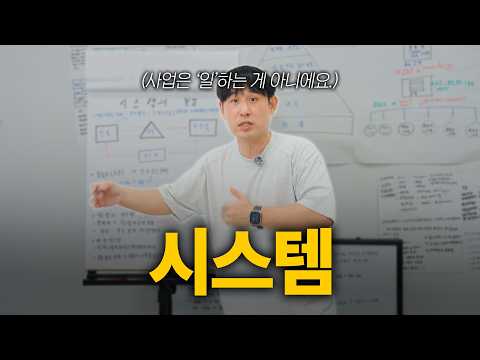
This video explains that a business's success depends less on personal effort or one-off problem solving than on building repeatable systems that run on their own. A CEO's core job is not to handle everything personally, but to design systems that keep problems from recurring and to keep improving them. Above all, it stresses that the most important starting point is that you must systematize your own life and body before your organization.
1. Business Problems Are Ultimately System Problems
The speaker says it took him about five to six years to grasp systems thinking, and then roughly another two years to truly understand it deeply and apply it to his business. He introduces the video as an attempt to compress that long stretch of time so that even people unfamiliar with systems thinking can grasp the essentials in one go.
The essence of a system, as he describes it, starts from seeing the world as one giant machine. Humans, organizations, and businesses are small systems within it, and small systems inside the larger system repeat similar patterns in a fractal structure. Just as branches spread out from a large trunk, an individual's way of living and an organization's way of operating resemble each other.
"Every business problem is a system problem. It's not someone else's problem; it's a problem with my system."
A system fundamentally operates as a cycle of Input → Process → Output → Feedback → new Input. If the result differs from what you expected, instead of blaming someone or scrambling to patch things up on the spot, you should treat the result as feedback and change the process and the input.
The speaker particularly emphasizes the importance of input quality. The food we eat, the books we read, and the information we take in are all inputs. When useless or excessive information comes in, the process gets disrupted, which in the end produces useless outputs and feedback, creating a vicious cycle.
"Put useless things in and you get overloaded. When garbage goes through the process, you get useless output and useless feedback, and it becomes a vicious cycle where useless things just keep circulating."
So to run a business well, rather than simply trying to change the results, you first need to examine what you are putting in and how that input passes through the process to produce the results.
2. Translating Abstract Values Into Concrete Language
The speaker says that if the values people often talk about in business are too abstract, they can't be applied to how an organization actually runs. For example, expressions like "the purity of the business" or "being true to yourself" sound great, but different people can interpret them in completely different ways. When there's a lot of room for interpretation, it's hard for team members to move in the same direction.
That's why he explains that he has defined the concepts he talks about, such as the purity of the business, being true to yourself, and a childlike state, in as much detail as possible in the organization's principles. The key is the practice of translating abstract ideas into concrete actions and standards.
"You have to keep practicing making abstract things concrete."
To do this, the speaker recommends the habits of analyzing the etymology and meaning of words and clarifying your thinking through writing. Keeping a household budget, continually defining words, and reading newspaper articles are not just self-improvement tasks, he says, but mechanisms for aligning your inputs and your standards of thinking.
A word journal is especially important for creating and refining your mission. Business plans and strategies are made of language, so if the meaning of the words you actually use is unclear, your strategy and goals will inevitably be blurry too.
"If your words aren't clear, you can't make any strategic plan. The business plan itself becomes impossible, and so does alignment."
To make complex thinking simple, you shouldn't just cut things down or leave things out; you have to keep digging by asking, "Couldn't this be seen another way?" The speaker explains that alongside systems thinking you need thinking that holds both complexity and simplicity, in other words integrative thinking that organizes ideas into a form that has depth yet is still actionable.
3. What You Must Systematize Before the Organization Is Yourself
The mindset of systems thinking doesn't begin with grand management tools. The speaker says you must first put in order your own body and the system of your daily life. His argument is that if your own life is out of control and your routines have collapsed, building an organizational system is impossible.
"If my life isn't under control and my life isn't systematized, I can't build any organizational system."
He confesses that two or three years ago his own body was a wreck, and because he didn't value routines, building systems was hard for him. Even now, he says, when something that looks fun or a new opportunity that might make money pops into his head, he feels the urge to be swayed on impulse. For example, even if an idea like investing in a motel suddenly comes to mind, he catches himself and realigns with his principles and systems.
"Out of nowhere I think, 'Should I invest in a motel? Is there anything fun, anything that makes money?' Then I realign myself with my principles and my system."
This is where he mentions his own load factor and his habit strategy. When you exceed the level your body and brain can handle, your judgment and consistency can break down. The speaker says he tries to solve even minor health problems with systems, and gives his own snoring as an example.
He tried a method using cotton swabs to help air flow through his nose, and when that didn't solve the problem, he booked an appointment at a sleep center and got an anti-snoring device. He also keeps changing his bedding to improve his sleep quality. What matters is not any particular method, but the habit of building a structure to solve a problem when it arises, instead of letting it slide by "just putting up with it" or thinking "it'll get better someday."
"If my human system doesn't work, my business system doesn't work either."
As you accumulate experience solving small problems systematically, one, two, three at a time, building organizational systems also becomes easier, because the methods you've applied to yourself can be extended to other people and to the organization. These life systems secure peace of mind and ultimately strengthen decision-making ability, which is crucial for a CEO. 🌱
4. Develop an Eye for Systems Before Learning Tools
The speaker points out that many people try to systematize their organization while their own lives are still disorganized, and start by learning tools like Notion or Slack. But tools are not the system itself; they are merely a means of executing and recording a system that has already been designed.
"People who don't have their own system are learning Notion and Slack to systematize their organization. That's not it. It's impossible."
In other words, you shouldn't view organizational problems simply as a lack of apps or collaboration tools. What needs to be answered first are questions like these:
- Why does this system need to exist?
- What problem is it meant to prevent or solve?
- Who does what, how often, and according to what criteria?
- How will the results be checked and improved?
Only once this structure is in place can tools like Notion, Slack, budgeting apps, and accounting systems function properly. Systems thinking, in the end, means looking at everything not in terms of "who will work harder," but in terms of how to make it run well, repeatedly.
5. The CEO's Role Is to Improve Systems
The speaker describes an organizational system as "a system of systems." And he repeatedly offers sentences that CEOs and leaders must remember.
"A leader is simply someone who improves systems."
"I am someone who improves systems."
"I am someone who builds systems for everything."
Having the CEO step in personally every time a problem arises, scolding people or doing the work for them, is only a temporary fix. By contrast, improving the system reduces the chance of the same problem recurring and lets the organization move according to consistent standards even without the CEO.
As an example about people and organizational culture, the speaker describes an experience where he gave a team leader the vague responsibility of "building a culture of praise," and it didn't work well. In the end, he was the only one who kept giving praise, so to solve this he designed a more concrete system.
He gave a four-person group, as its reason for existing and its mission, "managing the recognition rate of this group chat and building a culture of praise." He also set a clear goal: once a day, each person would post three things they could praise themselves for in the group chat.
"Tell the group chat three things you can praise yourself for today."
For example, people write small, specific things every day, like "I'm grateful I didn't snore last night" or "I'm grateful I slept really well." He explains that this repetition raises self-efficacy, which leads to self-esteem and confidence, and can ultimately affect work performance too.
The flow of system design the speaker presents is relatively simple.
- Define the mission, that is, the reason for existing.
- Set the goal to achieve.
- Lock in the rules and repeated actions that make sure the goal is actually carried out.
- Look at the results and improve the system.
"You set the mission, set the reason for existing, set the goal, and then fix the rules in place. Then the system changes and the problem gets solved."
6. Safeguards That Prevent Problems Before, Not After, They Happen
A system is a structure for solving problems, but beyond that, it should be a safeguard that prevents problems. The speaker explains this using his accounting system and his legal-risk system as examples.
First, for personal spending, he records the amount in an app after buying something. He doesn't just write down how much he spent; he also keeps what he calls a spending-fast journal, or reflection log, looking back on whether the purchase was truly necessary. This is his first-tier accounting system.
In the second tier, his tax accountant sends him itemized books every week, and he reviews them weekly. In the first week he checks that week's entries; in the second week, everything through the previous week; in the third week, everything through the week before that; and in the fourth week, he reviews the entire month. As the checks accumulate, he says, the flow of money going out takes shape in his head like a graph.
"The verification accumulates. When you do it that way, the flow of money leaking out gets drawn in your head like a graph."
He doesn't respond on impulse to potential legal problems either. When something arises that creates a legal burden, he immediately sends the relevant documents to his lawyer and calmly carries on with his own work. He has a processing system that routes things to experts, so the CEO doesn't have to hold onto everything alone.
"When something comes up that's a legal burden, I send it straight to my lawyer and do my own work in peace. I let the lawyer handle it."
Principles and rules are also part of the prevention system. The speaker says he sometimes puts a clause in contracts stating that there is no second chance if a principle is violated. This isn't about treating anyone coldly; it's a way of setting standards in advance so that after a problem arises, you don't have to argue emotionally or repeat unpleasant confrontations.
"I also put a clause in the contract saying there's no second chance if you violate a principle. That way I don't have to have uncomfortable confrontations."
7. J-Curve Growth Starts With Your Own System
At the end of the video, the speaker returns to his opening premise. You can give team leaders a mission and goals and, through rules, make the organization's systems run on their own. But for that to be possible, the CEO must first be able to set up their own body and life.
"Only people who can first set up their own body and their own system can extend it to an organization."
The speaker points out that many people pour attention into the organization, revenue, team members, and business model, yet don't treat the system called "myself" as important. But if the CEO's sleep, health, focus, habits, spending, and way of making judgments fall apart, the organizational system is easily shaken too.
The J-curve growth he describes is not growth that comes from the CEO working more. It comes from systems that run repeatedly even without the CEO doing the work personally, that get corrected through feedback when problems arise, and that scale more stably over time. 📈
"My system, the system of my body, has to come first. Only then can you become someone who builds systems that grow exponentially, like a J-curve."
Closing
The core of this video is simple. What a CEO needs to do to run a business well is not to handle every task personally, but to build and improve systems in which input, process, output, and feedback are connected. And the first of those systems should not be the organization, but your own body, habits, daily life, and way of thinking.