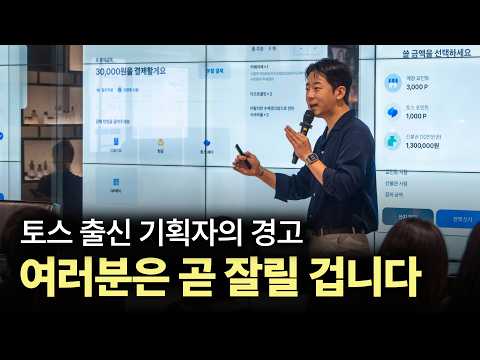
In this video, Neo (Lee Seok-hee), a solo founder formerly of Toss, shares the changes of the AI era, his own personal experience of them, and his insights about the future. Predicting the shifts AI will bring to the job market, he delivers the message that it is no longer about 'starting a company with AI' but about 'doing your startup with AI', and stresses the importance of building the strength to stand on your own. In particular, he lays out ways to actively use AI in your personal life and your business, and argues that we need to prepare for the coming AI wave.
1. The AI Era: A Wave of Change and the Future of the Job Market 🌊
Neo warns that the arrival of the AI era will bring major changes to the job market. He believes there is a strong chance that 80% of management roles will be replaced by AI, and says that anyone who cannot use AI will be left behind. Watching AI develop, he says, made him feel that "the definition of success could change completely."
"You're all probably going to get laid off soon." "Increasingly, only the true top 10% or 20% of managers will remain at the company, and I think the other 80% are genuinely easy to replace. What struck me while using Claude was: ah, the definition of success could change completely now." "So if you don't adjust your stance now, you could really get tumbled by a wave the size of a building." "Depend on AI."
Neo explains that on the strength of 11 years at Toss and Coupang, he worked up the courage to quit and walk the path of a solo founder in order to ride the AI wave. He currently builds IT products while also working as a creator, running the YouTube channel 'Learning Curve', which captures the stories of IT makers, and his personal Instagram 'neo.aimaker', where he shares his own struggles.
2. A Solo Founder's Challenges After Quitting, and How He Uses AI 🚀
After leaving his job, Neo set up his own content studio and has been exploring the path of a content creator. The anecdote of building his own studio because he begrudged the cost of renting one for podcast shoots shows his appetite for a challenge.
"I'm still searching. Honestly, there's no clear answer." "Recently, running a class together with Class101 has been one of the bigger challenges for me. And another is that once I started shooting podcasts, I had to keep renting a studio, and that felt like such a waste of money. So I set up my own studio. [laughs]"
He confesses that because AI is changing so fast, he has grown skeptical of the conventional startup approach centered on shipping an app and raising investment. Instead, he is concentrating on building his own trust and message, things that do not change even as the times do. To that end he invests a great deal of time in producing content, treating each piece as a product and experimenting to see what value people take from it.
Neo makes active use of AI in his work as a content creator. He uses AI agents to analyze trends and gets help with content planning, script writing, and even creative direction. He relies on AI especially heavily for making Reels: AI writes the script from start to finish, and when he does not like it he keeps refining through revision requests. For longer-form YouTube videos he works out the topic himself, but he gets AI's help at the processing stage — editing, thumbnail creation, extracting highlights.
"I'm really making good use of AI when I create content." "I built AI agents — a trend analysis agent, and then a content creator agent that also runs. (...) When each of them runs and I say, here's my reference, I want to make it like this, it just comes right out." "When I make it in Reels form and post it, it surprisingly does well."
3. The Success Formula AI Changed, and the Opportunity in Starting Up ✨
What led Neo to start using AI in earnest was experiencing Claude Code in the second half of 2025. For someone who had worked 11 years in the IT industry and always felt the limitation of not being able to build a product without a developer or designer, Claude Code was an enormous shock.
"What really hit me over the head — after I left my first company, I spent about seven or eight years making a great many attempts to start something. The limitation I always felt in that process was that whenever I wanted to build a product, make an app, do something, I needed a designer and a developer. And I couldn't do that myself." "But after using Claude Code late last year, I didn't need them anymore. I could build the product I wanted in a day or two — I was genuinely shocked at that point."
Through Claude Code he implemented Kakao login and shipped an app despite lacking coding knowledge, and that experience convinced him that the success formula for future businesses and services will change completely. He also noted that without needing to hire developers, a startup's initial costs drop dramatically and it can grow perfectly well without investment.
"The first thing I felt was that the success formula for business and services going forward is going to change completely. The second was that startups and products won't need investment." "In the old days I could only get rich if the company became a unicorn. But these days, if I'm doing it alone, honestly, earning even 10 or 20 billion won makes you an enormously happy, enormously wealthy person."
These changes gave him the conviction that he could learn more outside a company than inside one, and ultimately became a major factor in his decision to quit. He stresses that right now is exactly the right moment to ride the AI wave.
4. Why It's Not 'Starting Up With AI' but 'Doing Your Startup With AI' 💡
To people weighing whether to start something in the AI era, Neo delivers the core message: "It's not that you start a company with AI — you should do your startup with AI." Rather than getting absorbed in AI itself, he explains, you should focus on the fundamentals of 'how you make money' or 'how you build a service', and use AI as a tool that supports that.
"I think it's not that you start a company with AI — you should do your startup with AI." "When you set up the skeleton properly — I make content, or I do business through sales, or I build a service product — and then leverage AI well on top of it, you can better achieve the goal you want. If instead you say 'I'm going to become someone who's good at using AI itself,' the models change too fast, there are far too many people who are good at it, and I don't think there's any substance in that by itself. It's like how it isn't the person who's good at Excel who succeeds — you have to be good at Excel for the sake of your own success..."
For people who find learning AI difficult, he emphasizes "increasing the sheer amount of time you spend with AI, and having the tenacity and initiative to keep asking AI questions and work your way to an answer."
"I think the most necessary thing in the AI era is this: in the time you'd spend asking me 'what is this?' by DM or in a YouTube comment, if you ask GPT it will tell you everything. And it explains it better than I would." "Believe that AI can explain it to you extremely well — and rather than leaning your life on another person, when you have this excellent colleague called AI, honestly a colleague smarter than anyone, sitting next to you for 20,000 or 100,000 won a month, I really think the tenacity and initiative to keep asking it questions endlessly is so important. And I think you need to drop the habit of relying on other people, fast. Depend on AI for that instead."
5. Survival Strategy for Employees in the AI Era, and Preparing for the Future 🌟
Neo speaks frankly about the threat AI poses to the job market. Even employees at big tech companies like Toss are feeling severe FOMO about AI, he notes, and he points out in particular that junior hiring is shrinking. This is because replacement begins with the easy work and will gradually reach management as well.
"When I said I was quitting, almost everyone I met at Toss said they really envied me — and I think it wasn't simply envy about quitting, it was that their FOMO was enormous." "I feel it especially strongly in this: in the hiring market, it really seems like nobody is hiring juniors." "Juniors are just the beginning; I think it will gradually climb to mid-level and senior. Yes. So I think eventually only the true top 10–20% of managers will stay at the company, and for the other 80%, unless you prove you're a necessary presence at this company even though you cost more than Claude Code, I think you're genuinely easy to replace..."
He explains why the AX (AI transformation) market is currently so lucrative: because AI can dramatically reduce labor costs. In other words, he tells the frightening truth that the growth of the AX market means a threat to jobs.
"Why do you think people do AX? It's to cut staff." "Three or five years from now, simple office work will effectively have nowhere left to go. Junior developers already aren't being hired — right now it's at the level of not making new hires, but they'll start cutting existing headcount too. And I think we're moving toward an era where how few people a company uses becomes its competitive advantage."
In this situation, he predicts an era in which "everyone gets startup-ed into" — that is, forced to stand alone because companies no longer hire. But he does not see this in purely negative terms. On the contrary, he stresses that we now have a powerful tool in AI, and that media like YouTube and Instagram have opened up the chance to make yourself known at low cost.
"I think we're entering an era where everyone gets startup-ed into. If you don't start something yourself, the company won't hire you, so you have no choice but to start something — because there's nowhere that will take you. I think that era is coming." "If anything, right now — while the company isn't firing you and is still paying you a salary [laughs] — while you're still employed, I think you should keep trying things that let you survive on your own, whether that's a product, a business, selling something, or making yourself known. [clears throat] You have to keep attempting it."
6. How Should We Ride the AI Wave? 🏄♂️
Neo compares AI to a giant wave, and says what matters is seeing the wave in advance and adjusting your stance. If you move only when the wave is already breaking in front of you, it is too late and you get swept away. He stresses that a wave far larger than the smartphone is coming, and that we are still at a moment when we can see it and correct our position.
"I actually love surfing, and the reason I keep comparing AI to a wave is that when you surf, you have to watch the wave coming from far off. If you try to catch it when it's breaking right in front of you and correct your stance then, it's already too late and you get buried. You get washed away — we call it the washing machine." "I think right now is that moment. I believe a wave far bigger than the smartphone is coming." "If you don't adjust your stance now, you could really get tumbled by a wave the size of a building."
He advises using and building with AI tools right now to find the direction that suits you. If you fail to ride this wave properly, he adds, you will 'get startup-ed into' it — and starting a company unprepared will be very hard.
7. Turning Points and the Waves of a Life 🌊
Neo recalls two major turning points in his life. The first was joining the startup Goodoc as an intern during university and riding the wave of startup growth. At the time nobody knew what a startup was, but that opportunity let him grow quickly.
"At a time when nobody was interested in startups or even knew what one was, I went in thinking I'd try interning for a bit, and then decided I should stay. I think that moment was the turning point of my life — because honestly, the reason I can say today that I worked at Coupang, that I worked at Toss, is not that I was so outstanding but that I caught a steep wave back then."
The second turning point was the moment he grasped AI's potential while using Claude Code. He says that right now is precisely when another such wave is rolling in, and that he is working to ride it.
He believes that the portion of our lives an individual can change through their own ability is smaller than we think. Rather, he stresses that environment and decisions at particular moments shape a life enormously, and that reading the wave of change and getting on it is what matters.
8. 2026: A Crucial Moment for All of Us ⏳
Neo emphasizes that the changes of the AI era are not a story that applies only to certain people. Just as jobs suddenly disappeared during the Industrial Revolution, he explains, we are undergoing rapid change now.
"I don't think this is a change that only some special person has to face. I think we're going through change on the order of the Industrial Revolution, when machines suddenly appeared and the people doing that work vanished."
He advises thinking carefully and concretely about what will become of the work you do now in three or five years. If there is a chance your job could be replaced by AI, he says, you need to prepare and try something — anything — starting now.
"I think right now, 2026, is a truly, truly crucial time for all of us."
Rather than the grand word 'entrepreneurship', Neo describes this situation as 'the process of finding another way to put food on the table'. He stresses that you should change a way of life that depended solely on a salary and think about how you could earn even 10,000 won on your own.
"What you need to do now — most of you have probably lived on the salary the company pays you. But I think you need to make an effort to change that definition." "For now, the settled future, in my view, is that you're all probably going to get laid off soon." "You're going to have to make a living some way other than a salary, and you need to think about what that way is. Bringing it down one level into reality: where could I earn 10,000 won right now? I think that's a good place to start thinking."
In Closing
Neo argues that AI is a massive wave that will fundamentally change our lives and our jobs. To avoid being swept away by it, he advises actively using AI right now and building your own survival strategy. Precisely while the company is still paying you a salary is the opportunity to make various attempts at standing alone, he says, and AI is a tool that will powerfully support those attempts. May this video give you insight into the coming AI era and the courage to begin a new challenge of your own.