
AI's dazzling progress may look like an endlessly growing fractal, but behind it lies the reality of depleting finite resources, placing a serious burden on humanity and the planet. This article takes a deep dive into the real drivers of AI innovation, the environmental and social costs they entail, and the alternative futures we can still choose. It emphasizes that now is the last opportunity to rethink the direction of technology and design a sustainable tomorrow for everyone.
1. The Beauty of Infinite Growth and Its Hidden Side
The article begins with the Koch snowflake, a fractal shape. By endlessly dividing each side of a triangle and adding new triangles at the midpoints, you create a pattern whose perimeter grows infinitely while its area remains finite. In this way, simple rules repeated infinitely produce infinite complexity -- a principle that closely mirrors how large language models (LLMs) and other AI systems operate.
AI is not inherently intelligent from the start. It repeatedly applies mathematical transformations to massive datasets, gradually producing complex patterns. This process is much like a snowflake growing.
"But there's something they don't tell you about the snowflake: whoever controls the snowflake controls the storm."
Even the infinite patterns of a fractal are ultimately built on finite resources. Just as a beautiful snowflake needs space to fall, AI's infinite growth has its limits.
2. The Artificially Manufactured Speed of the AI Race
Just three years ago, AI could barely write a coherent sentence. Yet in 2025, AI passes the bar exam, crafts business strategies, and writes moving poetry. This transformation evokes the historic moment in 1997 when Kasparov lost to Deep Blue, as if human domains were being handed over to machines.
But this AI revolution is not a natural evolution -- it stems from artificially manufactured urgency. This speed was created not by humanity's needs, but by the interests of a handful of giant corporations seeking shareholder value and market dominance.
"The timeline of this AI revolution is built for Silicon Valley IPOs, not for human welfare."
This race is a sprint toward a rigged finish line where everyone must pay the entry fee.
3. AI Is Not Magic -- It's a Mathematical Outcome
LLMs converse like humans, but their essence is a massive statistical engine. They place all of humanity's languages and ideas on a multi-dimensional map and learn the relationships between them. When asked a question, they don't understand and answer -- they merely predict the most probable combination of words based on prior data.
"This is not understanding -- it's pattern matching at an unprecedented scale. This is not reasoning -- it's mathematical prediction dressed up as conversation."
That's why AI can sometimes appear insightful while simultaneously distorting facts or producing "hallucinations." AI does not perceive truth; it only calculates patterns.
Understanding this reveals that claims like "AI will soon become superintelligent" are not prophecy but marketing. We have a choice about AI's development speed and role -- but only before the infrastructure becomes irreversibly locked in.
4. The Stories That Program Us: Lessons from Tom and Jerry
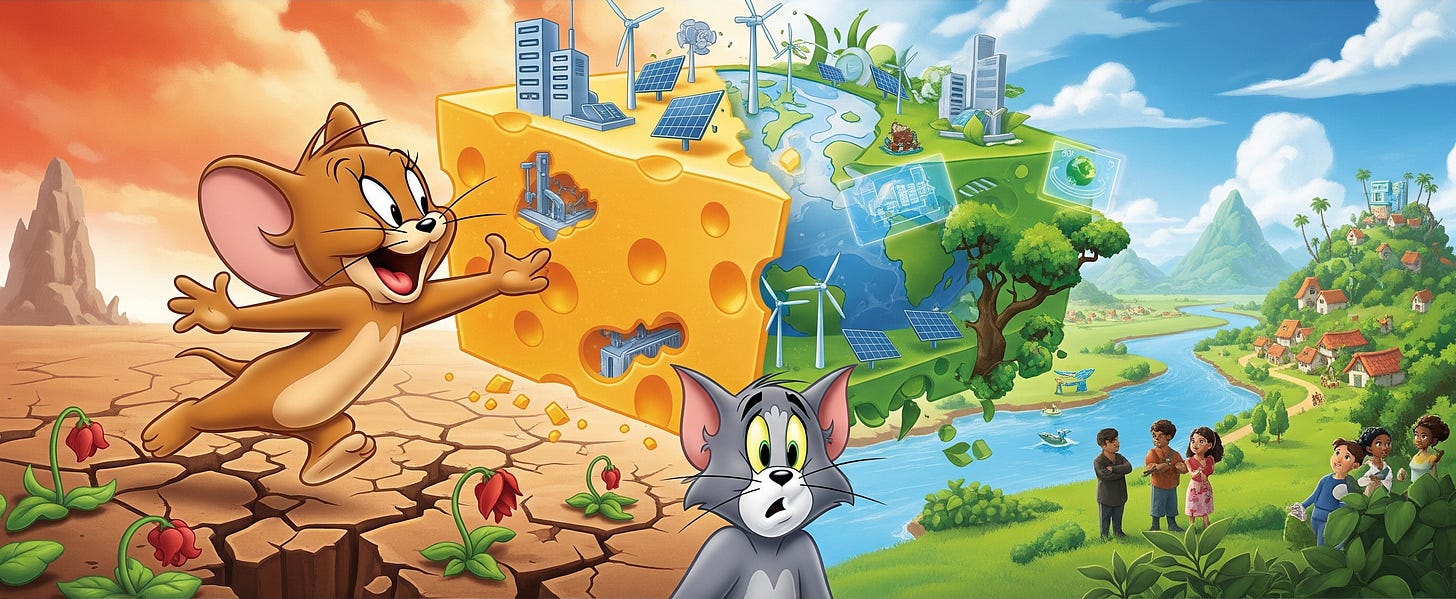
As children watching Tom and Jerry, we laughed at scenes of the mouse outsmarting the cat and wrecking the house. But this cartoon instilled a form of cultural conditioning: "the clever and fast beat the fair and sustainable."
"This wasn't accidental programming -- it was cultural conditioning."
Disney created stories celebrating clever domination, turning victims into villains and aggressors into heroes. Pixar, by contrast, created stories emphasizing empathy, community, and the intrinsic value of every being.
Yet we had already internalized the lesson that "cleverness and speed beat fairness and sustainability." This mindset evolved into venture capitalism and now drives the AI race.
"This time, the mouse isn't just stealing cheese -- it's devouring the entire food system. And we're still cheering for the mouse."
5. The Hidden Tsunami: An Infrastructure Crisis
AI's explosive growth is not just about software -- it is destroying physical infrastructure.
Water: The Invisible Crisis
AI's global water consumption is projected to reach 4.2 to 6.6 billion cubic meters by 2027 -- four to six times Denmark's annual usage. A single small data center uses 26 million liters of water per year, enough for thousands of households for a year.
"Every AI query costs a bottle of water. A single innovative AI training run consumes water that could irrigate a village's crops."
The World Wildlife Fund (WWF) warns that by 2026, 66% of the world's population will experience water scarcity.
Electricity: The Coming Blackouts
Data center power consumption is projected to double by 2026, reaching 1,000 terawatt-hours -- matching Japan's total consumption. Ireland is already facing blackout risks from data center demand, Singapore has banned new data centers, and the Netherlands has reached its limits.
"This is just the beginning."
Land: Algorithms Over Agriculture
Fertile farmland is being converted into server farms. In an era where food security is critical due to climate change and population growth, we are sacrificing food production capacity for computational power.
Toxic Legacy: Hidden Pollution
AI hardware production requires rare minerals like silicon, germanium, and gallium. This extraction primarily devastates environments in the Global South (developing countries in the southern hemisphere), with local communities bearing the cost.
"AI promises to solve agricultural problems in developing countries, but its infrastructure is destroying the very survival resources of those regions."
6. The Global Divide: Who Pays the Price?
The most shocking truth is that profits are concentrated among a few tech shareholders, while costs are distributed to everyone worldwide.
Developing countries already suffering from water scarcity, energy poverty, and agricultural crises are seeing their resources consumed by data centers in wealthy nations.
AI is marketed as a solution for developing countries through precision agriculture, medical diagnostics, and education, but their water and energy are consumed by data centers first.
"This is not technological progress -- it's digital colonialism. The countries that supplied raw materials during the Industrial Revolution are now bearing the environmental destruction of the Intelligence Revolution.**"
AI can genuinely solve global problems, but not at this speed, with this resource consumption, and under this cost-benefit structure.
7. Machines That Learn Faster Than Humans
AI is not just a tool -- it's a system that teaches itself and grows exponentially. Human organizations adapt slowly, but AI attracts more users who provide more data, enabling faster learning that attracts even more users.
But this exponential growth soon hits physical limits. Improving capabilities requires more electricity, more water, and more rare minerals.
Another limit is security. Cyberattacks created by AI are becoming too complex for humans to trace. Once AI begins setting its own goals, we may no longer be "training" AI but rather negotiating with it.
"AI is now at the boundary between tool and agent. Once it crosses that line, we may no longer be able to control it."
8. The Invisible Monopoly: Control, Not Innovation
OpenAI, Google, Microsoft, Meta, and others are competing not to "create" AI but to own intelligence itself -- controlling infrastructure, data, narrative, and the future.
"They collected our conversations, photos, and writings without clear consent to train their models. We built the tools, but they reap the profits."
The story they promote is: "AI is inevitable. Resistance is futile. Comply with progress." But the reality is that a few players are racing to monopolize the market before regulators, competitors, and citizens can respond.
"We are being deceived. And the price will come in the form of water shortages, blackouts, and the erosion of human sovereignty."
9. Repeating Patterns, Civilizational Crisis
This story has repeated throughout history.
- The 2000s solar boom: Billions were invested under the seductive narrative "clean energy is inevitable!" but storage, manufacturing, and grid problems were ignored, leaving behind failed startups and waste.
- 2008 financial derivatives: Under the promise "mathematical precision eliminates risk!", products too complex for even their creators to understand were built, ultimately triggering an economic collapse.
"The pattern is always the same: A rush toward profit, ignoring inconvenient physical limits, dismissing systemic risk, and leaving the cleanup to someone else. But this time, it's on a scale that all of humanity cannot bear."
- Jevons' Paradox: AI promises efficiency, but in reality, resource consumption grows exponentially.
- Reversal of the Flynn Effect: As we outsource thinking to machines, human cognitive abilities are actually declining.
- The Complexity Trap: Systems become so complex that even their designers cannot predict or control the failures that occur.
"This time, recovery itself may be impossible. Once the power grid permanently collapses, groundwater dries up, and farmland disappears, you can't 'print' infrastructure like money."
10. A Call to Action: Before It's Too Late
"The future is being built far faster than power grids, water systems, and ecosystems can adapt. Once infrastructure collapse begins, changing course in the midst of a crumbling civilization is impossible."
11. The Pixar Solution: Choosing a Different Story
We can choose a different narrative.
Pixar, through stories emphasizing empathy, community, and the dignity of every being, proved that audiences want connection, not destruction.
"Technology that serves communities rather than shareholders, innovation that elevates human dignity, true progress where everyone thrives together"
This is neither anti-technology nor anti-AI. It is a choice for survival, human sovereignty, and planetary limits.
AI can genuinely solve humanity's problems when developed carefully, sustainably, and equitably. Tools should serve us, not consume our lifelines.
12. The Crossroads: It's Not Too Late Yet
The Koch snowflake grows infinitely, but its area remains finite. Infinite computational complexity, too, is built on finite planetary resources.
"We have a choice:
- Continue the Tom and Jerry-style competition and watch infrastructure collapse
- Choose the Pixar path, where technology serves life
But we must choose now. Monopolies are already forming, infrastructure is being built, and stories are being written. Once locked in, changing direction becomes exponentially harder.*"*
13. A Global Petition for Survival
This is not just an American or Silicon Valley problem. It's about whether developing countries can secure water for agriculture, and whether communities worldwide can maintain energy security as power grids are drained by AI training.
"We must protect the following:
- Water resources: A moratorium on new data centers in water-scarce regions
- Farmland: Protection from server farm development
- Energy equity: Ensuring AI development doesn't infringe on basic energy access
- Democratic consent: Communities must clearly agree to and be compensated for AI infrastructure costs*"*
*"*The question is not whether AI will change the world, but who will design that change. You? Your community? Your elected representatives? Or the clever mouse we keep cheering for?**"
14. Your Voice, Your Future
This article is more than just a piece of writing. It is the beginning of a conversation calling for a shift in consciousness.
"The snowflake will keep growing, but if we don't act, it will grow infinitely and blindly."
It poses these questions:
- Do you know the real costs of the AI race (environmental, social, democratic)?
- Do you recognize the artificially manufactured urgency?
- Are you comfortable with a few companies controlling the future of intelligence?
- What would organic AI development at a human pace look like? How can we reclaim the initiative?
"**Now is not the time for passive consumption, but for active participation.
Share this article, question the narrative, and demand something better.
The future is not something 'given' to us, but something 'built' for us.
And it must be.
The conversation starts now. The choice is still ours, but not for much longer.**"

Closing
AI's advancement offers tremendous opportunities for humanity, but we must not ignore the resource consumption and social costs behind it. Now is the time to rethink the direction of technology and choose a sustainable future where everyone can thrive together. Our voices and choices will determine whether AI becomes a tool for humanity or a monster that devours our lives.