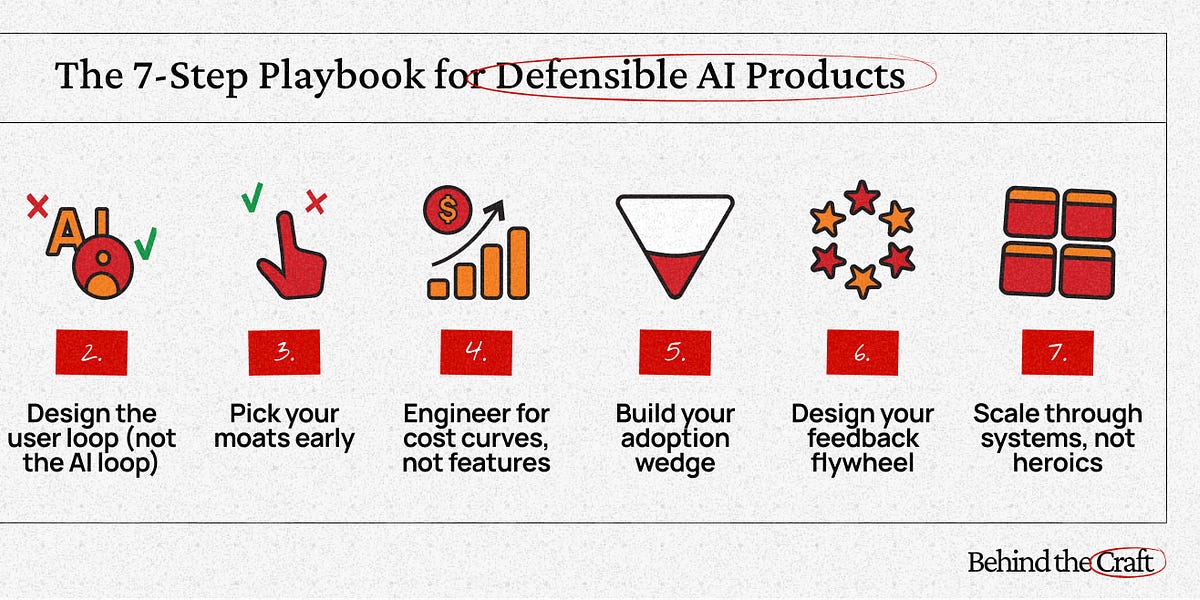
To survive in the AI era, product design with defensibility and sustainability is far more essential than "shipping fast." The 7-step strategy presented by OpenAI product leader Miqdad guides you toward building AI products that truly captivate users and accumulate competitive advantage -- going beyond mere features or impressive demos.
1. Clearly Define Your Competitive "Arena"
Many AI products disappear without competitive strength because they lack a clearly defined arena. Miqdad emphasizes that the most important first step is to definitively determine "Where, and against whom, are we truly competing?"
"The AI product graveyard is filled with cases of being copied, losing users, and burning through funds without any defensive walls."
Rather than targeting an overly broad market (e.g., "AI for Healthcare"), the starting point of defense is digging into a specific arena where highly frequent problems that genuinely cause users pain occur.
Three criteria for arena selection:
- High-frequency problem: Is it an urgent, frequently recurring problem within the user's daily/weekly routine?
- Data generation: Can usage experience accumulate to produce progressively better outcomes (data loop)?
- Adjacent expandability: Can the initial entry arena naturally expand to related customer problems later?
"If your arena definition is five words or fewer (e.g., 'AI for Marketing'), it's too broad. If you can't describe the specific audience, use case, and difficulty in one sentence, it's abstract."
Example: Clay
Clay built its defensive wall by solving the specific problem of relationship intelligence, rather than simply being "AI for sales."
"They solved a high-frequency pain point, and as data accumulated over time, their competitive advantage multiplied."
2. Design a "User Loop," Not an AI Loop
Many teams obsess over model performance, prompts, and evaluation metrics -- the AI engine -- but from the user's perspective, those details don't matter. What truly matters is the user loop: the flow where users go from "problem -> quick resolution -> behavior change -> habit formation -> a structure that's hard to leave."
"Users care about only one thing: has my life clearly become easier, faster, and better?"
By focusing on the "user loop" instead of the "AI loop," you can deeply embed your product within users' habits. And this habit becomes a powerful defensive wall.
Stages of the User Loop
- Pain: Moments of repeatedly experiencing inconvenience
- Resolution: The product solves the problem faster and more easily
- Behavior change: Repeated usage increases and default behavior shifts
- Habit: Product usage becomes daily routine
- Switching cost: Accumulated data/integrations/trust make it hard to leave
Example: Granola
Granola isn't just AI meeting notes:
"It automated the meeting organization and note-taking that professionals wasted hours on each week. As usage habits changed and meeting history accumulated over time, it became an irreplaceable system."
Practical Tips
- Focus on repeated utility rather than "elegant demos."
- Clearly show the "pain time" you've eliminated. e.g., "You saved 22 minutes this week."
- The shorter the cycle from pain to resolution (daily > weekly > monthly), the faster habit formation occurs.
- Check whether users don't just use it once and stop, but whether their behavior itself changes.
3. Design the Moat from Day One
"In AI, the speed at which features get copied is extremely fast. Anyone can copy a prompt template or substitute a better model."
A moat that competitors truly cannot replicate overnight must be considered from the very beginning of product design -- adding one retroactively is nearly impossible.
Three Core Moat Elements
- Data loop: Proprietary/structural data that accumulates as the service continues to be used
- Workflow integration: A structure deeply embedded in the user's core processes, not just a standalone feature
- Trust and governance: In regulated industries, "not surprising the regulators" is the real moat
Each of these elements:
- Differentiation accumulates the more users engage,
- Making it harder for competitors to follow the same path.
4. Engineer Around the "Cost Curve," Not Features
Rather than rapid feature additions, what matters is a structure where cost efficiency improves as you scale. In other words, usage and cost should not be proportional -- efficiency must increase over time to build true long-term competitiveness.
5. Create an "Adoption Wedge"
Don't try to capture the entire broad market at once. Start by penetrating the most desperate problem group that you can absolutely win, build trust, data, and success stories in this small arena, and then gradually expand to adjacent areas.
6. Design a Feedback Flywheel
Design the system so that usage experience naturally connects to a product improvement-data loop for sustained growth. The virtuous cycle of "feedback -> improvement -> more value delivered -> more feedback" is critical.
7. Scale with Systems, Not Heroes
Build your growth structure on repeatable, scalable systems and processes, not on a handful of star performers doing manual work.
In Closing
For AI products to differentiate and survive, the emphasis is not on new technology or feature additions but on obsessing over specific user pain, preempting a clear arena, and simultaneously designing user loops, data accumulation, feedback loops, and systematization within that flow. Remember: defensive walls must be built from the start, not added later!
"The most common mistake in AI is team leaders targeting too broad a market." "When users clearly feel their lives are better, that's when truly sticky habits and defensive walls are built."