This article argues that computing is shifting from smartphone apps toward AI agents. Agents will operate computers and apps for users and generate personalized apps on demand, weakening the role of existing apps. The central competition is not simply building a good model, but accessing context and data to become the single interface users turn to first.
1. The iPhone's Three Products, and a Question for AI
The article opens with Steve Jobs introducing the iPhone as three products: a widescreen iPod, a revolutionary phone, and a breakthrough internet communicator. He emphasized that they were one device, but the audience did not fully grasp the innovation implied by "internet communicator."
"These are not three separate devices. This is one device, and we are calling it iPhone. Today Apple is going to reinvent the phone."
The author sees a similar moment for AI. Chatbots may look like conversational search or writing assistants, but messaging, natural-language interfaces, computer use, and custom UI generation are not separate trends. They form one reality.
Borrowing Jobs's phrasing, he asks:
"Are you getting it? Messages, chatbots now and natural interfaces later, are how we will communicate with AI? That we will not only stop programming computers, but stop using them ourselves? Because AI will use them?"
Instead of operating apps and systems directly, people may state their desired outcome and have AI operate computers, websites, and apps. He calls this not a distant prediction, but something already beginning in 2026.
2. Messaging Became Central to Mobile, but Apps Persisted
Reflecting on a 2014 article, he recalls arguing that messaging was mobile's killer app. Smartphones made information and the web available anywhere, but constant connection with friends, family, and colleagues drove the longest and most frequent use.
"The home phone enabled real-time communication, and the web enabled asynchronous communication. Messaging enables perpetual communication. The conversation never ends; friends enter and leave with the flow of attention, not physical distance."
Meta's 2014 WhatsApp acquisition followed this trend. But he sees greater ambition in the earlier Facebook Home, which tried to center Android's lock and home screens on Facebook and combine SMS with Facebook Messenger.
Mark Zuckerberg said:
"Apps are not the center of the world. People are."
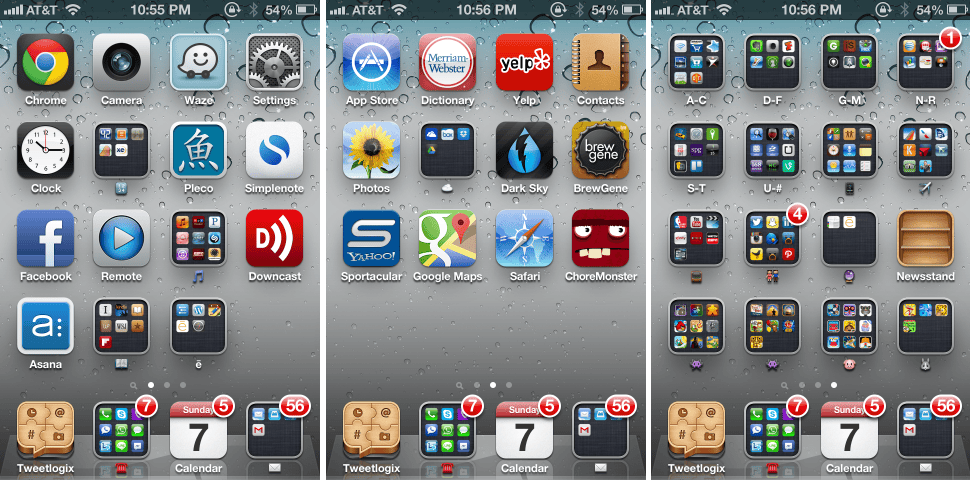
The author strongly disagreed. What matters on smartphones is not the single category "people," but the many Jobs to Be Done. His iPhone then had 151 apps serving around 80 distinct needs and tasks.
"Apps are not the center of the world. But neither are people. Smartphones dominate because they let more people do more things in more places than anything else in human history."
Facebook Home privileged Facebook's network over users' varied tasks. Users also wanted navigation, banking, photo editing, food ordering, documents, and games. Facebook had no right to bury these behind its home screen.
His phone now contains 689 apps, accumulated to meet various needs, though most are rarely opened. Core apps have changed surprisingly little: messaging, social media such as X, and now ChatGPT and Claude.
3. Agents Need Computers Too
A recent WhatsApp group conversation inspired him to make another app, illustrating the difference between agents and chatbots.
He already used coding agents, Claude threads tracking ideas, and specialized business agents. Meta's Muse interested him immediately because it provided not just a model but infrastructure for users to run their own agents.
His definition is clear:
An agent is not merely AI. It is AI with access to a computer.
AI does not replace the computer; it operates it for us. LLMs probabilistically predict the next word and struggle with exact calculation, file processing, and web operations. Given deterministic tools such as calculators, browsers, execution environments, and file systems, agents can combine language ability with computer precision.
He made the same observation in 2023 when ChatGPT gained tools such as Wolfram|Alpha through plugins:
"That this works shows what an AI assistant is and isn't. It isn't computing as we previously understood it. It is remarkably human in how it thinks and communicates. Frankly, I would have struggled with those three problems too. That's why computers exist. Now ChatGPT has its own computer."
For agents to be useful, users should not have to install and maintain servers or virtual machines. He therefore focuses less on Muse's model than on Meta providing US users with a virtual computer with two CPU cores, 8 GB of memory, and 8 GB of storage: an environment for actually doing work.
4. App Number 690: Organizing Instagram Recipes
After hearing that a friend used Muse to analyze Instagram favorites, he asked:
"Can you organize all the recipes I've saved on Instagram?"
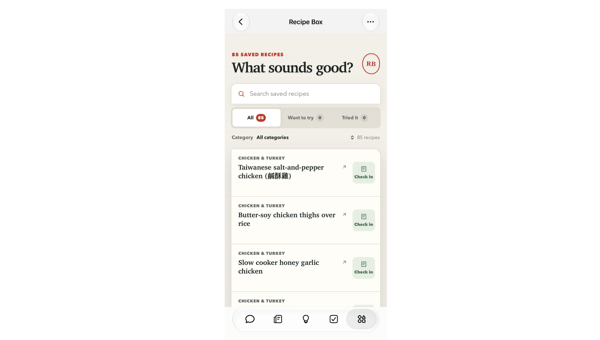
The first output was a PDF, which he found inconvenient for searching, categorizing, and managing. He requested something more accessible. In about five minutes while walking his dog, he had a personal recipe app.
The app categorizes and manages saved recipe videos. It remains rough: primarily sorting videos, with a further request to read captions and analyze video contents still in progress because of Instagram rate limits.
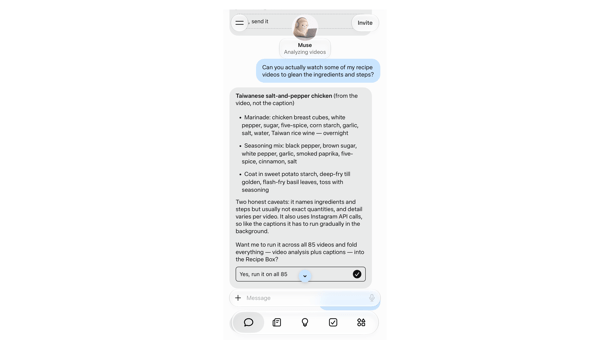
This is an early form of "infinite apps." The tool was not discovered in an app store. An agent created an interface for one person's needs. It need not be distributed and could disappear after solving one specific problem.
He thinks this may change app economics. Using services once required learning each app's features, screens, and settings. Apps were procedures for accomplishing tasks, rather than the tasks themselves. If AI understands and executes the goal, people need not learn app operation.
"I'm not a professional app user. I'm someone who just wants to get things done. And AI gets them done."
5. From Discovery to Inspiration
He sees personalized AI-generated UI already emerging. In 2024, he predicted on-demand UI presenting only choices relevant to a user's situation.
On a small smartwatch, for example, AI could understand context and offer only needed actions rather than requiring menu navigation. Today's apps offer the same screens to everyone; generated UI can fit one person at one particular moment.
The recipe app is not fully instantaneous, real-time UI, but moves in that direction. Built for one person, it can be changed or discarded; another need can produce another app. App creation loses its scarcity.
He compares this with publishing. Newspapers and magazines once required presses, distribution, and delivery, making publishing scarce. The internet reduced distribution costs nearly to zero, flooding the world with content. The central problem became discovery, not production.
Google and Meta solved discovery, aggregating demand and gaining power over publishers and media suppliers. This is his longstanding Aggregation Theory.
In the agent era, scarcity moves again:
- On the early web, finding information and content was difficult.
- In the app era, operating services to accomplish tasks was difficult.
- Agents operate apps and websites, making capabilities abundant.
- Inspiration, helping users imagine what they want and which problems are worth solving, becomes scarce.
Powerful companies may therefore help people discover worthwhile needs, not just search for known desires. Once a user gives an agent a goal, apps and services become invisible execution mechanisms. They risk becoming mere suppliers to the agent.
6. Meta and Microsoft's New Platform Ambitions
Microsoft is rebuilding Copilot as a super app combining chat, coding, and agents. A Code tab creates apps, dashboards, and automations; Autopilot keeps working while users sleep.
Autopilot resembles a personal assistant or digital colleague with its own cloud computer. It can monitor Teams channels, perform recurring tasks, and follow up. Designed for enterprise use, it integrates permissions, auditing, security policies, and organizational information.
A Microsoft executive explains:
"Autopilot runs inside the customer's tenant with its own identity, memory, computer, and workspace. Powered by Microsoft IQ, it understands how the organization actually works. People can @mention it like a colleague where they already work, in Teams, Outlook, chats, channels, and documents, with permissions, auditing, and governance behind it."
He sees this as the latest version of Microsoft's strategy to become the operating system for work. Windows was the PC interface; Teams sought to become the SaaS workplace hub; Copilot seeks the workplace interface for agents.
Muse has similar ambitions. Meta's glasses and other devices become ways to deliver Muse into daily life, beyond merely AR, VR, or AI glasses. Muse operates computers, generates interfaces, and works in the user's absence.
He summarizes their intended destination:
"Be the only interface for everything you need: use computers on your behalf, make the UI you need when you want it, and spend the rest of the time working for you without you there."
This exceeds a conventional operating system or social platform. It is a platform, a gateway aggregating demand, and a personal agent deeply understanding goals, desires, and data.
7. Distribution, More Than Agent Performance, Will Decide the Contest
This future may seem obvious to experienced agent users, but many people do not yet use agents actively. The question is whether they will adopt the new interface.
He believes they will. People use apps to accomplish things or find enjoyment, not for apps themselves. Once they can ask AI directly for outcomes, finding, installing, and learning many apps may feel strange. Complex, unfriendly enterprise interfaces may be displaced especially quickly.
"People don't want apps for their own sake. Apps are means to accomplish something or have fun. Once people realize they can go straight to the job to be done, the old way will seem strange."
This threatens SaaS companies. He mentions Salesforce seeking substantial extra fees to connect core functionality as a Claude plugin. But if an agent can operate the computer directly, a user may never need to open Salesforce's complex UI again. Existing interfaces lose value.
The fiercest contest may be becoming the one agent a user talks to daily. Models may be relatively interchangeable, but agents improve through access to files, logins, workflows, conversations, preferences, and context. Deeply integrated agents become hard to replace.
He expects most individuals and companies to center on one primary agent, rather than several. Companies with broad distribution and routine contact have an advantage:
- Meta reaches most people through WhatsApp, Instagram, and Facebook.
- Microsoft is embedded in employees' work through Windows, Office, Teams, and enterprise identities.
Existing user bases and distribution may spread agents faster than expected, alongside technical advances. That is why Jobs's "Are you getting it?" is relevant again.
8. Closing
The conclusion is not necessarily that apps disappear, but that they lose their status as the direct user interface. People state goals to agents and receive outcomes, while apps and websites become tools operating behind the scenes.
Winners will include not just makers of the best individual models, but companies building agent platforms most deeply connected to life and work, most broadly distributed, and able to provide both inspiration and execution.