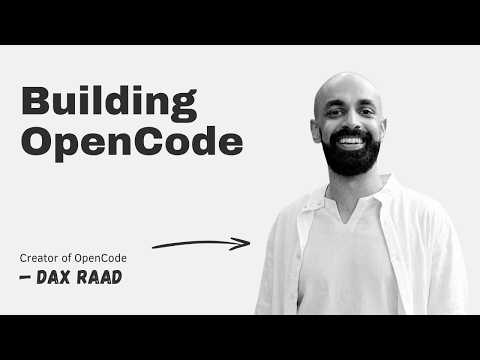
This video features an interview with Dax Raad, co-founder of OpenCode, a fast-growing AI development tool. Dax discusses the background behind OpenCode's creation, the advantages of open source, and why taste and engineering judgment become even more important in an era where AI sits at the center of software development. He also offers deep insights into how OpenCode turned Anthropic's integration block into a growth engine, why GPU demand is creating bottlenecks, and why AI coding tools do not automatically increase development speed. Dax is an interesting figure who has built a successful AI tool while maintaining a healthy skepticism toward the potential of AI technology.
1. Dax Raad's Skepticism About Developer Productivity in the AI Era
As co-founder of OpenCode, Dax Raad emphasizes that AI engineering tools help people write code faster and accelerate software development, but that alone does not produce better software.
While building OpenCode, he was confident the product was useful because the team used it directly. Even so, he says they still face many difficulties in the development process.
"Objectively, work has become easier, so why am I still thinking just as hard as before?"
Executives often assume that because coding used to take so much time, introducing AI tools will make everything faster. Dax explains that reality is different.
2. The Product-Launch Dilemma: Too Many Features, Too Many Hacks
Dax talks about the core challenge facing a startup that has achieved product-market fit. There are too many possible directions to move in, and the team constantly feels pressure to add new features from user requests, competitor features, and their own ideas. But adding features to satisfy all of these demands does not always lead to a good result.
"If a user has a problem, you tell the agent. If a competitor has a feature, you tell the agent. If a user has a problem, you tell the agent. Add all of that up and you might think, 'Oh, we shipped a thousand features, so now we have a good product.' In reality, you get a terrible product."
Adding a new feature is easy, but once it ships, it has to be supported forever, and it affects future feature development too. Dax points out that being able to ship ten times more features does not mean the team has ten times more good ideas. If anything, he says, the speed itself is causing mistakes.
He says he is now wrestling with the question, "How do we slow everyone down?" OpenCode has operated in a very different way over the past six months, and that has created many problems. The team is now reevaluating which older ways of working are still valid.
3. Dax's Background: From Minecraft to Startups
Dax has a classic developer origin story: he enjoyed programming from a young age. Because his father was a software engineer, he was able to encounter coding easily, and after graduating from high school he went straight into founding startups.
Working on Minecraft servers played an especially important role in Dax's growth. He says he was less interested in the game itself than in using mods to create interesting sandboxes and observing how people behaved in specific scenarios. He learned a great deal from experienced developers he met in IRC channels, and that experience helped him improve his programming ability dramatically in a short period of time.
Dax later gained engineering leadership experience across several startups. When he led engineering at Right Health, most of the team members were in their early twenties. Through that experience, he came to believe that startups succeeding at a young age are exceptional cases, and that when people are immature, emotional factors can have a major impact on how the company operates.
"A startup is a very intimate relationship. It is just you and a few people, and it is very intense. If you are not a fully developed person yet, if you are trying to prove something to the world or are still insecure about something, all of that shows up at work."
4. Moving Into the Open Source Ecosystem: SST and OpenNext
After his experience at Right Health, Dax was working in management but still felt a strong desire to program. That led him to open source projects. He began contributing to a newly released project called SST, which pulled him more deeply into the open source community.
The SST team later achieved major success through a project called OpenNext. OpenNext was a tool for developers who were struggling to deploy Next.js applications on AWS. The team had not originally planned to build it, but strong user demand pushed them in that direction. While the Next.js team focused on Vercel, OpenNext filled what Dax describes as a "weird gap." He explains that although the project also "bothered" Vercel, support from other cloud providers such as Cloudflare and Netlify helped advance the broader Next.js ecosystem.
"OpenNext was probably what made us explode early on. It wasn't something we wanted to build."
5. The Birth and Explosive Growth of OpenCode
OpenCode was born in February 2025, when the company was going through a financially difficult period. The team was searching for a new direction and turned its attention to AI.
"We knew AI was the thing to work on this decade, especially if you were working in developer tools. We had seen waves before. When something happens, a lot of investment always comes in, and most of that investment usually does not make sense."
The team initially tried several AI ideas, but one tool, Anthropic's Claude Code, helped solve real workflow problems for them. With the question "Why didn't we build this?" and drawing on their open source experience, the OpenCode team decided to open up the open source space in the AI coding-agent market.
That strategy worked. They believed every developer tool eventually needs a default open source option, and that a neutral open source solution would be valuable in a market where model providers were competing fiercely. That judgment proved correct.
After launching in June 2025, OpenCode grew explosively.
- December 2025: 650,000 monthly active users
- January 2026: 2.5 million monthly active users
- April 2026: 6.5 million monthly active users
- May 2026: 8 million monthly active users
Dax says the sharp growth in January 2026 was partly because people tend to learn and try new technologies during the December holiday period, and partly thanks to Anthropic's "help."
6. Anthropic's Block Became OpenCode's Opportunity
In January 2026, Anthropic blocked the use of Claude Code subscriptions inside OpenCode. Anthropic tried to do this quietly, but the developer community reacted strongly, and the incident unexpectedly became a growth opportunity for OpenCode.
Dax says Anthropic handled developer communication poorly. Rather than a sudden block, he argues, it should have communicated gradually.
"Dropping a block suddenly at 9 p.m. only makes people hate you. If they had rolled it out with communication over a month, everyone would still have been angry, of course, but there would not have been this concentrated moment where everyone was angry at the same time."
When the news broke, Dax immediately contacted OpenAI and argued that if OpenAI took the opposite stance from Anthropic and officially supported OpenCode, it would create a strong PR opportunity. OpenAI accepted, and OpenCode announced OpenAI model integration within a day.
This incident showed OpenCode that a strategy of "pointing to one temporary villain, rallying that company's competitors, and pushing something forward against them" could be effective.
"We did not predict this exact scenario, but our fundamental understanding of our positioning was right. If there is a neutral party, every company with billions of dollars will use that neutral party to advance its own interests. So being in the middle is advantageous."
7. Why OpenCode Worked: A B2C Mindset and an Irrational Pursuit of Quality
Dax identifies thinking about developer tools like B2C products as one of OpenCode's key strengths. Most developer-tool builders are not used to B2C products, but OpenCode focused on giving users a different experience from the first moment they encountered the product.
In particular, building its own terminal rendering framework was an "irrational" decision made to deliver that different experience. While other coding agents used existing frameworks, OpenCode invested early in a high-quality terminal experience that would make users feel the product was capable.
"The biggest advantage in DevTools is that everyone who works in DevTools is a programmer. And programmers are terrible at B2C products. They do not realize DevTools is a B2C product."
"We focused on making OpenCode feel very different and better the moment you opened it."
"Building our own terminal framework was irrational. But we did it. We knew we could not get the experience we wanted through the existing approaches."
Dax says OpenCode's early harness was not outstanding, but the team gained market share by focusing on optimizing the user experience and reducing friction. For example, they concentrated on making OpenCode usable for people on corporate laptops. After securing a sufficient user base, they are now focusing on improving the harness itself.
8. OpenCode's Business Model: Profitable Inference and Enterprise Solutions
OpenCode currently generates revenue through two main business lines.
-
OpenCode Zen, an inference service: It was initially built to make user onboarding smoother, but it grew quickly into a major revenue source. Users had difficulty connecting their own Anthropic or OpenAI accounts and securing enough rate limits, so OpenCode Zen provides access to all models.
- Noting that open source models are especially hard to host well, OpenCode Zen provides optimized inference for open source models.
- Dax says OpenCode Zen reached $50 million in annual revenue within five to six months of launch, and because open source models have good margins, the service is highly profitable.
-
An enterprise control plane: This is management software for companies using OpenCode at scale. In a company where 1,000 engineers use OpenCode, each engineer should not have to configure API keys individually. A central control plane is needed to manage providers, permissions, budgets, rate limits, and more.
- It is currently provided as a custom enterprise solution, but it will soon be made publicly available.
- Dax explains that as companies increasingly optimize language-model costs, open source models become a highly competitive alternative. OpenCode provides these companies with a control plane plus access to open source model inference, naturally encouraging usage.
Dax says that if inference becomes the main long-term revenue source, the control plane itself might eventually be offered for free. He also emphasizes that the inference business is highly profitable, comparing it to how cloud services were extremely profitable in the past but that fact was kept quiet.
9. GPU Bottlenecks and Overheated AI Investment
Dax points out that GPU supply is extremely tight right now. The entire supply chain, from GPU production to supporting hardware and labor, cannot keep up with demand.
"Across the entire GPU stack, from GPU production to supporting hardware to people, everything is very tight right now. Inference demand is increasing. I think it may not be increasing linearly, but exponentially. GPU production, however, does not grow exponentially. It is a linear process."
Because of this GPU shortage, companies like OpenCode have to pay large amounts upfront to secure the GPUs they need, and everyone is stockpiling inventory because they expect the bottleneck to continue.
Dax also warns that investment in AI is overheated. It is already extraordinary for a startup to raise $2 billion, but big tech companies like Amazon and Meta are spending tens of billions of dollars a year and absorbing all GPU demand.
"It dwarfs everything happening in the startup space. They are sucking up all the demand. Every company in the supply chain does not want to talk to you, because they are busy trying to do something with Amazon, Microsoft, or Google."
10. The AI Productivity Debate: Happier Engineers, But Not Faster Teams
Dax takes a critical view of the social hype around how much AI tools increase engineering productivity. Referring to one of his tweets, he says many people claim their teams have reached peak efficiency and are bottlenecked only by code production capacity, but the real situation is different.
"Everyone says their team has reached peak efficiency and is bottlenecked only by code production. But the actual picture is this: your organization has good ideas. People now use AI to become ten times more productive. They use less energy to complete the work."
He explains that most software engineering environments are not "motivating and interesting environments." Many people simply try to do the work assigned to them and go home to their families. In that context, if AI tools let them finish work faster, they will use the extra time to improve work-life balance. That is perfectly rational behavior, but from the company's point of view it may not translate into higher productivity.
"There is a world where the net result of these AI coding tools is that the same amount of work gets done, but every engineer is happier because their work is easier. That is not enough for many companies."
Dax argues that because AI makes code generation easy, pressure on quality is increasing. In the past, a small number of "irrationally motivated" engineers who cared about code quality could hold up the quality of the entire team. Now they are being overwhelmed by hack-filled pull requests generated by AI and are burning out.
He argues that companies need to rethink engineer motivation and compensation. Startups like OpenCode have an easier time motivating people because they work in an exciting field, attract competitive talent, and give everyone equity that lets them contribute to the company's success. Dax says it may be more effective to pay a small number of talented people well than to hire 1,000 people unnecessarily.
11. OpenCode's Internal Reflection: Dax's Memo
In a memo to the OpenCode team, Dax identified three major challenges the team is currently facing.
- They are shipping features that are not worth shipping.
- When iterating on features, the original design is often wrong, so the team resorts to hacks, but LLMs do not handle those hacks well.
- They need to spend more time cleaning up.
Dax explains that AI technology accelerates these problems. Because AI agents make code generation so easy, developers overuse temporary hacks instead of reconsidering or refactoring the system from a long-term perspective.
"The worst part is that none of this is so that we can move faster. We are moving at normal speed."
He says AI agents do not recognize a hack as a hack. They simply generate code according to their training data, so developers no longer feel the discomfort or guilt they used to feel when creating hacks themselves. That distorts the feedback loop and can degrade the quality of the codebase over the long run. He compares it to a CEO assigning work to employees without understanding the pain on the ground.
Dax feels the startup pressure to "move fast," but he stresses that from a long-term perspective, investing in cleaning up and improving the codebase is important. He says AI has made it much easier than before to pay down technical debt. Teams can use AI agents to apply new patterns across a codebase or remove old code.
12. Dax's Skepticism Toward Predictions
Dax expresses strong skepticism toward the future predictions flooding social media. In particular, he criticizes predictions such as "engineers aged 24 to 29 will soon become the most valuable people in tech," saying that most such predictions are just defense mechanisms where people confidently describe a future in which they are the winners.
"Everyone is just casting spells on themselves. The defense mechanism is confidently asserting a future in which you are the winner. Almost every prediction you see is like that."
"People always say companies like mine will succeed and other companies will fail. My job will not be replaced by AI, but everyone else's job will be."
He points out that we are living through a period of enormous change, and everyone is anxious about their position. Dax says he focuses less on prediction and more on what he can do today and what he can do tomorrow. He did not know a year ago that he would build OpenCode, and he honestly says he does not know what he will be doing a year from now.
13. OpenCode's Engineering Culture and Taste
OpenCode now has more than 20 team members and is growing quickly, with the usual early growing pains. Dax says that as an open source company, OpenCode tries to build in public as much as possible. The team receives user feedback directly and uses it to decide the roadmap.
He emphasizes that it is important to help team members work with motivation and enjoyment. OpenCode is a long-term game, so the company gives people autonomy so they can immerse themselves in interesting work every day.
"What do you think the biggest problem is, and what is hurting us the most? They will take that and work on it. If we are good at giving them the right context about what is happening, they will make roughly good judgments."
Dax also stresses the importance of taste and quality. No matter how far AI advances, taste remains a uniquely human domain, and it is essential for building good products. He asks, "Do you actually want to build a good product?" and criticizes the tendency for many people to settle for short-term success and neglect quality.
"Ultimately, this is a good idea, and it is reasonable. Good ideas are simple, so everyone repeats the idea, but even though good ideas are simple, actually practicing them is very hard."
"A lot of people say the code does not need to be good, the product does not need to be good. Nothing needs to be good. It is just different, and it can still succeed."
Dax believes that commitment to quality may not look like a rational business decision, but over the long run it has a major impact on company culture and talent attraction. He explains that OpenCode's early success against giant competitors like Claude Code came from focusing on irrational quality: the excellence of the terminal experience.
"We focused irrationally on quality problems. That allowed us to fight a much larger product company."
14. Changing Engineering Leadership and Advice
Dax diagnoses that the role of engineers is changing in the AI era. The important work is no longer only writing code, but also setting up guardrails that allow code to be shipped safely, prevent errors, and maintain the quality of the codebase. He explains that this is essentially the same problem as helping junior engineers deploy code safely.
"What is the role of an engineer now? If you are not writing code, what do you do? Your role is probably to figure out how to make code easy to ship, meaning how to ship code safely."
Interestingly, because AI agents are "idiots" that can generate enormous amounts of code around the clock, strict enterprise patterns that used to be dismissed as boring and complex, such as domain-driven design, are becoming useful again. AI agents follow these formalized patterns well, so they help strengthen guardrails.
Dax advises experienced engineers to become experts in a specific industry. If software engineering ability is combined with deep understanding of a particular industry, someone can become one of the top ten people in that field. Because software engineers, unlike many other professionals, have the flexibility to experience many industries and become experts in them, he urges them to use that opportunity actively.
"Software engineering is a skill that can be applied to industries. You can be a great software engineer, and that alone is good enough. But if you become an expert in a specific industry, that is a deadly combination."
15. Book Recommendation: Nassim Nicholas Taleb's Skin in the Game
Dax frankly admits that he does not read a great deal, and that he often gets good ideas from his wife's reading list instead. Still, he names Nassim Nicholas Taleb's books as works he read in the past and still considers important.
In particular, he mentions Skin in the Game and The Black Swan, saying Taleb's books helped him understand the idea of emergent properties.
"Almost every great thing in the world was not designed top-down. It emerged from countless small entities working together randomly."
He says that understanding top-down design and bottom-up systems helps explain many things in the world, from robust software to livable cities to organisms that resist disease.
Closing
The conversation with Dax Raad clearly shows that software development in the AI era is more complex than simply increasing coding speed. He speaks candidly about the strategic thinking behind OpenCode's remarkable success, its user-centered approach, and its irrational insistence on quality. His insight that AI reduces the manual labor of coding while making human judgment and responsibility even more important is especially striking. Rather than being intoxicated by the fantasy that AI can make everything fast and chasing only short-term gains, the conversation reminds us that investing in quality and people from a long-term perspective is the real path to success.