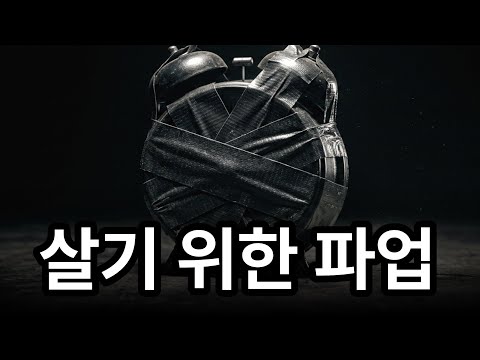
We tend to think of burnout as nothing more than physical fatigue, but this video argues that burnout is not simply a phenomenon caused by working too much. Drawing on the perspectives of psychologist Freudenberger and philosophers Byung-Chul Han, Hegel, and Kant, it digs into the true nature of burnout, explaining how a complex web of factors — the brain's reward prediction error, the desire for recognition from others, and conditional self-esteem — contribute to it. Ultimately, the video emphasizes that burnout is a survival strike that arises from the failure of how we treat ourselves as instruments, and it argues that we need a shift in perception: respecting ourselves by separating our value as beings from our performance.
1. Burnout: The Phenomenon That Strikes the Most Passionate First 😔
The narrator of this video frankly confesses that he himself is experiencing burnout. He spent months without rest, repeating the same cycle every single day — agonizing over video topics, revising scripts, recording, and editing — but the result was a disappointing 4 comments and 300 views. We usually think of burnout as fatigue caused simply by working too much, but psychologist Freudenberger overturns this belief. Burnout, he says, is by no means a simple phenomenon like a drained battery.
In 1974, at a free clinic in New York, Freudenberger noticed a peculiar phenomenon among the volunteers. People tend to assume that it is the lazy or irresponsible who will wear out and collapse. But the reality he witnessed was the exact opposite. The first to burn black and fall into helplessness were none other than the most passionate people.
"The first to burn black and fall into helplessness were the most passionate people."
Freudenberger was the first to give this strange syndrome the name "Burnout." In other words, burnout is not simply a depletion of physical stamina, but clear evidence that the way you treat yourself has completely failed, he says. 😥
2. Byung-Chul Han's "Burnout Society" and the Yoke of Voluntary Self-Exploitation ⛓️
Regarding this burnout phenomenon, philosopher Byung-Chul Han offers a chilling insight. He argues that modern society is a "Burnout Society." In the past, masters lashed out at slaves, and factories at workers — "You must do this!" — and people suffered under external oppression. But the situation is different now. We live within an atmosphere of infinite positivity: "You can do it! You can become a better version of yourself!"
Why is this chilling? Precisely because the one holding the whip and the one being whipped are one and the same self. There is nowhere to run. So we don't know how to stop until we have burned out completely and turned to ash. Picture yourself lying in bed on a Sunday afternoon, supposedly resting, yet endlessly anxious. This, he says, is the very scene of voluntary self-exploitation. 😟
At this point, a sharp objection might arise: "Isn't it just that people these days are mentally weak?" But from the perspective of neuroscience, this is explained as a perfectly rational outcome produced by the brain's "reward prediction error" system.
3. What Neuroscience Says About Burnout: Reward Prediction Error and the Survival Strike 🧠
When the human brain invests painful effort, it always predicts a commensurate reward. In the past, the relationship between effort and reward was relatively clear — you went out to hunt and either got food or went hungry. But what about our labor now? Work has no end, and even if you grind your bones to dust in front of a monitor, there is no guarantee tomorrow will be safe.
At this point, our brain does a cold calculation: that the predicted reward and reality are seriously misaligned. When you pour out 100 units of energy but the meaning or reward that returns is only 10, and this repeats, what does our brain do? To survive, it simply flips off the switch for motivation.
"This is a game whose math doesn't add up. Stop wasting energy."
The brain halts the secretion of dopamine, rendering us helpless. In other words, burnout is not an illness born of weak willpower. It is a fierce survival strike staged by the brain — to save you, who keep pouring water into a bottomless jar. 🚨
4. Hegel's Recognition by Others and Conditional Self-Esteem 💔
Here a reasonable doubt may arise. If the brain went on strike because there was no reward, then can't you just stop working and stop expecting any reward? Sadly, no. This is because we have mistaken that misaligned reward, the one neuroscience spoke of, for nothing more than money or physical rest.
According to philosopher Hegel, the reward that humans ultimately seek to obtain — even at the cost of enduring terrible pain — is recognition from others. We want to be acknowledged by society as "my effort is useful." We seek to confirm the value of our existence through the gaze of others.
But modern society exchanges that recognition only for performance. Things like view counts, salaries, and evaluation sheets. And here a horrifying inversion of means and ends takes place. The work we began in order to be recognized in our existence somehow degenerates into fear — the fear that "if you fail to prove your usefulness, you will be discarded."
"Without performance, I as a human have no value either."
We treat ourselves as nothing but machines stamping out output, and this formula has been etched into our brains. In psychology, this cruel formula is called conditional self-esteem. This is the real reason we cannot rest even while resting, and tremble with anxiety even while at play. 😥
The narrator looks back again on his own experience. Those devoted volunteers of 1974 did not burn out because they ran short of energy. It was because the grand illusion — "my devotion will change the world, and through it my own value will be proven" — collapsed. The narrator, too, says that if his videos had reached many people and gained meaning in proportion to his anguish, he would have gone on agonizing over the next topic even with an exhausted body. But the world did not grant him the recognition he wanted in time, and he whipped himself onward while ignoring the pain and helplessness that came from this asymmetry.
5. Kant's Advice: Treat Humans as Ends, Not Means ✨
So what should we do? Philosopher Kant said, "Treat humans as ends, not as means." When a dear friend has fallen into burnout, we don't immediately demand that they get up and produce results. We simply let them rest, and we respect the very existence of that person who is doing nothing. This is precisely the attitude of treating a human as an end.
But we never once allow ourselves that obvious respect. When we face our own helplessness, the first emotion we feel is not compassion but impatience and self-loathing. We blame ourselves for wasting time even while resting, and we drive ourselves into a corner, calling ourselves incompetent for failing to produce something. This is evidence that we have treated ourselves not as a subject to be cared for, but as a tool for extracting output.
6. The Shift in Perception: Separating Usefulness from Existence 💡
In the end, only a shift in perception — separating my usefulness from my existence and respecting myself entirely — can break this cruel cycle. This realization does not mean the castration of desire. It is a firm declaration that you will fight fiercely for the view counts, but that you will not surrender your very soul to the result.
"We were not born as parts meant to be used by the world. Even if we fail to produce results, the value of our existence is not diminished by even a single gram."
Tonight, quietly ask yourself: "A broken machine that has stopped working deserves to be thrown away — so then, for today, a day in which you proved nothing, will you repent of your very existence as a being?" 😢
In Closing 🌱
The narrator says he is going to try to stop, for a while, using himself as a tool. For this one week, he resolves not to write a script meant to prove his usefulness, and not to return carrying a scorecard. In the same way, instead of being bound to performance and burning ourselves out, we must escape the yoke of burnout with an attitude that respects existence itself. After all, every one of us is precious, regardless of performance. 😊