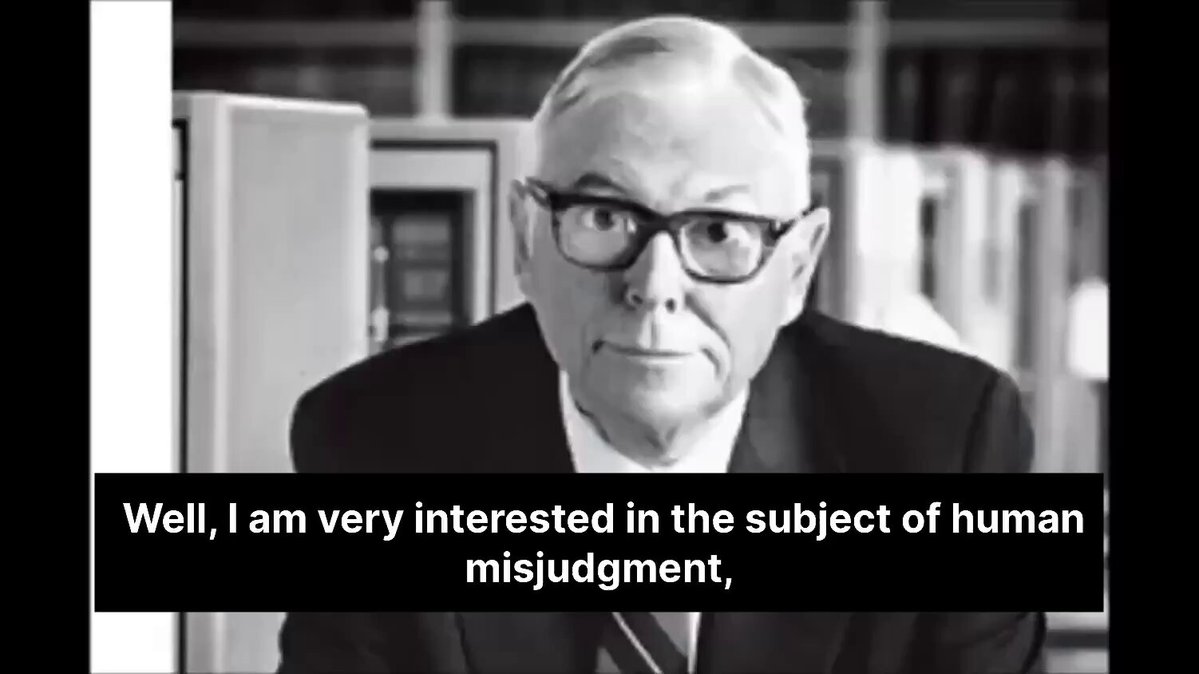
This summary covers 19 psychological insights from Charlie Munger's 50 years of research into why smart people sometimes make fatally foolish decisions. Munger explored in depth how various factors such as incentive strength, psychological denial, consistency and confidence bias, and authority bias influence human behavior and decision-making. In particular, he emphasizes that the Lollapalooza effect, in which multiple psychological tendencies act simultaneously, creates the most dangerous situation, and emphasizes that understanding and overcoming these psychological traps is the key to wise decision-making.
1. The power of incentives is stronger than expected ✨
Charlie Munger boasted that he was in the top 5% of his life when it came to understanding the power of incentives, but he still confessed that he underestimated its impact every year. This means that incentives influence behavior much more powerfully than we think.
Charlie Munger said, "I've been in the top 5% of my age cohort my whole life when it comes to understanding the power of incentives, and yet I still underestimate its impact every year."
For example, FedEx suffered from inefficiencies in its night shift. Because employees were paid hourly, work dragged on. However, as soon as we changed the wage payment method to pay per shift instead of hourly, the problem was immediately solved. It's an amazing example of how just one incentive can completely change people's behavior.
2. Bias due to incentives: The mask of rationalization 🎭
When incentives point in a certain direction, people tend to rationalize terrible behavior without even realizing it. A Nebraska doctor has been removing gallbladders from healthy people for years. When Munger asked his former colleague whether he knew the doctor was harming his patients, the answer he got was surprising.
"The doctor truly believed that the gallbladder was the root of all disease, and he thought removing it was an act of love."
In this way, incentive-induced bias can manifest itself in an extreme form, resulting in a scary phenomenon where people act irrationally for their own benefit but firmly believe that it is right.
3. Psychological denial: Ignoring painful reality 💔
Psychological denial doesn't only apply to weak people. A family friend of Munger's never returned from his son's crash from an aircraft carrier in the North Atlantic. But even though she was a perfectly sane woman, she never believed that her son was dead. Because reality was too painful, she distorted it to a degree she could bear. Munger says we all engage in this psychological denial to some degree, and that it causes terrible problems.
4. Consistency and Confidence Bias: Once you decide, stick with it! 🛣️
Consistency and Confidence Bias is one of the most powerful forces in the human mind. Once you publicly state a position, you become psychologically trapped in that position. Max Planck said that really important new physics was never accepted by established scholars. It wasn't until new scholars came along that it was finally accepted, because their brains weren't locked up in previous conclusions.
Charlie Munger emphasizes, "If this happens to the greats of physics, imagine what happens to ordinary people."
5. China's brainwashing system and gradual confidence 🧠
China's prisoner indoctrination system is said to be more effective than torture. They didn't make big demands from the beginning. Instead, he manipulated people into making very small, insignificant promises and declarations, and slowly built up from there. Mechanisms like this operate in every cult religion, every sales system, and every ideology that gets ingrained into people's heads. This is a chilling example of how consistency and certainty bias builds gradually.
6. Pavlovian associations: unconscious buying behavior 🛒
Pavlovian associations shape buying behavior at a level that most people do not consciously process. Munger estimates that three-quarters of all advertising operates purely through the Pavlovian effect. Coca-Cola doesn't want to be associated with funerals. They want to be associated with the Olympics, great music and heroic images. These associations themselves change the way people feel about the product at a subconscious level. Sometimes raising the price of a product can actually increase market share because price and quality are linked in people's minds and price acts as a signal of value.
7. Persian Messenger Syndrome: Bad news is taboo! 🤫
Persian Messenger Syndrome is alive and well in every major organization. The Persians killed the messenger who brought bad news. In his last 20 years, Bill Paley never heard anything he didn't want to hear. Because everyone around him knew that bringing bad news was dangerous. As a result, one of the most powerful figures in media has made some terrible decisions over the course of two decades. Because reality didn't reach him. This shows how distorted communication within an organization can have fatal consequences.
8. Social proof: Smart people who get caught up in the crowd 🐑
Social Proof causes even smart people to follow each other off a cliff. When one oil company acquired a fertilizer company in the 1970s, nearly every other major oil company rushed to do the same. There was no rational reason for an oil company to own a fertilizer company. But for Exxon to do that, it was a good enough reason for Mobil. Ultimately, all acquisitions ended in disaster.
9. Persistence of inefficient market theory 📉
Efficient markets theory has persisted in academia for decades, even with Berkshire Hathaway as a living counterexample. One economist kept adding sigma (standard deviation) to account for this anomaly. 2 Sigma, 3 Sigma, 4 Sigma, and eventually 6 Sigma.
Charlie Munger sarcastically said, "It is better to add sigma rather than change the theory just because the evidence comes out differently."
The economist later went into the money management business himself and sank like a stone. This is an example of how strong confidence bias and cognitive dissonance can be when it comes to existing theories.
10. Contrast Bias: An Invisible Perceptual Distortion 🕵️♀️
Contrast bias constantly and invisibly distorts our perception. If you put your hand in hot water and then put it in room temperature water, it feels cold. If you put your hand in cold water and then put it in room temperature water, it feels hot. Even though it's the same water! The human sense organs have no absolute scale, only contrast scales. Real estate agents use this intentionally. First you show two expensive, crappy houses, and then you show them just an expensive house, and you make that house feel cheap.
11. Frog in slowly boiling water: The dangers of gradual change 🐸
A frog in slowly boiling water is the business version of contrast bias. When bad things come in small chunks, it can be easy to miss them entirely. Munger says he has seen many talented and smart businessmen ruined in this way. It's not that they're stupid, it's that each incremental change is too small to be enough to set off an alarm. The contrast wasn't great enough so I didn't notice it.
12. Authority bias: Even experts suffer from it with their eyes open ✈️
Authority Bias is so powerful that it can cause even trained professionals to watch a plane crash. In flight simulator experiments, when the captain, an authority figure, does something that any trained first officer would know will cause the plane to crash, there is a 25% chance that the first officer will just sit back and let the plane crash. Even though they are trained to know better. Authority relationships trump training.
13. Deprivation hyperreactivity syndrome: psychological explosion even at small losses 💥
Deprivation Overreaction Syndrome explains why people go crazy over small losses. Munger's neighbor had a spectacular 180-degree view of the harbor. However, my next door neighbor planted a pine tree about 90cm tall, creating a view of 179.75 degrees. This small change caused bloody strife for several years. The New Coke debacle is the corporate version of this. When Coca-Cola told customers it was changing its flavor, the deprivation response was so strong that Pepsi came close to putting Old Coke in Pepsi bottles. Legions of smart engineers, brilliant lawyers and psychologists have missed this phenomenon.
14. Jealousy and envy: powerful forces that disappeared from textbooks 💚
Jealousy and envy are much more powerful than greed, and are almost completely absent from psychology textbooks. Munger reports that Warren Buffett has repeatedly said that it is jealousy, not greed, that drives the world. They say that in a thousand-page psychology textbook, the index entry for jealousy and envy is empty. This is one of the most powerful forces in human behavior, yet it is fundamentally ignored by academia.
15. Gambling addiction: a complex action of various psychological factors 🎰
Gambling addiction cannot be explained simply by variable reinforcement. Skinner thought he had completely explained gambling by showing that variable reward schedules reinforced behavior more strongly than fixed reward schedules. But the people who design modern slot machines know things Skinner didn't. Lottery tickets where you pick your own numbers sell much more than those with assigned numbers. Because people believe that the number they chose is more valid. Near misses on slot machines cause Deprivation Overreaction Syndrome. This is not a single psychological tendency, but the result of four or five psychological tendencies working together.
16. Lollapalooza Effect: A fatal combination of several psychological tendencies 🔥
The most dangerous situations occur when multiple psychological tendencies combine simultaneously toward the same goal. Munger calls this the Lollapalooza Effect. Tupperware parties use four or five psychological tendencies simultaneously. The Unification Church's conversion method combines several trends and is surprisingly effective. Alcoholics Anonymous (AA) achieves a 50% abstinence rate when all else fails because it combines multiple tendencies toward a constructive goal. The Milgram experiment wasn't just about obedience. It's authority bias, consistency and certainty bias, and the contrast effect all working together. This combination wreaks havoc on the human brain.
17. Board of Directors: Failure as a corrective mechanism 🤦♀️
Boards of directors are structurally designed to fail as a corrective mechanism. The CEO is an authority figure. He's doing something suspicious. I look around and no one is objecting. This serves as social proof that the behavior is okay. He flies you around on his corporate jet and increases your moving fees every year, which triggers reciprocity tendencies.
Charlie Munger's rule: "Boards only act when behavior gets so bad that it makes them look like fools or threatens legal liability. That's the only reliable enforcement function."
18. Tragedy of wrong judgment regarding trusted employees 📉
John Goodfriend of Salomon Brothers ruined his career and reputation by failing to fire a trusted employee who lied to the government. All psychological tendencies pointed toward keeping the man employed. He was a close associate, his wife was a known person, and part of a group that brought the company more than $1 billion. The employee said he had never done anything like that before and would never do it again, and Goodfriend looked him in the eye and believed him. But the man did the same thing again.
Lesson: "Everyone who gets caught embezzling says they've never done it before and they'll never do it again. That's what they all say."
19. Pursuing Darwin's Refusal: Habits of Wise Decision-Making 🧐
Darwin avoided confirmation bias by deliberately looking for contrary evidence. Munger says that Darwin was not particularly smart by the standards of ordinary people's intellectual acuity. But he is buried in Westminster Abbey. Munger studied how Darwin worked and realized that he had some psychological tricks to learn from him. Darwin always paid particular attention to evidence that contradicted his theories. Munger began to adopt the same habit, and calls it one of the most important intellectual habits of his life.
20. The most important word in communication: 'Why' 🗣️
Carl Braun designed an oil refinery with great skill, but at his company, if you communicated without explaining the 'why', you were fired. We had to explain not only the who, what, where, and when, but also why. Brown found that in complex systems that can explode, communication systems that always explain the reasons behind instructions work much more effectively than systems that don't. Forstein, Salomon's general counsel, told Goodfriend several times that he should report employee misconduct. He explained that it was the right thing to do. However, it was never explained what would happen to Goodfriend personally if he did not report. He failed to use his most powerful tool of persuasion. Goodfriend ignored him, and when Goodfriend fell, Forstein also fell. This shows how important explaining 'why' is, beyond simply conveying information, to driving behavior change.
Conclusion
Charlie Munger's insights clearly demonstrate how complex human decision-making is and is influenced by a variety of psychological factors. Understanding factors such as incentives, psychological denial, biases, and combinations of psychological tendencies is essential to help us make smarter, more rational choices. In particular, like Darwin, actively looking for contrary evidence and trying to understand the essence by asking 'why' will be of great help in avoiding foolish decisions and leading a better life and business. Munger's teachings are still relevant today and provide deep thought for all of us. 🤔💡