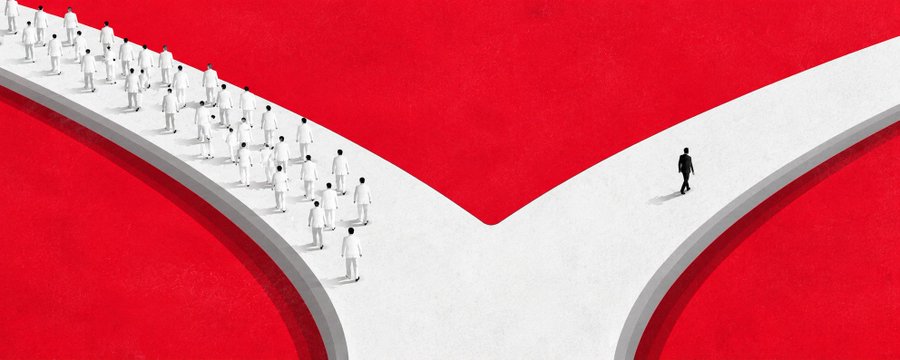
This piece argues that better decisions do not come from more information but from the way of thinking and the mental models you use to look at a problem. The core idea is to look past the immediate outcome and also account for hidden costs, long-term chain effects, the power of repetition, and the interests of whoever is giving you advice. Rather than waiting for perfect certainty, keep making choices that raise your odds of success and avoid the behaviors that invite failure — that is what ultimately shapes the direction of your life and career.
1. How you think matters more than what you know
Every day people make hundreds of decisions, from small ones like which book to pick, who to follow, or which podcast to listen to, all the way up to the big ones that change the direction of a life: a career path, who to work with, what company to start, where to invest your time.
Many people believe that making better decisions requires gathering more information. The piece says that is not necessarily true. Looking at the exact same situation, one person sees risk while another sees opportunity. One person sees a dead end while another builds an enormous company there. That difference usually comes less from raw intelligence than from which thinking framework you use to interpret the problem.
"Better decisions don't come from having more information. They come from having a better way of thinking."
2. Ask about first principles instead of copying other people's answers
A common mistake is starting from the question, "How does everyone else do this?" The piece suggests asking a different question first.
"What is fundamentally true?"
This is first-principles thinking. Instead of copying an existing solution as-is, you break the problem down to its most basic factual units and then rebuild a new solution on top of them.
For example, many founders believe that starting a startup requires investors first. But what you actually need may not be fundraising at all — it may be finding the first customer willing to pay you. Or you think building a company requires an office, when perhaps all you need is a laptop and an internet connection.

When you stop and start doubting premises that everyone treats as obvious, you can discover solutions most people never even consider. What matters is not inheriting other people's assumptions but building assumptions you have verified yourself. 🔍
3. Every choice carries an opportunity cost
Every decision comes with a price tag that isn't visible on the surface, because choosing one thing means simultaneously giving up something else. This is opportunity cost.
Watching Netflix, for example, is not simply watching video. It is also the choice not to learn a new skill during that time. Buying a new phone is not simply spending — it is a decision not to invest that money elsewhere. Scrolling social media absentmindedly for three hours is not merely entertainment either. It is also three hours you did not spend writing, building something, learning, or meeting someone new.
"Every 'yes' is automatically a 'no' to something else."
Thinking about opportunity cost does not mean feeling guilty every time you rest. The point is choosing deliberately. The life we end up with is the result of what we repeatedly chose over other possibilities across countless moments.
4. Look past the first outcome to the next one
Most people judge only by the first visible outcome — the first-order effect. Great decision-makers, by contrast, think about what happens one or two steps later.
Skipping a conference saves you $500. That is the visible outcome. But what happens next? You may fail to meet the founder who would later become your biggest customer. You may miss the chance to connect with an investor who would have introduced you to your future co-founder. You may never meet the engineer you would eventually build a company with.
Publishing one piece of writing may not change your life immediately. But that piece can create a new connection, that connection can create an opportunity, and that opportunity can change the trajectory of your career. Life-changing decisions usually don't look impressive at the moment you make them; their importance becomes clear only later.
"Most life-changing decisions don't feel life-changing when you make them. They only become obvious in hindsight."
So a good decision is not always the one with the biggest immediate reward. More often it is the decision that generates more opportunities later.
5. Small choices repeat and become your future
One workout does not change your body. One post does not build a personal brand, one conversation does not build a network, and one book does not change an entire life. Many people quit too early because they expect immediate results from things that only become valuable after hundreds of repetitions.
Conversely, one day of procrastination or one hour of mindless scrolling doesn't look like a big problem right away. But when small choices repeat often enough, they quietly become your future. Compounding does not work only on good habits; it applies equally to bad ones.

The piece ultimately poses this question:
"What are your daily decisions compounding into?"
Nobody becomes excellent through a single day of extraordinary effort. The person who becomes exceptional is the one who repeated ordinary days in a slightly better direction for years. So if you need to change your results, examine the small decisions repeated in daily life before reaching for one grand move. 🌱
6. Read the incentives behind advice
If you want to understand why someone says and does what they do, don't just listen to the words — look at what they get. When an influencer recommends a particular product, when a founder insists that every startup must raise venture capital, when a company says office work is better, when a YouTuber tells you to quit your job right now, each may have its own reasons and benefits.
"Every opinion comes with an incentive attached."
This does not mean everyone is lying. It means every recommendation and opinion is shaped to some degree by that person's goals, business model, experience, and worldview. So when you hear someone's advice, it is worth asking:
"What does this person gain if I believe this?"
Making this question a habit lets you filter information far more effectively. Instead of blindly copying someone else's advice, you can understand the background and interests it came from and make the judgment that fits you.
7. Don't wait for certainty — raise your probability of success
Another common trap is waiting until you're 100% certain. That moment almost never arrives. Investors cannot be certain which company will be the next unicorn, founders cannot know whether their startup will succeed, and creators cannot know in advance whether a post will go viral.
They make decisions anyway, because life is not a game of securing certainty — it is a game of raising the probability of success.
"Instead of asking 'Will this work?', ask 'Does this choice increase my odds of success?'"
Starting a personal brand does not guarantee success. Going to a conference will not change your life, and having one more conversation with a founder will not necessarily lead to building your next company together. But each of those actions can raise your odds a little.
In the end, the people who succeed are not the ones who predict the future perfectly. They are the ones who keep betting on the better choice even under uncertainty. 🎯
8. Avoid failure before asking about success
Good decision-makers don't only think forward. Sometimes they think in reverse: instead of trying to find the road to success directly, they first identify and avoid the behaviors that almost certainly cause failure.
The piece warns especially against these attitudes:
- Never shipping anything publicly
- Never talking to users or customers
- Never taking any risk
- Never asking questions
- Never starting at all
Simply avoiding these behaviors well enough already puts you ahead of a lot of people. Rather than standing still waiting for a perfect strategy, it is far better to remove the behaviors that raise your chance of failure and take action, however small.
9. The trajectory of your life is built from daily decisions
The piece closes by emphasizing that even very small decisions change the direction of a career and a life over the long run. That is why you should learn how to look at decisions as early as possible.
The point is not to memorize more right answers, but to ask about fundamentals, see opportunity costs, think about long-term consequences, understand the power of repetition, examine the incentives behind advice, and keep making choices that raise your odds.
"Learn how to think, and the decisions will follow. And eventually the results will follow too."
Consistently stacking slightly better choices every day matters more than one perfect choice. Ordinary days accumulated that way are what eventually build an extraordinary future. ❤️