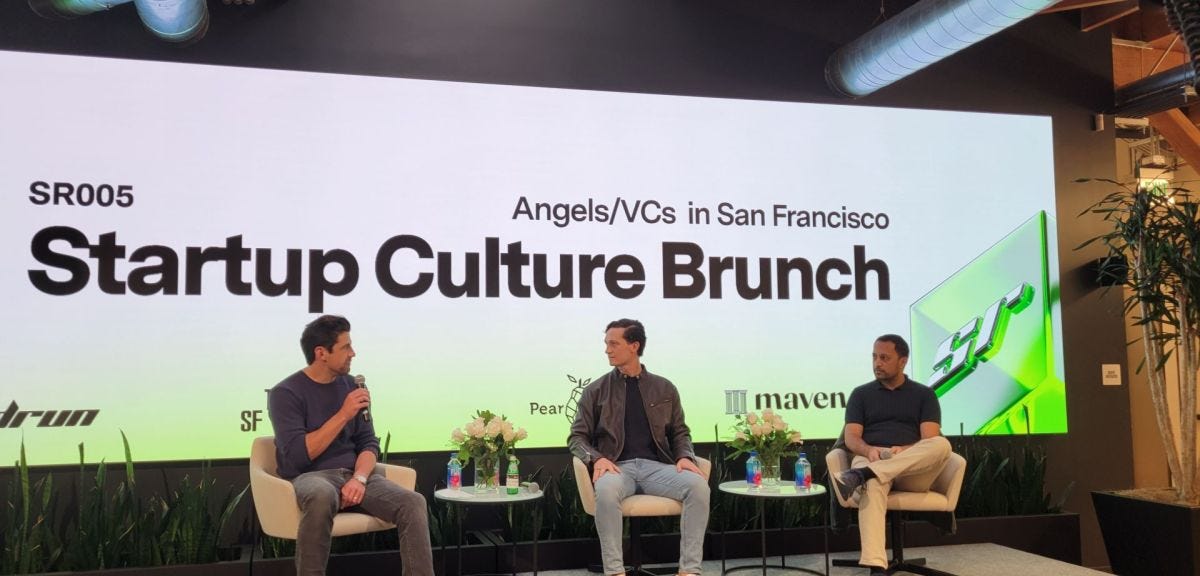
During Tech Week 2025, I attended the a16z Speedrun Startup Culture Brunch, where I joined over 100 early-stage and angel investors for an in-depth discussion on startup team building and culture. The event provided critical insights into how startups build and maintain culture, with a particular focus on the common mistakes founders and investors make when building early-stage teams. This summary unpacks the complexities and nuanced truths of startup team building based on the key takeaways from the panel discussion.
1. The Risk of Hiring the Wrong People at the Early Stage
Founders tend to move fast, but sometimes they rush to hire too hastily. Especially when the pressure to fill a seat intensifies, they often hire based solely on "good credentials." Famous company logos and impressive resumes may appear safe and suggest competence on the surface, but in reality, experience does not automatically equate to execution capability.
One of the panelists, Gagan Biyani, emphasized this point:
"At the micro level, you should forget about speed and focus on the risk of hiring the wrong person."
In an early-stage startup team, a bad hire can have exponentially growing costs. Before rushing to extend an offer based on resume appearances alone, founders should pause and ask these questions:
- What has this person actually built?
- What decisions did they make on their own?
- What went wrong under their watch, and what did they do about it?
While speed still matters, the principle of "hire slow, fire fast" is not just about hiring pace. It means precision -- the discipline of hiring people who can create their own momentum rather than simply inheriting assigned tasks.
2. The CEO's Role: Finding Talent and Setting Direction
Many early-stage founders believe that a good leader is a good mentor. While the intention is admirable, when the goal is to build a business that doesn't yet exist, there is often not enough time to devote to mentoring. Especially before finding Product-Market Fit, the founder's role is not to coach every team member for personal growth, but to make strategic decisions that steer the company in the right direction.
The panel explained:
"The role of the early-stage CEO is not to nurture talent -- it's to find it."
Management at this stage focuses on direction-setting, not development. That doesn't mean abandoning empathy -- rather, it means protecting focus on what matters most. Great founders design systems that attract and empower self-motivated talent, freeing their own time for higher-impact decision-making.
3. Understanding Constructive "Aggression"
Aggression in the workplace may sound negative at first, but the panel made a compelling case for its nuances. Unchecked aggression can destroy a company, but well-channeled aggression can build one.
"If people are angry for legitimate reasons, don't calm them down. Figure out what's beneath that frustration and address it."
When mission-driven intensity is combined with ethics, it can be a feature, not a flaw. Founders who endure adversity don't suppress their energy. Instead, they channel it toward solving important problems.
4. The Investor's Role: Holding Up the Mirror
When internal dynamics at a portfolio company become complicated, investors can feel tempted to intervene as pseudo-managers. But this instinct usually backfires. No one knows a startup's internal situation better than the founder.
The best investors know their lane. Their role is to reflect, not to rescue. Warren Shaeffer described the investor's role this way:
"Their role is to 'hold up the mirror' -- to remind founders why they believed in them and invested in the first place."
This means helping founders solve problems themselves rather than dispensing "parenting advice" on hiring and firing -- especially when the investor lacks direct operating experience. Support is not supervision.
5. Beware of Overvaluing "Experienced Managers"
Investors love pattern recognition, and founders with strong track records naturally earn trust. But this tendency can lead to overvaluing "experienced managers" -- assuming that past leadership success will automatically translate to the speed required at an early-stage startup.
Management skills matter, but they are not the differentiator many investors believe them to be.
At the earliest stages, what you need is not a polished executive, but someone passionate, decisive, and deeply self-aware.
Management can be learned. Passion and conviction cannot.
6. Self-Awareness Is the Core of Culture Building
Many first-time founders are not great managers. And that is perfectly fine. But when team dynamics start to falter, investors sometimes prescribe leadership training or executive coaching as a cure-all. However, as the panel pointed out, "there is no truly effective management training." Everything depends on context, and there is no one-size-fits-all solution for building culture.
Most early-stage dysfunction stems not from a lack of frameworks, but from a lack of self-awareness. Investors can step in when a leadership team has gone off the rails, but prompting reflection early on almost always leads to better outcomes. Culture improves when founders become more aware of their own behavior rather than following someone else's playbook.
7. The Difference Between Being "Kind" and Being "Nice"
As the brunch drew to a close, the conversation shifted from mistakes to lessons. Warren Shaeffer spoke about the difference between being "nice" and being "kind."
- Nice = pleasant in the short term, conflict-avoidant
- Kind = thoughtful in the long term, potentially uncomfortable in the short term
The most effective managers learn to be comfortable with uncomfortable conversations. When something feels wrong, they address it quickly. They understand that clarity, even when painful, is more useful than being nice because it actually helps people and teams improve.
8. The Best Early Hires Are Chosen Through Self-Awareness
Short tenures, weak references, vague contributions -- the list of red flags to watch out for when evaluating candidates is well known. But there is no universal heuristic for identifying the perfect hire.
As Gagan Biyani shared:
The best early hires are made through self-awareness, not through consensus checklists.
Founders need to understand what styles they work best with and what styles they don't. This allows them to build teams that amplify their strengths and compensate for their weaknesses.
9. At the Early Stage, Performance Takes Priority Over Culture
In the Q&A session, the panel was asked which cultural indicators matter most and what founders should do when turnover is low. The answer was clear. At the early stage, performance matters more than culture. Turnover is expected, and cultural metrics don't tell you much. Above all, founders' responsibility is to focus on building and scaling the business.
But performance doesn't replace culture -- it creates it. Culture is a byproduct of how teams perform under pressure. Every decision, deadline, and tradeoff teaches people what the company (its values) actually cares about.
Conclusion
Walking out of the a16z office, one thought from the brunch kept lingering in my mind. There is no set formula for culture, but every startup story begins with the team. Performance is, of course, paramount, but building a company is as much a process of self-discovery as it is of execution. The best founders surround themselves with people who push them to see the market, the mission, and themselves more clearly. This self-reflection is what keeps ambition from going off the rails and ensures that culture stays aligned with the values set from the start.
In a technology-driven world, the most decisive variable in every startup is the human element. What founders and investors get right in team building matters far more than what they get wrong.