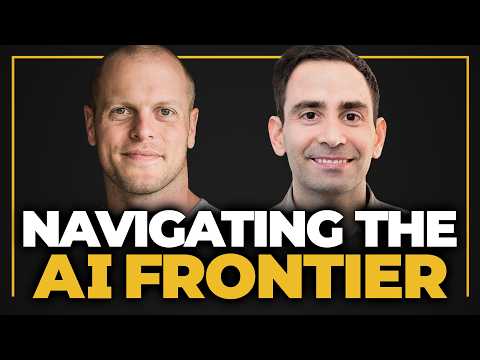
Elad Gil and Tim Ferriss have an in-depth conversation about investment trends in AI, the talent war, technical constraints, and strategies for identifying promising companies. Drawing on Gil's long experience and perspective, the conversation lays out the opportunities and challenges companies face amid the rapid growth of the AI industry, as well as the key factors investors should watch.
1. The AI Talent War and the "Personal IPO" Phenomenon
Elad Gil describes a quiet but striking phenomenon happening in AI: the "personal IPO." Compensation and stock-option packages for certain AI researchers and engineers have risen so dramatically that the effect resembles an individual going public.
- Meta's aggressive talent push: Gil says Meta began investing aggressively to recruit AI talent, and that this was a very rational strategy. Since companies already have to spend heavily on compute, it also makes sense to spend enough to secure the people who can use that compute well.
- A chain reaction across Silicon Valley: Meta's aggressive hiring forced other major technology companies to raise compensation in order to retain their top researchers. As a result, roughly 50 to several hundred AI experts across Silicon Valley are effectively experiencing personal IPOs.
- An unusual phenomenon: Gil says this is unusual and that he has rarely seen anything like it, except during moments such as the crypto boom when early investors or founders suddenly became wealthy.
- Long-term effects: It is still unclear what the long-term impact will be, but some people may redirect their lives toward bigger scientific projects, AI research for humanity, or personal goals.
- Top-tier compensation packages: Tim Ferriss asks what level of compensation these elite AI people are receiving. Gil says he does not know exact figures, but they could be "tens of millions to hundreds of millions of dollars." Because this is one of the most important technology races in history, huge investments are being made in a small number of world-class people.
2. AI Compute Constraints and the Oligopoly-Like Market
One of the biggest bottlenecks in current AI progress is the shortage of compute resources. Gil says he discussed this in an essay titled "Random Thoughts While Gazing at the Misty AI Frontier."
- GPU and memory shortages: Every major AI lab, including OpenAI, Anthropic, Google, and xAI, needs Nvidia chips and memory chips such as high-bandwidth memory (HBM) from Korean companies like Samsung and SK hynix to train giant models. Many constraints arise in procuring those components and building data centers.
- The memory bottleneck: The biggest current constraint is memory, especially the kinds of memory mainly produced by Korean companies. Gil expects this constraint to last for about two years, because building memory fabrication facilities and bringing production lines online takes time.
- AI market oligopoly: These compute constraints are creating an "artificial ceiling" that prevents one lab from racing far ahead of the rest in the short term. Because every lab can secure only a similar amount of compute, OpenAI, Anthropic, Google, and others are likely to maintain similar levels of capability for the time being.
- Unexpected solutions: Ferriss asks whether an unexpected solution could appear, as shale gas extraction did during periods of high oil prices. Gil says he does not currently see such a breakthrough, and that the situation looks more like a traditional capital-expenditure and infrastructure buildout cycle.
- Explosive growth of AI companies: Despite these constraints, AI company revenue is growing at a historically unprecedented pace. OpenAI and Anthropic are each reaching roughly $30 billion in annualized revenue within about a year, equivalent to around 0.1% of U.S. GDP. Gil notes that AI's contribution to GDP has gone from 0% to 0.5%, and adds that in the future individual companies might represent 1-2% of GDP.
3. Exit Strategies and Investment Opportunities for AI Startups
Gil advises AI startup founders not to miss the moment when they can maximize the value of their company amid the market's rapid growth and change.
- The lesson of the dot-com bubble: He warns that, just as only a small number of the thousands of companies that went public during the dot-com bubble survived, most AI companies will also disappear. In the 1990s internet bubble, around 450 companies went public, and then another roughly 450 went public in a few months in the early 2000s. About 900 companies went public in total. Of those, only around a dozen, maybe twenty at most, survived. Gil argues that the AI era will not be different.
- The timing of value maximization: Gil emphasizes that the next 12-18 months may be the best window for AI startup founders to sell their companies. After that, commoditization, intensified competition with large companies, and technical changes may reduce value. Every company has a moment when its value is maximized, usually a six-to-twelve-month window. During that window the company is important, growing well, and everything is working, before headwinds begin to appear.
- Traits of the few survivors: What traits will the small number of AI companies with sustainable competitive advantage have?
- Improvement from core model progress: When foundation models improve, does the product or service become dramatically better for customers in a way that keeps them using it?
- Deep and broad product integration: Does the company integrate multiple products into a coherent solution and become deeply embedded in core enterprise processes, making it hard to replace? One example is a solution that reduces resistance to workflow change.
- Use of proprietary data: Does the company collect, store, and use proprietary data to create advantage? Gil notes that data is important, but also tends to be overestimated.
- Multiple exit options: AI founders currently have several possible exit paths.
- Major labs, hyperscalers, and big tech companies: They can be acquired by buyers with enormous purchasing power, such as OpenAI, Google, Amazon, Apple, Tesla, SpaceX, Oracle, or Samsung.
- Vertical market players: Large companies specializing in specific industries may acquire relevant AI companies, such as a legal AI company being acquired by Thomson Reuters.
- Mergers among competitors: In intensely competitive markets, competitors may merge rather than fight each other, increasing market power, as happened with X.com and PayPal.
4. Elad Gil's Investment Philosophy and Predictions for AI
Gil discusses how his unusual background and experience shaped his investing style, and how he thinks about the future of the AI market.
- The influence of studying mathematics: His mathematics background helped him develop an understanding of technical and algorithmic computer science as well as logical thinking. Studying pure math taught him to reason step by step. In proofs, one often makes an intuitive leap, then proves or formalizes the reasoning behind that leap; Gil thinks investing is somewhat similar.
- How his investing career began: Gil became an angel investor almost accidentally while helping early startups such as Airbnb and Stripe. Founders voluntarily offered him investment opportunities. He says he did not intentionally set out to become an investor; he simply enjoyed talking with smart people, solving business problems, and working with technology.
- "Market first, team second": Gil generally puts market importance ahead of team capability. He has seen great teams struggle in terrible markets, and mediocre teams do very well in great markets, so he considers the market more important.
- At times, however, he makes exceptions when he finds a founder with overwhelming ability and invests "person first." For example, the founder of Perplexity AI impressed Gil by engaging with him before AI became a major mainstream theme and by rapidly executing on ideas.
- The moment he recognized AI's importance: Gil became convinced of AI's potential with the release of GPT-3 in 2020. GPT-3 was a much larger step forward than GPT-2; even though it was not yet truly usable, it showed that scaling laws worked and that the step change in capability was enormous.
- He predicted that AI would move beyond being a simple tool and become a general-purpose model accessible to anyone through APIs, containing all human knowledge and acquiring reasoning ability.
- Learning through data analysis: Gil shares how he gathers information not only through X, technical papers, and conversations with experts, but also by using AI models.
- He used multiple AI models to investigate the sharp rise in diagnosis rates for ADHD and autism spectrum disorder, finding that changes in diagnostic criteria and social incentives were major factors.
- He has even experimented with feeding photos of founders into AI models to predict their personalities, saying the results are "surprisingly accurate." When we meet people, we rapidly infer their character and traits. Tiny cues such as wrinkles around the eyes can suggest whether a smile is genuine or hint at a sense of humor.
- The key question for late-stage investing: When investing in later-stage companies, Gil focuses less on complex financial models or dozens of pages of analysis and more on the question: "What is the one thing I need to believe for this company to keep growing very large?"
- For Coinbase, the belief was that it was an "index on the crypto market," representing the growth of the overall crypto market.
- For Stripe, the belief was that it was an "index on e-commerce," growing alongside the growth of e-commerce.
- For Anduril, the belief was that "machine vision and drones will become important in defense."
5. Changes in Venture Capital and Advice for Founders
Gil offers advice on how the venture capital industry has changed and what founders need in order to succeed.
- The secret behind four-year stock vesting: The custom of four-year stock-option vesting arose because, in the 1970s, companies often went public within four years. After the Sarbanes-Oxley Act, however, companies delayed going public, and venture capital moved into growth-stage investing that had previously belonged more to the public markets.
- Focus on one core thing: Most successful companies spend their first decade growing around one core product or service. Google, for example, focused on search and advertising for a long time before expanding into other products and services.
- The importance of markets versus founders: YC School tends to argue that more founders lead to more successful companies, while Gil argues that a large company can emerge only when a market has opened up.
- AI has opened a huge number of markets not only because of technical progress, but because every CEO is now asking, "What is our AI story?"
- If an AI company is not seeing explosive growth quickly, Gil argues, something is fundamentally wrong. The market is so open that growth can happen at speeds that were previously impossible.
- "Go-to-market" versus "go-through-market": Citing advice from Vinod Khosla, Gil explains that the strategy for entering a market can differ from the strategy for disrupting it. SpaceX began with rocket launches, but Starlink disrupts the internet market.
- Now is a time to follow consensus: Gil says there are times when being contrarian is very smart, and there are also times when following consensus is the smartest move. He thinks now is a time when following consensus is very right. Do not overcomplicate things.
- How new investors can win: Gil advises new investors who want to succeed in AI to begin by spending time with the smartest people and helping them. This matches the traditional venture story he himself lived: invest in early-stage companies, help them grow, then raise larger funds and move into later-stage investing over time.
6. Longevity Research and the Future of Bioelectric Medicine
Gil also talks with Ferriss about a practical approach to longevity research and the potential of a new field: bioelectric medicine.
- A realistic longevity strategy: Gil says the basics matter most: sleep well, exercise a lot, and eat well.
- The supplements he specifically mentions taking are vitamin D and creatine.
- He says he is still waiting for "real drugs," and mentions areas he would like to invest in, such as eye drops for ocular aging, treatments for sensory nerve aging, and anti-aging cosmetic products.
- Ibogaine and the idea of "rebooting": Ferriss asks whether there are ways to "reboot" the human body like rebooting a computer.
- Ferriss mentions cases where ibogaine has shown effects in treating drug addiction, especially opioid addiction. He explains that ibogaine can open a window for people with addiction, giving them time to enter rehabilitation without withdrawal symptoms.
- He also says ibogaine research has observed effects that appear to "reverse the age of the brain," which may be related to substances such as glial cell line-derived neurotrophic factor (GDNF).
- The potential of bioelectric medicine: Ferriss emphasizes that brain stimulation and bioelectric medicine may become important fields.
- These approaches could potentially contribute to treating mental illness or improving cognition through non-invasive brain stimulation, without drugs or invasive procedures.
- He says we are now in a period when people are looking for a very good answer to the question "why now," and predicts that many experiments will take place in this area.
7. Ten-Year Planning and Final Thoughts
Gil says he is, for the first time, creating a ten-year plan, and describes how that is changing his sense of direction.
- The importance of a ten-year plan: He quotes John Lennon's idea that life is what happens while you are making plans, acknowledging that life often unfolds differently from what we plan. Still, the process of making a ten-year plan has helped him redefine the scope of his goals and ambitions. It has meaningfully changed the way he thinks about what he wants to do and what he should or should not attempt.
- Uncertainty about the future: Gil admits that because we are living through a period of major change, half of his predictions about the future may be wrong. But he also says it is fun to find new opportunities and adapt amid that uncertainty.
- Optimism: In response to claims that AGI will arrive within two years, Gil says it is very defeatist to conclude that there is no point in planning. He takes an optimistic view: during a period of change, he will make his own plans, adjust them, and search for interesting work.
Closing
The conversation between Elad Gil and Tim Ferriss offers deep insight and practical advice for living and building in the AI era. It ranges widely across AI talent wars, technical constraints, and investment strategy. Gil's "market first, team second" principle and his focus on "the one core belief" behind an investment are especially useful guideposts for navigating the rapidly changing AI market. His practical approach to longevity research and his outlook on bioelectric medicine also offer a glimpse of the positive effects future technologies may have on human life. The conversation ends by moving beyond AI market trends and asking what posture we should take toward an uncertain future.